Every morning he appeared at the border crossing – the same man, the same rickety “Gazelle,” the same load of brick rubble, planks, dust, and rusty metal. The customs officers had long stopped seeing him as anything unusual.
“Here’s the guy with his trash again,” one of them muttered, blowing into his coffee cup as he lazily pressed the button to open the barrier.The driver himself looked completely unremarkable. Mid-forties, weathered face, hands stained with dirt that never quite washed off.
He spoke little, only nodding briefly when told to shut off the engine. His clothes smelled of diesel and dust, his eyes had that empty, patient look of someone who drives the same route every day and expects nothing anymore.
He didn’t look like a smuggler. He looked like a man who simply worked.And that’s exactly why he became interesting.At first, there were only passing glances. Then came the first inspections. Later, they became routine. The officers began systematically taking his vehicle apart.
“Empty it all out,” the shift supervisor ordered one morning.Bricks were lifted one by one, planks turned over, every layer searched. One officer even tapped the underbody with a metal rod, as if something could be hiding there. The fuel tank was checked, the seats unscrewed, even the door panels removed.
And every time, the result was identical: nothing but debris. Dust. Rusty nails. Old wooden beams that crumbled at a touch.The driver stood nearby, sometimes smoking a cigarette, shrugging.“I take it to the dump on the other side,” he always said. “They pay per load. That’s it.”
He could have been believed. Or considered the worst smuggler in the world.After a few weeks, suspicion turned into routine, routine into fatigue. The officers kept checking, but without conviction. It was as if they were performing a play whose ending they already knew.
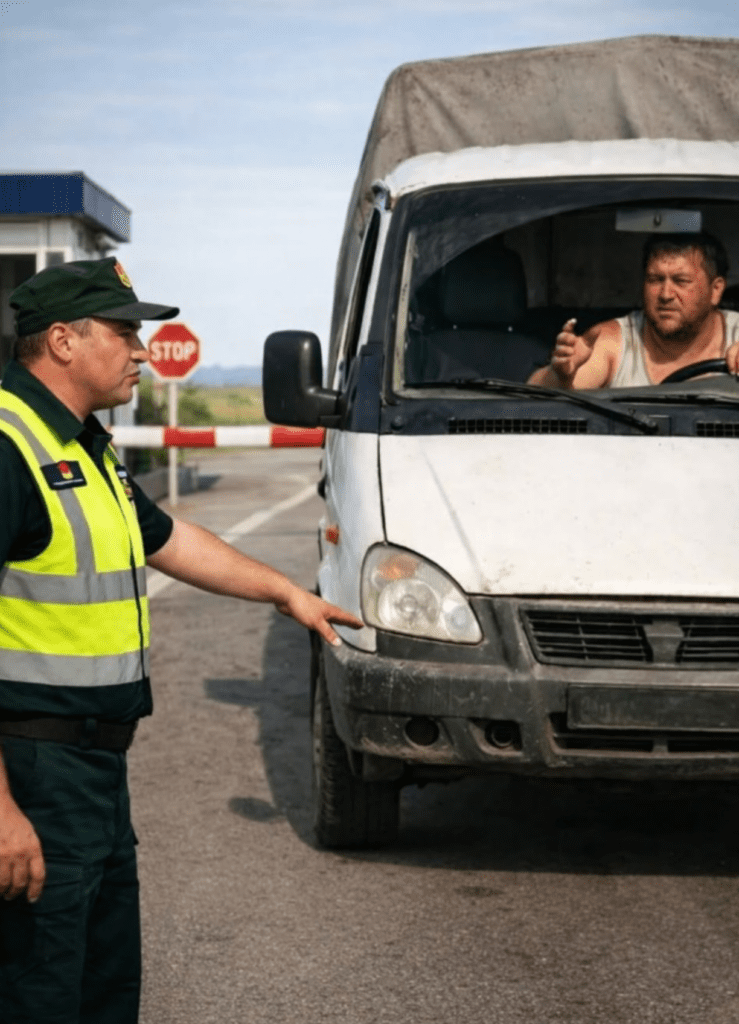
The man arrived, the truck was unloaded, the trash examined, nothing found, stamp, move on.But somewhere deep in the file, his name remained flagged.Then he disappeared.One morning, the old “Gazelle” didn’t show up. Neither did the next day.
The officers only truly noticed after a week – and only then did they realize how much they had grown used to his daily presence.Two weeks later, he was arrested.Not at the border, but in a small workshop outside the city. No resistance, no attempt to flee.
As if he and the authorities were simply meeting at the next step of a script already written.In the interrogation room, he sat calmly. The handcuffs were heavy on his wrists, but he didn’t look surprised. Rather… relieved.The investigator placed a file on the table.
“We reviewed your trips,” he said. “For months, every day the same route, the same load. And every time, nothing.”The man nodded slowly.“Yes.”“Why did you really cross the border so often?” the investigator’s voice sharpened. “It makes no sense. No one transports garbage across an international border every day just to dump it.”
A faint smile crossed the man’s face.“You were always looking at the trash,” he said quietly. “You never looked at the vehicle itself.”The officers exchanged glances.“What do you mean?” one asked.The man leaned slightly forward, as if sharing a secret he had held too long.
“The cargo was never the important part.”Silence filled the room. Only the hum of the fluorescent light could be heard.The investigator leaned back. “Explain.”The man took a deep breath.“The vehicles were stolen,” he said calmly. “Not the ones you saw. The ones underneath them.”
He paused briefly, as if making sure they were following.“Every time I crossed the border, there was another car hidden under the rubble. Dismantled, modified, with fake parts, sometimes in pieces. The trash on top was only there to make everything invisible.”
The officers froze.“You inspected every stone,” he continued. “Every brick. You dug into the dirt, the dust, the rust. But you never looked beneath it. You never understood that the trash wasn’t the cargo—it was the disguise.”A heavy silence settled over the room.
The investigator flipped through the file frantically, as if expecting a different truth to appear inside it. But there was nothing. Only reports of “unremarkable transport,” “no irregularities found,” “no contraband detected.”All correct. And yet completely wrong.
“How many vehicles?” someone finally asked quietly.The man shrugged.“Enough.”The word hung in the air like a verdict.Later, when the investigation expanded, the full scale became visible. Workshops were discovered, cross-border contacts, forged documents, parts chains that had gone unnoticed.
The “dump” he always spoke of partly existed – but it was only a waypoint, a perfect cover for something much larger.And the most frightening thing wasn’t the technique.It was the simplicity.The officers had carried out every inspection perfectly. They had done everything right—and still examined the wrong thing.
Because they believed that what was suspicious had to be visible.In the end, only one bitter realization remained in the room:The best disguise is not invisibility.But something so ordinary that no one looks anymore.