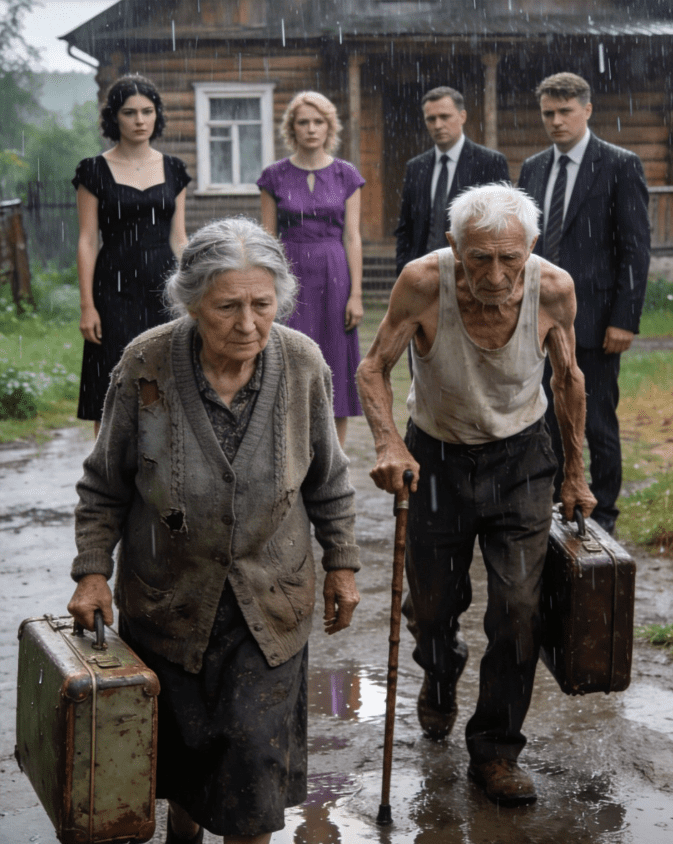
On the night of April 22 in the quiet town of San Rafael, everything began like any other evening: wet asphalt, streets glistening under lamplight, and a spring rain that didn’t thunder or rage—but simply persisted, slowly soaking everything,
as if the sky was not angry, only remembering. But on this night, two people were not heading home. An elderly couple made their way through the deserted streets. Carmen, 72 years old, and Fernando, 75.
They dragged two worn suitcases behind them, each step producing a dull, tired sound against the wet pavement. The suitcases held more than clothes and belongings—they contained the last remnants of an entire life.
Carmen’s coat was soaked, her hair stuck to her forehead. But it wasn’t the cold that made her tremble. It was the emptiness inside her—the realization that the people she had brought into the world,
for whom she had breathed every day, had now closed the door on her. Literally.
A love that built a lifetime: Carmen was 19 when she first saw Fernando. It happened at a village celebration where the music was slightly off-key, the lights were dim, yet every moment somehow felt important.
Fernando worked in a carpentry workshop on the edge of town. His hands were rough, marked with calluses, small cuts, and sawdust. Yet when he smiled, a strange calm radiated from him—as if life could not truly shake him.
His white shirt was carefully ironed, as though it were the only luxury he allowed himself. And perhaps it was.
Carmen later often said it wasn’t love at first sight, but recognition. As if someone had finally spoken what she had already felt: “With him, you will be safe.”
A year later, they married. There was no lavish wedding—just a small church, a few relatives, and a simple white dress Carmen had sewn herself at night by candlelight because she couldn’t afford a store-bought one.
Fernando rented a suit—slightly loose, slightly worn—but that day it looked perfect. Because they were happy.
A life sacrificed for the children: The years were not kind to them. Fernando woke before dawn, when the town still slept. In the workshop, sawdust filled the air, wood scent clinging to his clothes.
He worked until sunset, and often beyond. Tables, chairs, and cabinets were born under his hands—each carrying his patience, his pain, and his love.
People quickly learned: anything Fernando made would outlast them. But he never became rich. Not by choice. Every extra coin went to one place—his children.
Carmen held another world together. She cooked, cleaned, raised the children, and when the house finally fell silent, she returned to her sewing machine at night. Its sound was her only companion.
Her eyes often stung from exhaustion. Her hands ached. But she did not stop—because Daniel wanted books, Mónica needed piano lessons, Sebastián required medical care, Gabriela wanted new shoes. And they all received them.
Children who drifted away: Over time, the children grew up. Daniel became a successful engineer, always busy. Mónica worked as a doctor—precise, distant. Sebastián became an artist searching for “freedom.”
Gabriela married a wealthy architect, living in a world where everything appeared perfect.And slowly, their parents stopped being part of their lives—becoming background noise. Phone calls grew shorter.
“Are you okay?” “Yes, yes, everything’s fine, I’ll call you later.”And the call never returned.
The breaking point: Fernando’s stroke changed everything. One morning, he simply couldn’t move properly. His left side failed him, his speech faltered.
Carmen called an ambulance without screaming. Her hands were cold but steady—because she could not afford to collapse.The hospital’s sterile whiteness surrounded them like cold walls.
And then they called the children. The answers differed—but the meaning was the same:No time.No possibility.Something more important.
The house that meant everything: The family home was not just a building.
On the doorframe were pencil marks tracking the children’s growth. In the garden stood the old swing frame Fernando had built with his own hands.
In the living room, the sofa armrest was worn from years of sitting there reading stories. In the kitchen, every scratch told a story.This house was their life.
But the children now saw only numbers: $1,200,000. The pressure begins. “Sell it,” they said.First politely. Then more firmly.
“That’s foolish—you’re sitting on a gold mine.”“This is our future.”“This is in everyone’s interest.”Carmen first stayed silent. Then she argued. Eventually, she only looked at them with exhaustion.
Fernando grew quieter. Not because he was weak—but because he understood something he didn’t want to say out loud: his own children were no longer the same people.
The ultimatum: One evening, all four children arrived together.The air changed before they even entered, as if the house itself sensed the end approaching.
They brought papers. Legal proposals. Cold, measured sentences.“Two weeks.”Fernando slowly stood up. His body trembled, but his voice did not.
“This house is not for sale.” And in that moment, everything that had once been a family finally fell apart.