I am thirty-six years old. My name is Grant, and five years ago I lost my wife, who was taken suddenly and mercilessly by cancer. One moment she was part of my world, and the next she was gone,
leaving behind a silence that didn’t just fill the house—it settled into it, into every wall, every corner, every breath I took. It’s the kind of silence you don’t get used to. You only learn how to survive inside of it.
After that, it was just me and my daughter, Juniper. She was three when her mother died. Too young to fully understand what death meant, but old enough to feel the absence like a weight she couldn’t name.
Now she is eight. She has grown into a quiet, observant child—one of those rare children who seem to notice everything but say very little.
Sometimes I catch her looking at me with an expression that feels far older than her years, as if she understands more about life than I am ready to admit.
For a long time, she was the only reason I kept moving forward. I didn’t look for anyone else. I didn’t want to rebuild, or replace, or restart anything.
I told myself that part of my life had ended with my wife. Love, in my mind, had become something finished, something sealed off forever.
And then Maribel entered my life.
She felt like something from another world. Confident, radiant, full of energy that seemed to fill every space she entered. When she walked into a room, people noticed.
Conversations shifted. Attention followed her naturally, as if she carried light with her. And for the first time in years, I felt something I thought I had lost permanently—the sense that maybe life still had more to offer me.
I let her in slowly at first, but eventually completely. Into my life. Into my home. And most importantly, into my daughter’s world. Juniper didn’t talk much about her.
She would only say things like, “She’s kind…” but even then, her voice carried something uncertain, something carefully measured. I told myself it was normal. That children need time. That trust takes patience.
I believed things would settle.
When Maribel accepted my marriage proposal, I thought we were stepping into a new beginning. A shared future. Something stable, something real. We decided to hold the wedding in the garden behind my house.
It felt perfect at the time—white chairs lined neatly across the grass, soft music playing in the background, fairy lights hanging between the trees like floating stars. Everything was arranged to feel like hope itself.
But just minutes before the ceremony began, something inside me shifted.Juniper wasn’t there.
At first, I only noticed it in passing. An empty chair. A missing presence. Then I looked again, more carefully. Panic began to rise slowly, tightening in my chest.
I walked quickly at first, then started running—through the kitchen, the living room, the hallway, calling her name. No answer. No sound. Just the growing certainty that something was wrong.
I found her in the bathroom.She was sitting on the floor, her knees pulled close to her chest, hands clasped together as if trying to make herself smaller, as if shrinking could protect her from something outside the door.
“Juniper, what are you doing here?” I asked.She looked up at me calmly. Too calmly for a child in that situation.“Maribel told me to stay here,” she said.
The words hit me harder than I expected. Cold. Immediate. Disorienting.“Why would she tell you that?”“She said I’m not allowed to talk to you,” Juniper replied.
My stomach tightened. “For how long?”“Until the ceremony is over.”“And you were just going to stay here?”She nodded slightly. “She said it was important.”Then, after a pause, she added quietly, “She was angry at me. I think because I saw something.”
That sentence changed everything.“What did you see?”“Papers,” she said. “On her desk. With your name on them.”
In that moment, something inside me went completely still. Not calm—just focused. Alert. As if every sound in the house suddenly sharpened.
Outside, the garden was still alive. Music playing. Guests laughing softly. The illusion of celebration continuing without interruption. And there was Maribel, standing in her white dress, looking exactly as she always did—perfect, confident, untouchable. Almost unreal.
I walked straight to her.“Why was my daughter locked in the bathroom?” I asked.She didn’t even flinch. If anything, she looked annoyed, as if I was interrupting something minor.“Grant, don’t make a scene. She’s too curious.”“She’s a child,” I said.
“And she was disruptive,” she replied. “I didn’t want her to ruin this day.”My voice dropped. “What did she see in those papers?”For a brief second, something flickered across her face. Not fear. Calculation.
“It’s just administrative paperwork,” she said.“Say it clearly,” I replied.Silence followed.Finally, she exhaled. “A contract… about merging assets.”
“And?”“A joint ownership agreement.”“So everything I own becomes shared with you?”She didn’t answer immediately. That hesitation said more than words ever could.
Around us, the guests were starting to notice the shift. The laughter faded. Conversations slowed. The music still played, but it no longer belonged to the moment.
“This could have been discussed later,” she said defensively.“So after the wedding,” I replied, “when it would already be too late.”Her expression tightened. There it was—the truth beneath everything. Not misunderstanding. Not confusion. Planning.
I didn’t raise my voice. I didn’t argue further. Something inside me had already decided.I walked to the microphone.The garden fell silent as I stepped up.
“Marriage is built on trust,” I said. “And truth.”“I came here today believing I was beginning a new life with someone.”“But that person locked my daughter in a bathroom and tried to manipulate my trust.”
I paused.“So this marriage will not happen.”I placed the microphone back down.I turned away and walked back into the house. Juniper was still there waiting, small and uncertain.
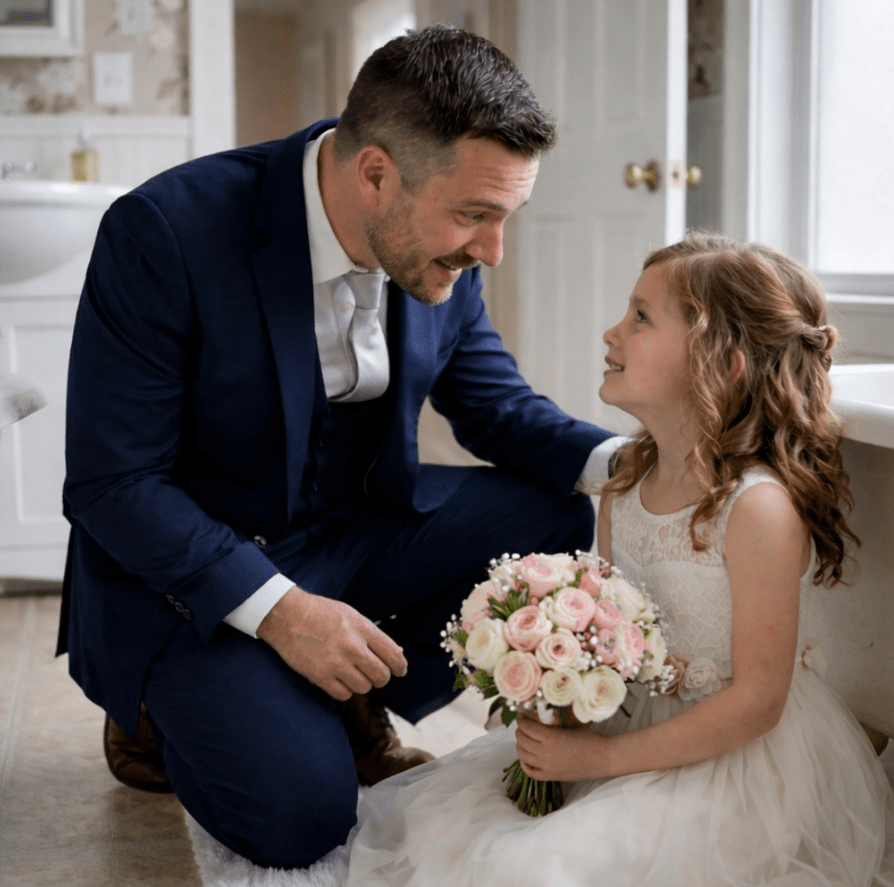
“Did I do something wrong?” she asked quietly.I knelt in front of her immediately.“No,” I said. “You did exactly the right thing. You told the truth.”
Something in her expression softened—fear mixing with relief, confusion giving way to understanding.“Let’s go home,” I said.She took my hand without hesitation.
As we left the garden behind—the unfinished wedding, the watching guests, the shattered illusion of a new beginning—I realized something clearly for the first time.
I hadn’t lost anything that day.I had seen everything for what it was.And I had walked away with the only thing that truly mattered.My daughter.