The whole village froze in shock that day when the sound of a familiar, long-forgotten motorcycle broke the silence of the dusty country road. People turned their heads one by one: someone stepped out of a gate, others stopped by the well, and even Aunt Nina put down her bucket when she recognized the sound.
It was Sztyepán.The seventy-year-old man who had lived almost like a shadow since the death of his wife. His days passed monotonously: the same old jacket, a neglected house, a leaking roof, a sagging fence, and a yard overgrown with weeds. He rarely spoke to anyone, as if he was slowly disappearing from the world.
But that day, it wasn’t the sound of the motorcycle that truly shocked the villagers.It was who was sitting behind him.A woman in her thirties, wearing a blue dress with daisies, calmly and confidently holding onto Sztyepán, as if it were the most natural thing in the world.
The motorcycle struggled along, sometimes coughing, sometimes needing to be pushed forward with a foot, but in the end, they arrived.When they stopped in front of the house, a small crowd had already gathered along the fences.
— “Oh my God… he’s gone mad,” whispered Aunt Nina.— “Who is that? His granddaughter?” asked Uncle Kólya in disbelief.Sztyepán, however, seemed not to notice the murmurs. He calmly got off, helped the woman down, and simply said:
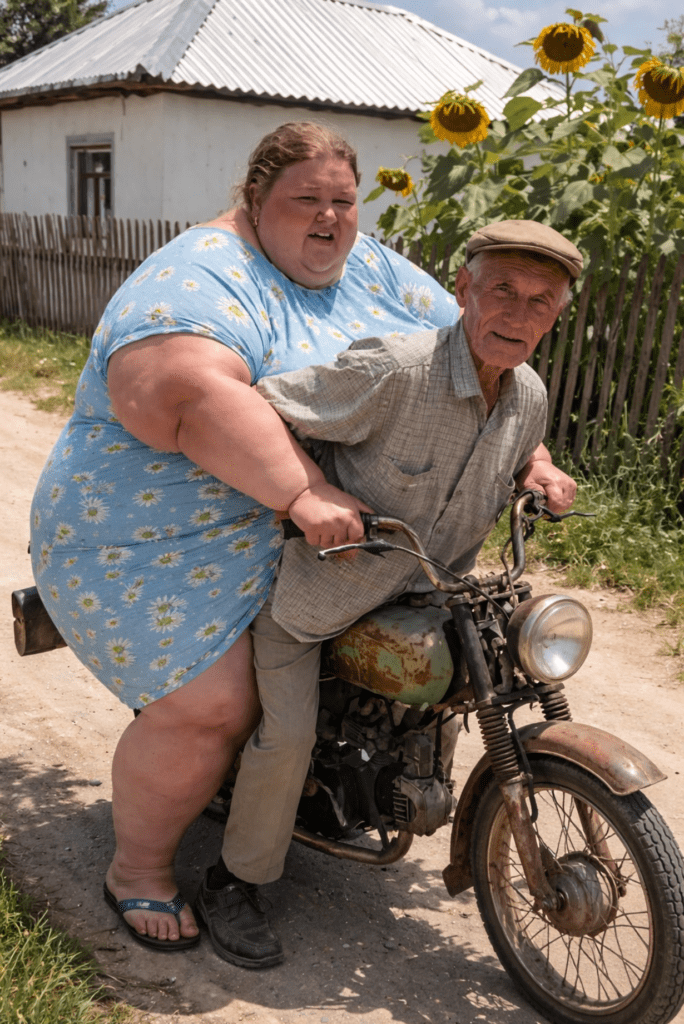
— “Meet her. This is Léna. My wife.”The silence became almost tangible. For a moment, even the chickens fell quiet. Then the whispers began, followed by speculation and disbelief.— “She’s forty years younger than him…”— “Must be the money…”
— “This won’t last long…”Léna heard all of this, yet she wasn’t bothered. She smiled calmly, greeted everyone, as if it were completely natural to stand in the middle of the village in such a situation.But what happened next was something no one expected.
Two days passed. Nothing happened. The village waited—for arguments, for a scandal, for some kind of breakdown. Instead, on the third day, something entirely different became noticeable. In the morning, smoke rose from Sztyepán’s house.
The smell of fresh bread filled the yard. The windows sparkled clean, and carefully hung laundry dried in the sun.Léna was working.She didn’t rest, didn’t wait—she made things orderly. She cleaned the windows that hadn’t seen water in years. She reorganized the shed,
threw away unnecessary clutter, and brought life into the house that had previously looked more like an abandoned museum than a home.On the fifth day, something truly unexpected happened.Léna looked up at the roof and said:
— “This isn’t livable. When it rains, it leaks inside just as much as outside.”Sztyepán shrugged awkwardly:— “I’ve been planning it for a long time…”— “Then we’ll start today,” Léna replied firmly.And the village witnessed something they could never have imagined for years.
Sztyepán climbed onto the roof. The same Sztyepán who had barely left his house before was now replacing boards, hammering nails, and… laughing. He didn’t complain, didn’t sigh—he simply lived.Below, Léna handed him tools, guided him, encouraged him,
and there was something inexplicably powerful in every one of her movements.A week later, a new fence stood around the yard. Two weeks later, the garden was full of life again. The house was filled with the smell of pastries, and every evening more neighbors came by—not just out of curiosity,
but because it felt good to be in Léna’s company.One evening, Aunt Nina quietly said:— “At first I thought he had gone mad…”Uncle Kólya looked at her:— “And now?”Aunt Nina glanced toward the yard. Sztyepán was repairing his old motorcycle, laughing, with Léna standing beside him, saying something to him.
— “Now I think… she gave his life back.”And in that moment, all the villagers understood: sometimes the most unexpected encounters don’t bring scandal—they bring new beginnings. Sztyepán, whom everyone had known as a lonely, broken man, had suddenly started living again.