Marcos Zanetti adjusted the collar of his white polo and glanced at his watch for the third time in five minutes. It was half past two on a sparkling Saturday afternoon in Santos, the sun dancing on the sea like a lamp, and everything seemed possible.
At the Yacht Club pier, his sixteen-meter yacht—white, flawless, proud—gently rocked on the waves. Marcos liked to think of it as a “strategic tool”: a floating office where he could close deals without interruption. But deep down he knew the truth:
the yacht was more than a tool. A trophy. Silent proof that the boy from the Carapicuíba slum had won.At forty, Marcos Zanetti was the CEO of Zanetti Holdings, a conglomerate that spanned everything: construction, hotels, tourism along the Paulista coast.
He had built his empire with cold discipline and hard work, sometimes turning his life into a lonely island. He had money, connections, power… yet, as he walked along the pier with a leather briefcase at his side, a familiar emptiness ran through his chest, like a vast, empty room.
But this day was not ordinary. On the yacht, champagne and smiles awaited his associates. The plan was to finalize a multi-million joint venture in Ilhabela Island: three years of negotiations, forty tense calls, promises, and clauses to review. Marcos took a deep breath. “One more step… and everything changes,” he thought.
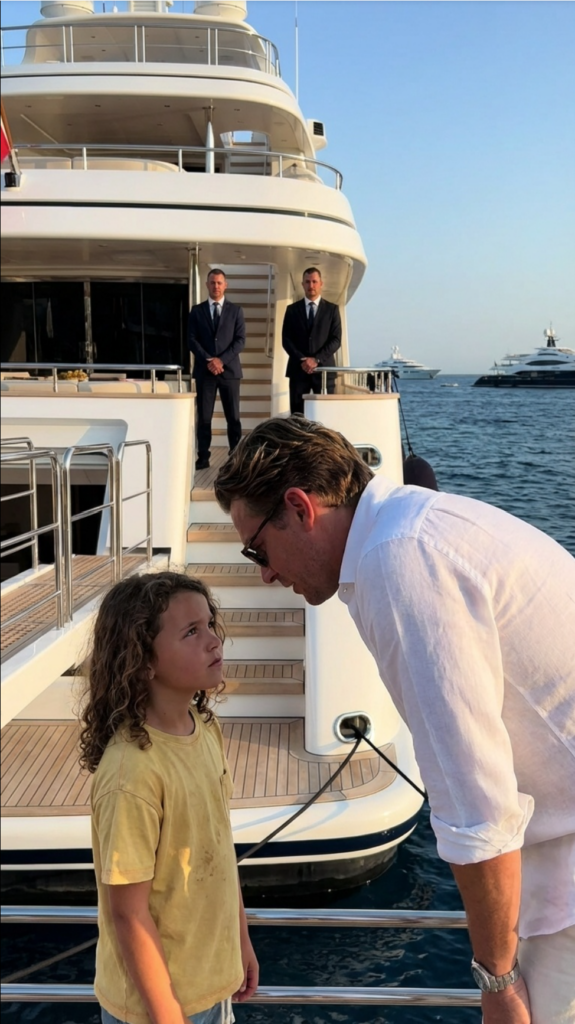
Then a small but sharp voice cut through the air.“Sir!”Marcos turned wearily, as if he had already sensed the interruption. Between the pier posts stood a girl of eight or nine. Her curly hair was tied in a messy ponytail, barefoot, her clothes worn but clean.
She carried a small backpack—not toys, but life inside it. In one hand, an old plastic bottle.“I’m sorry, but I don’t give alms,” Marcos said dryly, trying to move on.“I don’t want alms,” the girl replied, quickly running after him. “I have something important to tell you.”
Marcos stopped, almost reluctantly.“Look, I have a very important meeting. If you’re lost, find a police officer.”But the girl’s eyes shone with brown light, her seriousness not childish.“Are you the one with the white yacht?”The question was unexpectedly precise. Marcos paused.
“How do you know?”“I heard the conversation about you last night,” she said softly. “Something bad will happen to you today.”The air froze for a moment. Marcos wanted to laugh, shrug, move on… but her seriousness weighed more than any threat.
“What are you talking about?”“My name is Júlia,” she said as if it were her signature. “I’ve been living on the streets around the harbor for two years. No one watches us… so we see and hear everything.”Marcos looked at the yacht: Álvaro, Miranda, and João. They raised glasses, laughed, waved.
“Júlia, this is ridiculous. My companions are respectable people…”The girl stepped closer, fearless.“They’re planning to throw you into the sea.”A chill ran down Marcos’s spine. Júlia discreetly pointed.“The fat guy in the blue shirt… yesterday he was with two strangers.
They said it could look like an ‘accident.’ You just sign… and it’s done.”Marcos swallowed. Álvaro was indeed wearing a blue shirt and had gained weight recently. He looked around: the deck was full of strangers.“Don’t go up alone,” Júlia warned. “If you go like that, you won’t come back today.”
His survival instincts awakened an old alertness. He reached into his pocket and called Marcelo, his bodyguard, a robust ex-soldier who spoke little but saw everything.“Come to the Yacht Club immediately. Quietly alert the Military Police. Serious… there could be danger.”
Júlia was already hiding behind a container, like a shadow. Marcos knew she was watching. Twenty-five minutes later, Marcelo arrived, his steps firm.“What happened, boss?”Marcos showed her Júlia’s notebook: childish, neat handwriting, notes, fragments of conversations. Too precise to be made up.
Marcelo nodded.“The information, no matter the source, can save lives. First, we observe from a distance.”The deck appeared calm: champagne, laughter, sunlight. But Marcelo’s eyes were alert.“Boss… those two at the back aren’t guests.”
There they were: a man with a scar on his face, another wearing a black cap. Just watching. Marcos’s heart wanted to leap out.“God… you were right.”Marcelo whispered:“Look at the bags… there could be weapons.”Marcos took a deep breath and went up.
“Marcos!” Álvaro shouted with forced cheer. “We’ve been waiting!”“Business,” Marcos lied, smiling, but his eyes trembled.The moment was tense, the atmosphere on deck suffocating. Álvaro, Miranda, João… all carrying some dark secret.
Soon the scarred man stepped forward with a pistol.“The plan is for you to hand over eighty percent of your shares to us.”The other man drew a gun as well. They blocked the exits. The air froze.Marcos felt a mix of anger and fear. Álvaro sobbed:
usurers, threatened family. Miranda and João offered similarly weak excuses. Marcos felt as if a dagger pierced straight into his heart.“You could have talked to me,” he whispered. “We’ve always been partners.”The situation became unbearable by the minute. Marcelo moved: fast, decisive, and the police appeared like shadows.
“Police! Drop your weapons! Hands up!”Chaos erupted: shouting, scuffling, shots fired. Álvaro, Miranda, and João collapsed in tears. The hitmen were neutralized, the plan foiled.Two hours later, at the police station, Marcos heard the whole truth:
six months of planning, fake documents, 150,000 reais for the hitmen. “If it weren’t for the girl,” said the inspector, “it would have looked like an accident.”Night fell. At the pier, the smell of salt and metal mixed. Marcos looked for Júlia and found her sitting by a small fire, warming a can of sardines with trembling hands.
“Júlia!” Marcos said, as if seeing a miracle.The girl lifted her head, tired, hungry, but with brightly shining eyes.“You okay?”“I’m alive. Thanks to you.”Júlia sighed, as if now allowing herself to believe in goodness.“So… will you keep your promise?” she asked in a soft, fragile voice.
“Yes,” Marcos replied. “I will never forget you. Now, let’s start the search… but first, a proper dinner.”At a diner open all night, Júlia ate the burger as if it were a feast, ordered a chocolate milkshake, and looked at the glass like it was a star. Marcos watched quietly, ashamed of all the times he had passed her by.
“My mother died of cancer,” Júlia spoke softly. “My father left when I was a baby. I was sent to a shelter. They separated us. I went to Santos, Marina to São Vicente. My place… was awful. But she… she stayed there.”Marcos clenched his napkin.
“We will find her. I have a lawyer, connections, social workers. We’ll mobilize everything.”On Monday he canceled all his meetings. Hired detectives, called Dr. Fernanda Oliveira, a child protection lawyer. She listened with restrained anger:
“This happens often,” she said. “The system is flawed. If Marina is officially at a shelter, we can locate her within 48 hours.”On Thursday came the call: Marina was at Lar Esperanza, in São Vicente. “Physically she’s fine,” explained the lawyer, “but sad, constantly looking for her sister.”
The next day Marcos went there. Júlia was trembling in the waiting room, biting her lip.“What if she doesn’t recognize me?”“She will recognize you,” Marcos encouraged. When Marina entered, she was small, curly-haired, shy, as if the whole world had stopped. For a moment she froze…