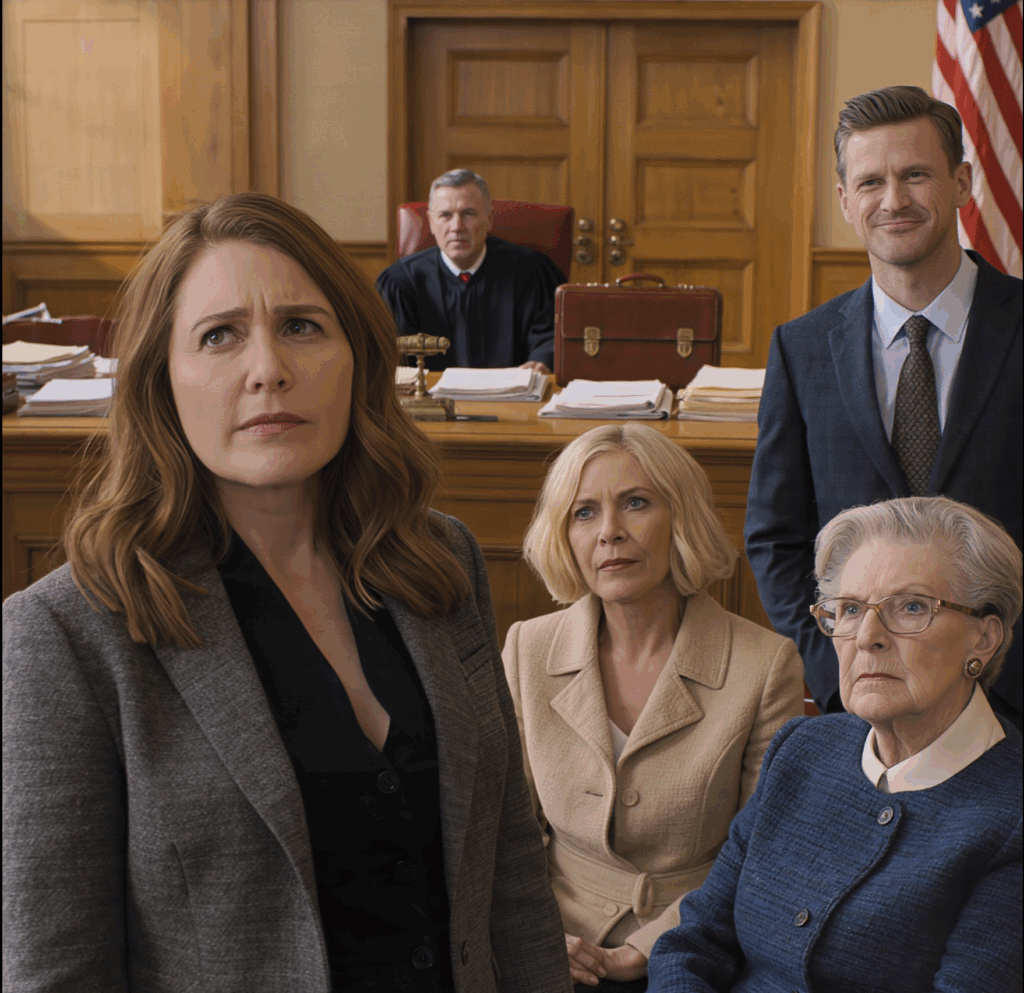
When the gavel struck and the agents moved in, triumph didn’t touch me. Instead, a hollowness spread through me, like I’d spent eight years in a windowless room and someone had finally cracked a sliver of light through a door.
Benjamin’s hands were cuffed, rigid, knuckles ghost-white, while Detective Antonio Rivera read him his rights in a calm, measured voice that reverberated under the coffered ceiling. The U.S. flag hung stately to the right of the bench,
its fabric catching the harsh fluorescent light, and the state seal gleamed like a cold eye. Veronica’s heels clicked a staccato rhythm as she fled the room, while Dorothy’s pearls—those perfect, tiny moons—rattled against her chest with every hitch of her breath.
“Mrs. Foster?” Detective Rivera’s voice broke through the emptiness of the clearing courtroom. “We’ll take it from here.”I nodded, my throat too tight for words. A reporter I recognized from the local station lingered near the door,
whispering urgently into a phone, and Mr. Peterson pressed a neatly folded tissue into my palm, reminding me gently to breathe. Judge Hawkins lifted her hand—five fingers, soft as a feather, holding more power than any gavel—then disappeared through the chamber doors,
leaving my letter behind on the bench like a talisman.The hallway smelled of coffee and copier toner. Agents in windbreakers passed with precise, purposeful strides, doors opening and closing with quiet authority. My knees shook in a delayed tremor as the adrenaline ebbed,
leaving me raw and fragile.“You did exactly what you promised,” Rivera said as we walked past the elevators into a side corridor I’d never noticed. “Victim-Witness will reach out tonight. AUSA Chen wants you for a debrief tomorrow at nine.”
“Will he get out?” My voice sounded impossibly small, even to me.Rivera’s jaw tightened, his mouth a firm line. “We’re arguing detention this afternoon—risk of flight, risk of obstruction. The evidence is strong. You gave us the foundation to build the case.”
I exhaled slowly, tasting relief and fear together. “Okay.”He leaned closer, lowering his voice. “You did a brave thing, Carmen. Most people don’t make it this far. Go home—no, go to the safe apartment we discussed. Use the back entrance.
We’ll have a patrol swing by twice tonight. Dorothy calls? Don’t answer. Veronica calls? Don’t answer. Benjamin’s attorneys? Refer them to AUSA Chen. You owe no one anything.”I nodded again, clinging to rules like a lifeline. Step to the door.
Take the stairs. Keep your phone face-down, ringer off, screen wiped. In the reflective glass, I caught a glimpse of a woman I hadn’t seen in years: a version of me with a spine.Outside, the November wind off the Charles cut through my coat like a warning and a prayer.
I kept my head down against both wind and curious eyes, sliding into a rideshare whose driver asked no questions. A Red Sox cap rested on his dashboard, an American flag keychain swayed in the ignition. Somewhere between the courthouse and the safe apartment in Jamaica Plain,
my breathing found its own rhythm again.The safe apartment was a furnished studio, modest and immaculate. New towels. A coffee maker still wrapped in plastic. Candace, the Victim-Witness advocate with soft eyes and a laminated badge,
had stocked the fridge with fruit and yogurt, leaving a handwritten note: Lock the deadbolt. Chain the door. Sleep if you can. Call if you can’t. Sleep didn’t come. I sanitized the phone as though it held every bad decision I’d ever made and stared at the ceiling
while the radiator ticked like a relentless metronome. Across town, federal agents likely moved through my life with gloved hands and cameras: searching, seizing, recording.When the phone buzzed, it was Lisa. I’m outside. Don’t freak out.
Through the peephole, her curly red hair caught the light, and I saw the fearless friend who had once dared me to send a résumé to an agency neither of us deserved. She folded me into a hug that hurt in the best way.“Carmen,” she said. “You did it.”
“I don’t feel like I did it.”“That’s because you haven’t had coffee yet,” she said, raising a paper cup triumphantly. “And because everything that was keeping you upright just collapsed. Your body is trying to remember what neutral feels like.”
“I forgot what neutral feels like,” I admitted.“You’ll remember.” She scanned my face, soft and scrutinizing. “How are you, really?” “Like I ran a marathon in heels.”
“I hated those heels,” she said, and I laughed, ragged but real. “Drink.”
The coffee was scorching and perfect. Lisa perched on the arm of the couch like she had other places to be, and chose me anyway.“AUSA Chen called,” she said. “Your cooperation agreement is solid. Restitution, asset carve-outs, protective orders. They’re locking the financial picture down fast.”
“Dorothy’s going to lose her mind.”“She can borrow one,” Lisa said, kindness sharp and surgical. “You focus on breathing. And not checking his name in the news every five minutes.”I lied, and Lisa saw it immediately.
“Maybe once an hour,” she said.That night, we watched the news. Grainy footage of Benjamin, jaw tight, hands cuffed, being led down the courthouse steps flashed across the screen. The banner: FEDERAL CHARGES: LOCAL DEVELOPER ACCUSED OF LAUNDERING MILLIONS.
A quick shot of our maple-columned house. Veronica in a cerulean gown at a gala. Dorothy’s pearls catching studio lights like tiny, cold moons.“Do you think she knew?” Lisa asked.“She knew everything that made her feel important,” I said. “Maybe enough to notice.”
“Are you safe?”“I am now.”“Good,” she said, squeezing my hand. “Then let me say what I’ve been waiting to say for two months.”“What?”“I’m proud of you.”The arraignment moved with the efficiency of a well-oiled federal machine. Benjamin stood before a magistrate,
listening as the words of indictment redefined his life: money laundering conspiracy, substantive laundering, tax evasion, wire fraud, obstruction of justice. Each phrase landed like a precise scalpel, severing layers of deceit.AUSA Chen spoke in sharp shorthand: structuring,
layering, suspicious activity reports ignored, shell corporations inside shell corporations. Benjamin’s defense attorney argued release with conditions—ties, family, employment—but Chen’s counter struck with unyielding logic: flight risk, danger to the case, access to substantial funds.
The magistrate judge, glasses perched on wire rims, finally said: “Detained.” The gavel’s soft thud felt like a bell tolling the end of illusion.Outside, the air cut through my coat like a benediction. Chen approached with a small, professional smile and a folder tucked under her arm.
“You did well,” she said.“I didn’t talk.” “Sometimes ‘did well’ means ‘didn’t talk.’” She handed me the folder: protective orders, carve-outs, seized and safe assets. The house on Maple remained tangled. The lake condo, Veronica’s jewelry, the Lexus—gone.
My retirement account and a portion of legitimate proceeds—mine. Enough to breathe. Enough to imagine.Trial prep became a new intimacy. Chen and Priya, the paralegal with color-coded tabs for everything, built a timeline that made my marriage read like a ledger.
Receipts, dates, voices—traces of a life I could smell again if I closed my eyes. We practiced testimony until I could tell the truth linearly, without drowning in it.Questions about anger, motives, or desires—the jury leaned forward for every hint of drama.
I held fast. “I want clean money,” I said. “I want my name on things that won’t make my skin crawl.”The trial rolled onward. Alberto Carrillo traced transactions on bank statements: skim, envelope, drop, clean. Veronica testified under a cooperation agreement, offering her own reckoning.
Day after day, Chen braided numbers and motives into a story that refused to be unread.The jury deliberated two days and one hour. When they returned, the foreperson’s declaration—guilty—lifted a weight I had carried for years. Benjamin stared at the table, searching for loopholes that weren’t there.
Sentencing: fourteen years and one day. Restitution. Forfeitures cataloging a false life. Benjamin’s eyes flickered—fear? Regret?—but I didn’t look away. My duty was done. My life began.I moved into a small brick rowhouse in Roslindale,
sunlight pooling in the kitchen, floors creaking with quiet promise. I reclaimed a career, founding Kitchen Table Strategies, teaching women financial literacy, agency, and the power of saying no. Each class, each small victory, felt like reclamation.
Years passed in deliberate motion. A letter arrived with a fountain pen and a note:For the next letter you’ll write when you need five words again.Not this time. Not ever.I stepped into a life built on intention. Coffee with friends, snow on the stoop, small acts of joy and redemption.
Justice had been slow, methodical, a series of steady hands flipping switches. And through it all, I learned: control is not care. Silence is not peace. Love that asks you to vanish is not love.Sometimes, justice is a judge’s quiet laugh,
a detective’s steady gaze, a friend handing you coffee. Sometimes, it’s you, at the kitchen table, whispering to yourself: Not this time. Not ever. And then, finally, you put the pen down, lock the door with a key bearing only your name, and step into a life you built on purpose.