On a rain-slicked night in the American Midwest—neon trembling across the wet asphalt at Fifth & Main—a seventeen-year-old dishwasher was about to make a choice no one could have predicted.
Darius Johnson, seventeen, scrubbing plates for $8 an hour, had saved every penny for three days to buy his own meal. Tonight, he would make a decision that would change everything. At table six, an elderly white couple fumbled through empty pockets, desperation etched into every movement.
They looked helpless—but they weren’t. Not really. And Darius had no way of knowing the truth. All he saw were two people in need.Inside his modest life, every day was a study in sacrifice. Five-thirty a.m. and the broken alarm clock didn’t matter—Darius’s body knew when to wake.
He rolled out of the narrow twin bed he’d slept in since he was eight, creaking past his grandmother’s room. Miss Ruby was awake already, pretending to sleep so Darius wouldn’t worry. Her breaths were shallow, wheezing, a constant reminder of the world’s quiet hardships.
Their yellow house on Elm Street sagged under decades of use, windows held shut with duct tape, porch steps bowed from age. Miss Ruby kept it spotless anyway. “Being poor doesn’t mean you can’t be proud,” she always said.
Darius checked his jeans pocket: $3.47 in bus fare—enough to get to work, not back. Walking home three miles was nothing; he’d done worse. The walk to Murphy’s Diner passed through the spectrum of his town: manicured lawns, broken-down apartments, and abandoned shopping malls where older kids loitered, planning futures that might never come.
At Murphy’s, fluorescent lights cut through the pre-dawn darkness. Big Mike, prepping for the morning rush, nodded without words. In the kitchen, Darius’s hands moved on autopilot—stack, scrub, rinse, dry—calloused and precise.
Outside, he watched the world go by: families, workers, strangers whose lives seemed impossibly distant from his own.School was a different world. Roosevelt High’s brick walls and outdated computers didn’t matter here; Darius excelled.
Straight A’s, tutoring fellow students, dreaming quietly of college. Mrs. Patterson, his English teacher, encouraged him, offering brochures and scholarships. “Dreams find funding when the dreamer is worthy,” she said. Darius tucked the words away, knowing his reality might never align.
Evenings brought more dishes, more observation. He noticed the smallest gestures: the careful counting of coins, the generosity of tips, the kindness woven into the diner’s rhythm. At home, Miss Ruby sat in her recliner, oxygen tank humming, body fragile but spirit unbroken.
They never spoke of medicine or doctor visits—they only shared the quiet companionship of survival.But tonight was different. Outside, rain pounded Murphy’s windows like bullets. The couple at table six—Margaret and Harold—were soaked through.
Silver hair dripping, designer coat ruined, the man’s expensive suit clinging unnaturally to his frame. Coffee only, nursed for over an hour. They were stranded, humiliated, but Darius didn’t know they weren’t just ordinary travelers.
He watched as they searched for a missing wallet, frantic yet restrained. The diner staff had reached their limit; Big Mike couldn’t bend the rules. And then, something stirred in Darius. He saw pride, desperation, dignity. He saw a chance to help.
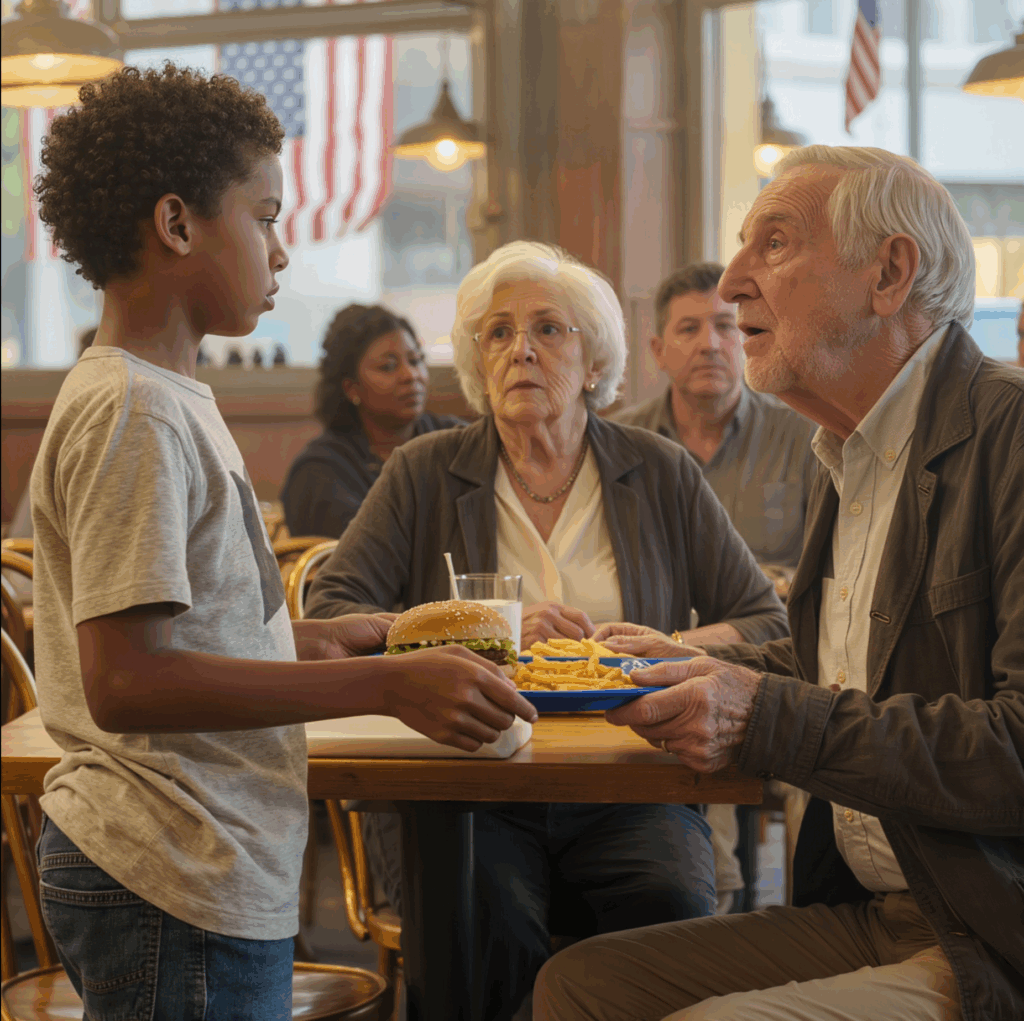
“Hold up,” he called. Crossing the diner, he placed his carefully saved meal in front of them. “This one’s on me tonight.”Margaret blinked. “Oh, sweetheart, that’s very kind, but we couldn’t possibly—”
“My grandmother says kindness multiplies when you give it away,” Darius replied. The words landed like a promise.Harold’s piercing blue eyes studied him, calculating, recognizing. “Son, this is your meal. And I can work for another one,” he said, almost testing Darius.
Sandy hustled for coffee, and the couple’s car troubles were suddenly addressed.Darius introduced himself. They revealed names—Harold and Margaret—and Darius listened as they explained, gently, that his character was extraordinary.
The lost wallet, the staged car—they had been testing him, evaluating the young man who gave up his own meal to strangers, who helped neighbors, tutored children, walked miles to save bus fare. Darius’s choices had revealed him.
By morning, the world had shifted. At school, phone calls, newspaper articles, and finally, the principal’s office awaited him. Harold and Margaret, now commanding and unmistakably powerful, laid out opportunities beyond imagination:
full scholarships, internships, and the chance to build a community center in his neighborhood—the Darius Johnson Community Development Center. Fifteen acres, $25 million in investment, programs for healthcare, education, vocational training, and more. His city’s needs finally met with real solutions, and he would lead it.
“Why me?” he whispered.“Because transformation has to come from within,” Margaret said. “You gave away your last meal because it was right, not because anyone was watching.”Darius, overwhelmed, realized the truth: kindness had opened doors he’d never dreamed existed.
The small choices he’d made every day—walking instead of riding, helping without recognition, giving without expectation—had prepared him for this moment. A moment where good people truly do win.
And for the first time, as he held the blueprints, the scholarship papers, the business cards, Darius understood: his life—and the lives of those around him—would never be the same again.