The marble floor of the kitchen was cold — deathly cold. Hard, unyielding, merciless. Every sound, every soft movement echoed sharply across its polished surface. And there, on that freezing floor, sat Doña Rosario — a frail,
seventy-two-year-old woman whose body seemed to fold in on itself, as though time had slowly pressed her down into the earth. Her trembling hands rested in her lap. In front of her stood a deep plate filled with cold, forgotten food.
It wasn’t yesterday’s dinner.It was two days old — clumped rice, sour beans, and a small, dry piece of chicken that smelled faintly rancid. The air around her was heavy with decay, like the scent of something long neglected.
Mariana stood nearby, elegant as ever, wrapped in an expensive silk dress that shimmered under the harsh kitchen light. Her arms were crossed tightly, her chin tilted upward in disdain. Her voice sliced through the silence like a blade:
“If you want to eat, do it right here. Dogs eat off the floor — and you’re no better than one.”Rosario lifted her tear-filled eyes, her voice fragile, trembling like a leaf in the wind.
“Please, Mariana… it’s spoiled. I can’t eat it.”
Mariana’s laugh was sharp and hollow, echoing cruelly through the tiled room.“You dare to complain? You should be grateful you have a roof over your head — and food at all. If it were up to you, you’d still be rotting in that filthy village of yours.”
Rosario’s lips trembled. She lowered her gaze, saying nothing. Every word felt like a stone pressed against her chest. She couldn’t tell her son, Javier. He was always busy, always tired, working endlessly to provide. He didn’t need to see his mother’s humiliation.
Mariana shoved the plate closer, her manicured nails tapping against the table.“Eat.”Rosario’s hand quivered as she picked up the spoon. Her fingers were thin, her skin translucent. She took a small bite. The taste was sour, bitter — almost unbearable.
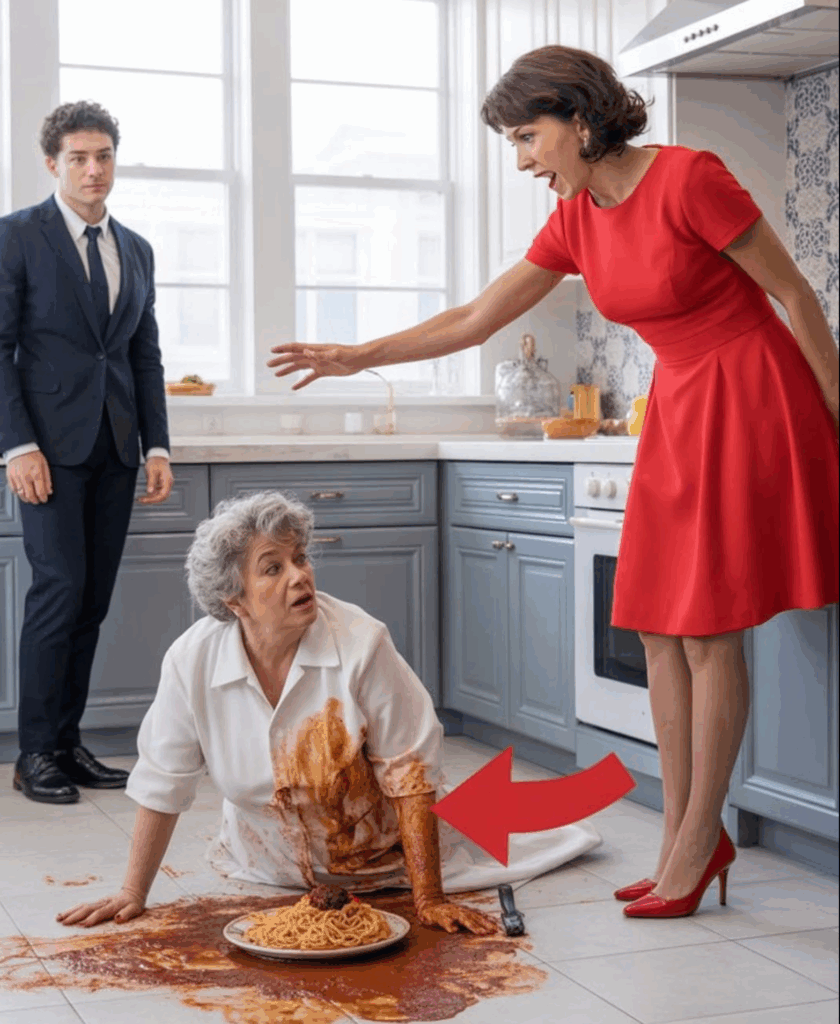
She forced it down, eyes filling with tears. Mariana scrolled idly through her phone, her expression bored.“Good,” she said coldly. “Keep eating.”Each mouthful was another wound. Rosario didn’t just swallow food — she swallowed shame,
loneliness, the heavy knowledge that she no longer belonged.Then, the sound of keys at the door.Javier’s voice.“Mama?”Mariana’s body stiffened. She quickly put away her phone, her expression softening into a sweet, practiced smile.
“Darling! What a surprise — you’re home early.”Rosario startled, instinctively trying to hide the plate behind her. Her heart raced as Javier stepped closer. His eyes scanned the room — the cold floor, the uneaten food,
his mother’s pale face — but exhaustion dulled his questions.“What’s going on?” he asked quietly.Mariana’s tone was syrupy smooth.“Nothing, love. Your mother just didn’t like what I cooked, that’s all. You know how picky she can be.”
Rosario forced a faint smile.“Yes, my son… I’m just not very hungry.”He nodded — tired, oblivious, lost in his own world. Sometimes, it was easier not to see.That night, Rosario sat alone in her small room. The walls felt colder than usual.
On her nightstand lay an old, faded photograph of Javier as a child — a boy with bright eyes and a wooden toy sword in his hand. She remembered the long nights of sewing by candlelight, selling tamales in the rain, the years of sacrifice
that had built the very life he now lived.And now, in his home, she was a ghost.In the next room, Mariana stood before a mirror, spraying perfume, her silk dress gleaming under the golden light. Everything about her was for display —
perfection painted over cruelty. The house itself seemed to hold its breath.Days passed. Rosario grew thinner, her cheeks hollow, her clothes hanging loosely from her shrinking frame. Yet every evening, when Javier came home, she smiled. She didn’t want him to worry.
Then came the day that changed everything.Mariana placed another plate of spoiled food before her.“Eat,” she ordered, folding her arms.Rosario obeyed in silence. The spoon clinked against the plate — a tiny sound that carried the weight of years.
And then, the front door opened.“What’s going on here?” Javier’s voice cut through the air like thunder.Mariana froze.Rosario turned, startled, her eyes wide and wet with tears.Javier took in the scene — his mother on the cold floor,
the plate of rotting food before her, Mariana standing over her like a warden. The truth crashed over him in one unbearable wave.He stepped forward, knelt beside his mother, and took her shaking hands into his.
“No more,” he said, his voice low but firm, filled with a quiet fury. “No one will ever treat my mother this way again.”The color drained from Mariana’s face. Her power — her perfect facade — shattered like glass.
From that day forward, everything changed. Javier cooked for his mother himself.Warm meals filled the house with comforting smells — soft rice, tender meat, fresh bread, coffee that wrapped the morning in warmth. He seated Rosario at the head of the table
— where she belonged.Mariana watched in silence, her kingdom crumbling around her.Rosario, her eyes glistening, took her son’s hand and whispered,
“Thank you, my child.”
And for the first time in years, she smiled — not the fragile smile of someone surviving, but the peaceful, radiant smile of a woman who finally felt seen, valued, and loved again.Javier understood then what true wealth meant.
Not the house, not the luxury — but love, gratitude, and the quiet, eternal strength of a mother’s heart.And as the morning light poured through the window, warm and golden, Doña Rosario knew: she was home again. Not as a burden.But as a mother.