The Mother-in-Law’s Gift: In the days leading up to my birthday, a restless unease began to coil inside my chest like a serpent, its movements subtle but insistent. I could not rationally explain the sensation,
yet every instinct—precisely the kind that rarely errs—warned me that something unusual, perhaps even sinister, was approaching.My intuition had never failed me when it came to my mother-in-law. She possessed an almost imperceptible aura of menace,
the kind that made the air itself feel colder when she was near. There was nothing overt in her hostility—no sharp words, no raised hand—but her presence carried an undercurrent of something calculated, something that whispered quietly of power and control.
She never greeted people with warmth, softness, or affection. Her demeanor was measured, impeccably formal, each word weighed and placed with care, as though each gesture held a secret sting beneath its surface. Her smile was never innocent;
it was a polished mask, a velvet-clad blade. Even now, recalling it, I feel a shiver slide across my shoulders—a prelude to the disquiet that always seemed to follow her.
So when she glided into my birthday celebration, poised and deliberate, holding a perfectly wrapped box, a wave of apprehension surged through me. The ribbon was immaculate, the paper flawless—but the moment it touched my hands,
the air around me seemed to constrict, pressing with invisible fingers. “Happy birthday,” she said, her voice cool and distant, like winter sunlight striking stone. There was no warmth in her eyes, only the faint glimmer of calculation.
I looked up, startled. She had never once given me a gift—never at Christmas, never at any occasion. Not a single token of goodwill. And now this. It should have been touching, a gesture of connection—but instead, it cast a shadow across my chest.
I hesitated, fingers brushing the satin ribbon, before lifting the lid. Inside, nestled like a precious jewel, were shoes.
Not merely shoes—exquisite, gleaming, undeniably luxurious. Their elegance whispered of sophistication, of evenings where every step would command attention, where beauty was measured in polished leather and the curve of a heel.
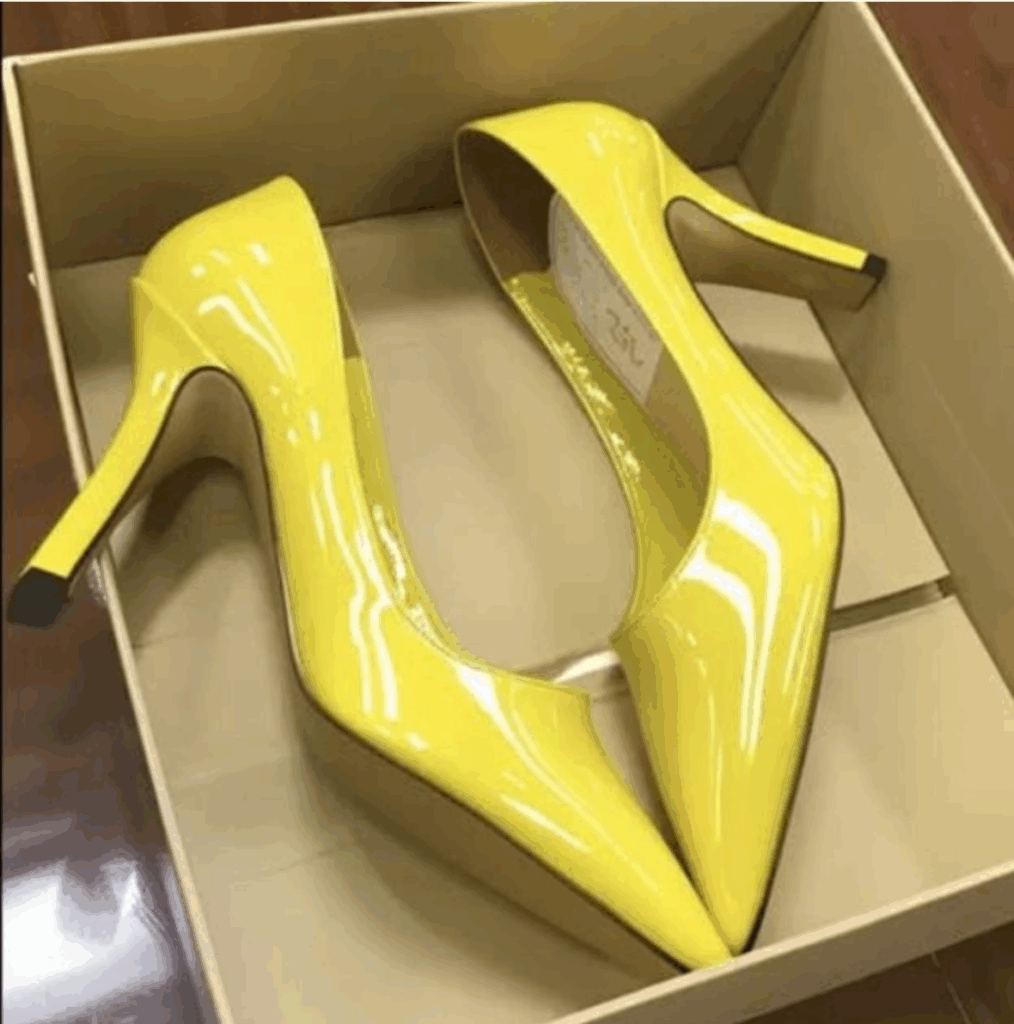
I felt my breath hitch as my fingers traced the smooth curve, the subtle gleam reflecting the light. My husband’s eyes shone with uncontained delight, the joy of witnessing a perfect gift lighting his face. I could not bring myself to ruin that moment.
I forced a smile, masking the uneasy coil tightening in my stomach.“They’re beautiful,” I said, my voice steady despite the icy prickle running down my spine. “Thank you.”
Yet beneath my polite words, something darker stirred—a cold, shivering tremor, crawling from my chest to my toes, as though a shard of winter had lodged itself in my heart.
The First Trial, A few days later, I decided to wear the shoes to work. As soon as my feet slid into them, the vague unease I had felt crystallized into something tangible, something precise and deliberate.
My toes cramped. The arch of my foot pressed against an invisible barrier. Each step felt unnatural, forced, as though the shoes themselves were resisting my movement. This was no ordinary tightness that time or wear might have remedied—it was calculated. Intentional.
Something rigid and foreign lurked beneath the leather, pressing against my soles, hidden yet unmistakable. I tried to dismiss it.“Perhaps it’s the insole,” I murmured to myself, flexing my toes, willing my mind to accept a minor imperfection as the explanation.
By the end of the day, however, denial was impossible. My feet were swollen, flushed with angry crimson blotches. Each step sent ripples of pain up my calves, my knees, my lower back.
When I finally slipped them off, it felt as though a suffocating weight had lifted—but the tension lingered, etched into my muscles and my chest, a memory of the pressure that had slowly suffocated my comfort.
I said nothing to my husband. How could I? His joy in the moment—the belief that his mother had softened enough to give me a gift—hung in the air like fragile crystal. I dared not shatter it.
The Ominous Week: The following week, I left for a business trip. I resolved to give the shoes another chance. Perhaps the first discomfort had been a fluke, a minor quirk of new leather.
At first, they seemed bearable. The click of heels on polished floors, the shuffle through crowded airports—normal. But gradually, the sensation returned, insidious and precise, as though the shoes themselves were alive with intent,
reshaping themselves to torment me. It was wrong. It was deliberate.Later, in the quiet of my hotel room, I removed them once more. Examining the shoes under harsh light, pressing, twisting, flexing, I saw nothing at first. My intuition, however, screamed that the secret lay hidden.
With a trembling hand, I lifted the insole. And there it was.A thin, metallic plate, concealed beneath the soft lining, studded with tiny protrusions—subtle, deliberate, designed to apply constant pressure: enough to inflame, to swell, to exhaust.
It was not meant to draw blood. It was a weapon of discomfort, a secret instrument of torment.A shiver ran down my spine. My chest tightened. My heart pounded in disbelief, fear, and anger.
The Terrible Realization: Everything fell into place in that single, horrifying moment. This was no factory defect. No oversight. Someone had hidden this plate intentionally—and the only person capable of such deliberate malice was my mother-in-law.
Her disdain had never been subtle. Her eyes lingered on me with quiet derision, her smiles measured, her words dipped in sarcasm. And now, she had escalated that quiet malice into a meticulously orchestrated form of torture: a gift designed to harm slowly, secretly, untraceably.
But why? To make me sick? To sap my strength? To control or punish me for being part of her son’s life? Or simply for the cruel satisfaction of knowing she had caused suffering?
The Decision: For hours, I sat in the dim hotel room, the dismantled shoe in my lap. My thoughts swirled like storm clouds. Should I tell my husband? Would he believe me, or dismiss it as paranoia, defending the mother he still loved?
Silence offered its own danger. Confronting her could ignite open conflict, force my husband into an impossible choice between his mother and me.
I made a decision. The shoes would remain. Evidence. I would not destroy them. I would not hide them. I would wait, patiently, for the moment when the truth could be exposed—undeniable, incontrovertible.
Until then, I would wear a mask of ignorance, pretending the gift was innocent, while keeping my vigilance close.
The Shadow That Remains: Now, whenever I see my mother-in-law, I see the hidden dagger behind every smile. The shoes lie buried in my wardrobe, mute witnesses to the extremes malice can take when cloaked in elegance and familiarity.
Every memory of that day tightens a cold, suffocating grip around my throat. The enemy is not distant; she sits at our table, in the center of my family, smiling as if nothing is wrong, while the silent truth of those shoes whispers: cruelty can hide in plain sight, disguised as generosity.
And with that knowledge, everything has changed. I move differently, watch more carefully, and trust less easily. The shadow she cast is patient, vigilant, a constant reminder that the heart of a household can harbor a quiet, relentless adversary.