My husband walked out on me—and our four children—without warning. He chose another woman over the life we had painstakingly built together for fourteen years. He didn’t just leave our home; he vanished entirely from our lives, like a ghost that once had a heartbeat.
For nearly three years, we lived with the hollow echo of his absence. Every room, every corner, whispered reminders of him, and we had to relearn how to breathe in a world he had abandoned. We had to learn how to stand on our own, how to fill the silence he left behind with resilience instead of despair.
Then, one ordinary afternoon in a supermarket, I saw him again. That single, quiet moment—completely unexpected—taught me something I never thought I would understand: the most powerful form of revenge is not anger, not bitter words, not even justice.
It is living well. With dignity. With peace. With joy.I still remember the evening he left as if etched into my mind in sharp relief.It was an unremarkable weekday. Dinner was simmering on the stove, the children’s laughter bubbled from the other room,
and I was setting the table, performing a ritual I had done countless times before.The front door opened, and instead of the familiar sound of keys and his tired greeting, there was only silence. I turned—and there he was—my husband—standing beside a woman I had never seen before.
She carried herself with a rigid elegance, her eyes distant and cold, as though everything that was about to unfold had been preordained long before she crossed our threshold.
He wasn’t angry. He wasn’t apologetic. He was distant, hollow. “Anna,” he said, his voice flat, lifeless, “I’m filing for divorce.”
No explanation. No softness. No attempt to cushion the blow. Just words that landed like a stone thrown into still water, rippling through the life we had shared.
Fourteen years of marriage. Four children. A thousand moments we had built together—all discarded in a single breath.
I asked questions. I pleaded for answers. For reasons. But he was already gone in every meaningful way. His body occupied space, but his heart, his loyalty, his mind—they were elsewhere.
That night, I packed a few bags. My sister helped me find a small apartment. It wasn’t much, but it was ours. I gathered the children—still stunned, still tear-streaked—and began a new life, a life I hadn’t asked for but was determined to shape.
It was terrifying. I had no grand plan, only a single, burning will: to protect my children and not let grief swallow us whole.The divorce was swift, clinical, almost mechanical. At first, he offered support—small payments, occasional texts asking about the kids.
But those gestures dwindled over time until they disappeared altogether, leaving behind a vacuum as cold and empty as the absence he had created.
Gradually, the children’s questions about him softened, became quieter, tinged with uncertainty. I answered honestly, but gently, never turning their hearts against him. His silence did that job perfectly.
We struggled—in every imaginable way: emotionally, financially, and in all the invisible ways that matter most. But somehow, day by day, we endured. I took on extra work, leaned on friends and family, and created a routine that gave us stability.
The children grew stronger, resilient, kind, and astonishingly brave. Laughter returned, sometimes through tears, but it returned nonetheless. We became a team—a family reshaped by pain into something even more unbreakable.
Then came that ordinary day in the supermarket. I wasn’t expecting anything, just navigating aisles, pushing a cart, thinking about dinner. And then I saw them.Him. And her.
They looked… different. Older, not in age, but in energy. The light in his eyes had dulled, weighed down by something I could not name. She seemed restless, impatient, irritated by some petty quarrel I couldn’t hear.
It wasn’t the fairytale they had left behind; it wasn’t the picture-perfect life he seemed to chase.And then he saw me.“Anna,” he said softly, almost like a question.“Olivier,” I replied, calm and measured.Time seemed to pause.
I could have said a thousand things. I could have unleashed years of pain, recounted the nights of tears, the sleepless hours of worry, the lonely battle to hold our world together.I could have shouted, wept, whispered every ache that had lodged in my heart. But I didn’t.
I smiled—truly, freely—and said, “We’re doing well.”Because we were.He looked down, ashamed or startled. She turned on her heels and walked away, the sharp click of her shoes echoing in the aisle. And there I stood—not angry, not shaken, just peaceful.
Whole. I had survived. I had endured. I had thrived.When I got home, the children greeted me with hugs and chatter. My daughter Emilia studied my face, mapping my expression.“Are you okay, Mom?”
“I’m fine,” I said. “I saw your dad today.”My son Lukas pulled me into a tight hug. “I still miss him,” he said. “But it hurts.”“I know, sweetheart,” I whispered. “It’s okay to feel both.”“Do you think he’ll ever come back?” Emilia asked.
“I don’t know,” I said honestly. “But I do know this—we have each other. And that’s more than enough.”A few days later, the phone rang. It was him.“Hi… Anna. It’s Olivier. Laura left. I’ve had time to think… I know I messed everything up.”
I didn’t yell. I didn’t slam the phone down. I listened. Then I said, “I’ll talk to them. But you need to understand—trust takes time.”Two days later, he came with small gifts—books, toys, a stuffed bear for the youngest. The children were hesitant, unsure, but curious. Emilia opened the door herself.
“Hi, Dad,” she said—not smiling, but not angry.Lukas lingered behind, then stepped forward slowly.“Thank you,” Olivier whispered to me. “I just want a chance to try. If you’ll let me.”
I looked at him—not as the man who shattered my world, but as a flawed human, perhaps finally willing to take responsibility.“That’s up to you,” I said. “I won’t stand in the way—if you mean it.” Over the following months, he kept showing up.
Slowly, the children began to trust him again—not fully, not instantly—but enough to start rebuilding. And I let go of the rest: the anger, the sorrow, the endless “what-ifs.”I didn’t need revenge. I didn’t seek it. I found something far richer. I healed.
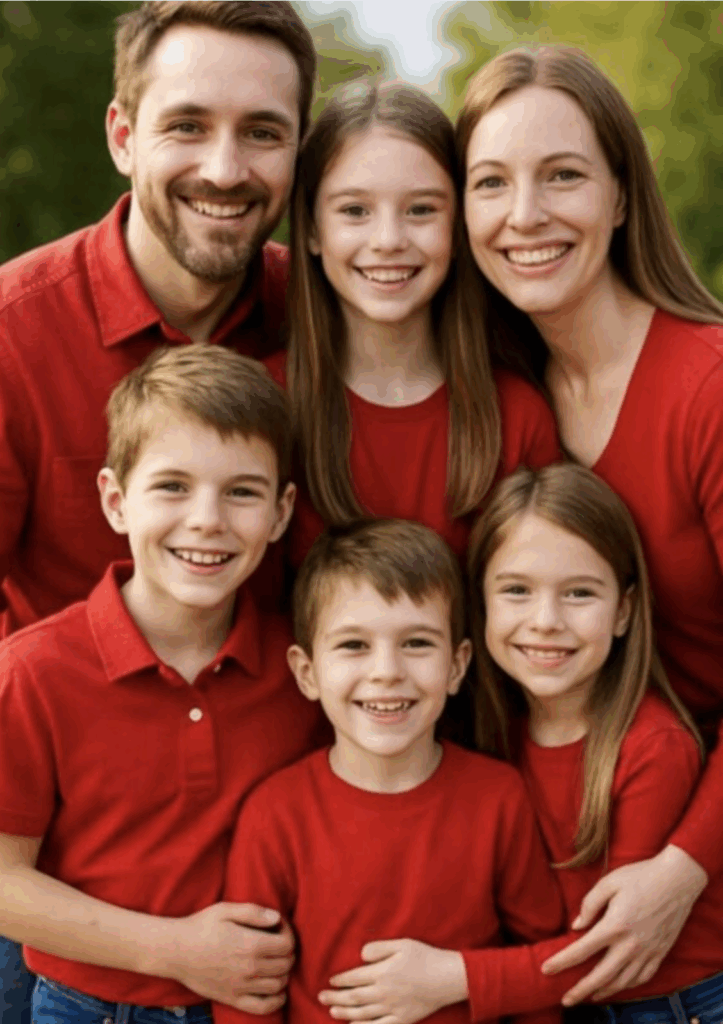
I built a life of laughter, warmth, and love. I discovered a strength I had never known. I raised four beautiful, resilient children. And I learned that real, quiet, steady happiness is its own form of justice.
Life may tear us apart, but it also offers the chance to become something stronger, something better. And perhaps, the truest revenge is living a life so full, so peaceful, and so free, that the past loses all its power to hurt you.