I didn’t notice the exact second the gym went silent. I only heard my name. “Sophie Hart. Valedictorian.” The principal’s voice rang out beneath the bright gymnasium lights, echoing off faded championship banners and metal bleachers filled with parents fanning themselves in summer shirts.
The air smelled like roses from bouquets and the sharp tang of floor wax. I felt the tassel brush my cheek, the medal’s weight press against my collarbone, the burn in my calves from standing too long in the same pair of heels that weren’t made for triumph but for survival.
Clutching my folded speech in my damp palm, I walked up the steps, my smile trembling between pride and disbelief. I had made it. Through midnight dishwashing shifts, through coffee-stained textbooks,
through dawn bus rides that blurred into nights of exhaustion and essays written with shaking hands—I had made it here. When the principal placed the crystal trophy in my hands, the world narrowed to light and gratitude. I lifted it high.
My classmates erupted in cheers. For a heartbeat, I felt weightless, as though the years of struggle had melted into this single, soaring moment. Then the back doors slammed open.
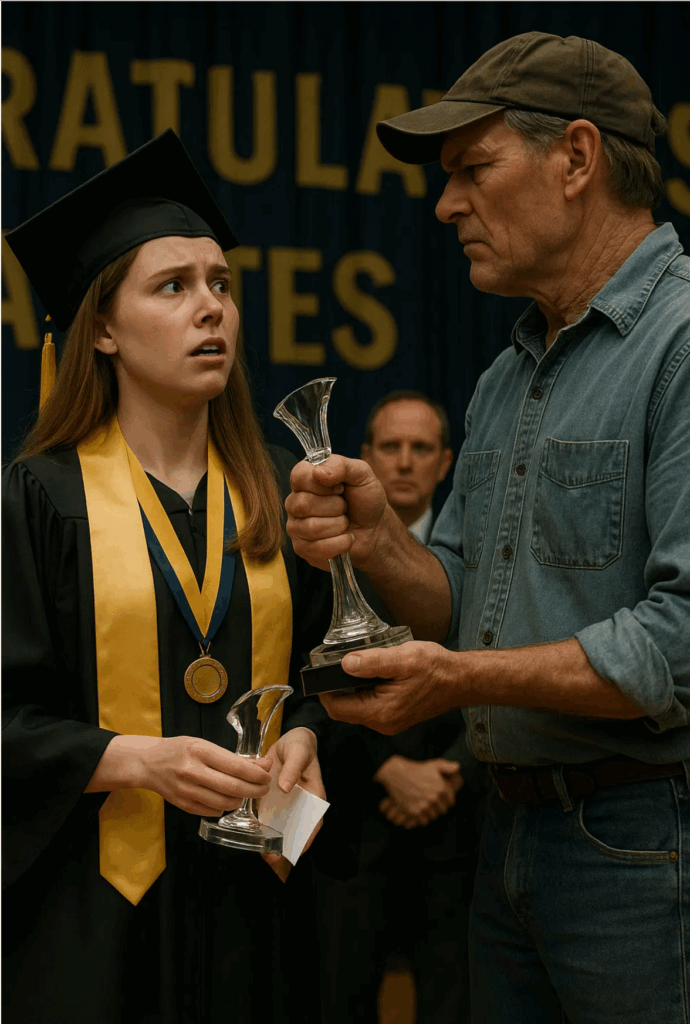
You can feel a storm before you see it. The air tightens, every head turns, whispers scatter like dry leaves. My father’s boots struck the polished wood as he marched down the aisle in his sun-faded work shirt, grease stains clinging like shadows.
I felt my smile freeze. That morning, he had promised he wouldn’t come. “Graduations aren’t for people like us,” he had muttered, wiping his hands on a rag dark with oil. “They’re for people who never got dirty.”
Still, he came. And for a split second, I let myself believe that meant something. He climbed the stage with the certainty of a man entering his workshop, like the rest of us were intruders. The principal stepped forward, uncertain, but my father didn’t look at him.
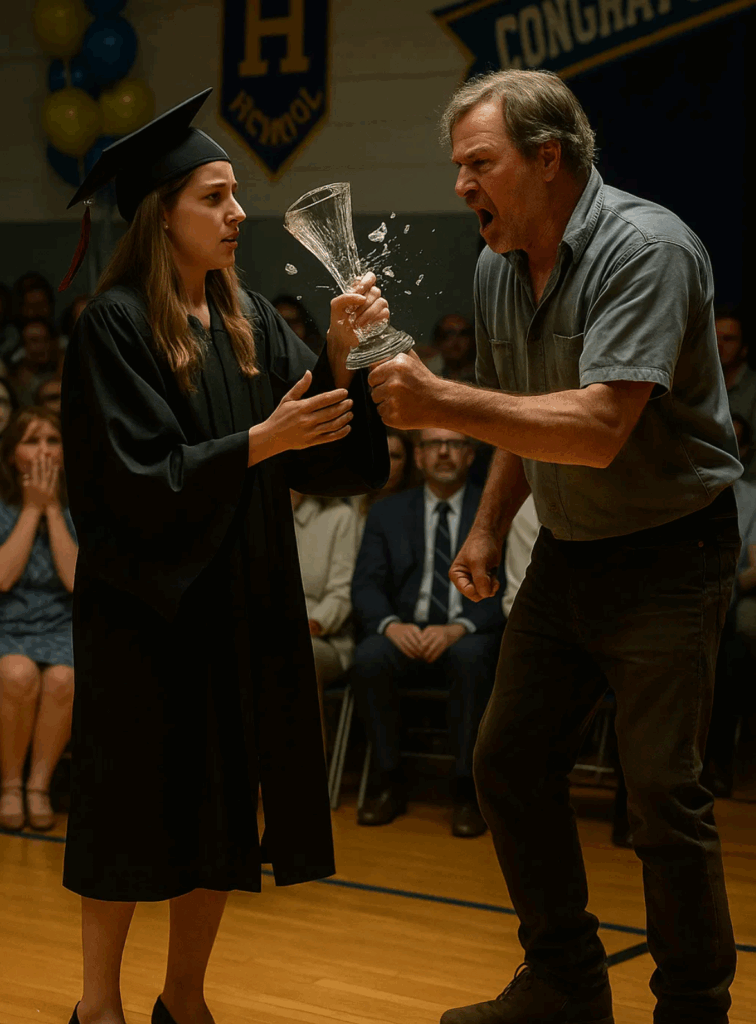
His eyes locked on me—or through me—and then on the trophy in my hands. For one impossible heartbeat, I believed he might lift my arm, hold it high, speak words that sounded like pride. Instead, his calloused hand closed around the stem of the trophy. And he ripped.
The crystal snapped in my hands, shards scattering across the stage with a sound so sweet it felt cruel. Gasps burst through the gym like startled birds. My father snatched the nameplate from the principal’s trembling hand, tore it in half, and let the pieces flutter to the floor.
“Garbage doesn’t deserve success,” he said. His voice wasn’t loud, but the microphone carried it, pebble by pebble, rippling into every corner of the room. “People who forget where they come from—garbage.”
I did not cry. Not then. My body knew enough to keep me upright. I stood as my father walked off the stage, down the aisle, out into the blistering afternoon. Around me, the gym stretched wider, a hollow cavern where sound used to be.
Later, people tried to patch the moment back together. The principal stammered apologies. My friend Ava grabbed my shoulders, desperate for me to say I was okay. My calculus teacher—who had handwritten my recommendation letter because she believed handwriting
carried more meaning—pressed a steady palm to my back. The custodian crouched on the stage, gathering the shards as if they were diamonds. I smiled. I nodded. I said thank you. And I delivered my speech anyway.
My hands shook, but my voice rose from a place deeper than fear. I joked about caffeine and resilience, thanked teachers and cafeteria ladies who slipped me extra fruit. When I finished, the applause came long and hard—clapping that tried to sew something back together.
But when the cheering faded, I walked home alone. The sunset painted the streets too beautifully for how hollow I felt. The house looked the same—peeling paint, a stubborn tomato plant, a front stoop we never fixed. The door hung open to the heat.
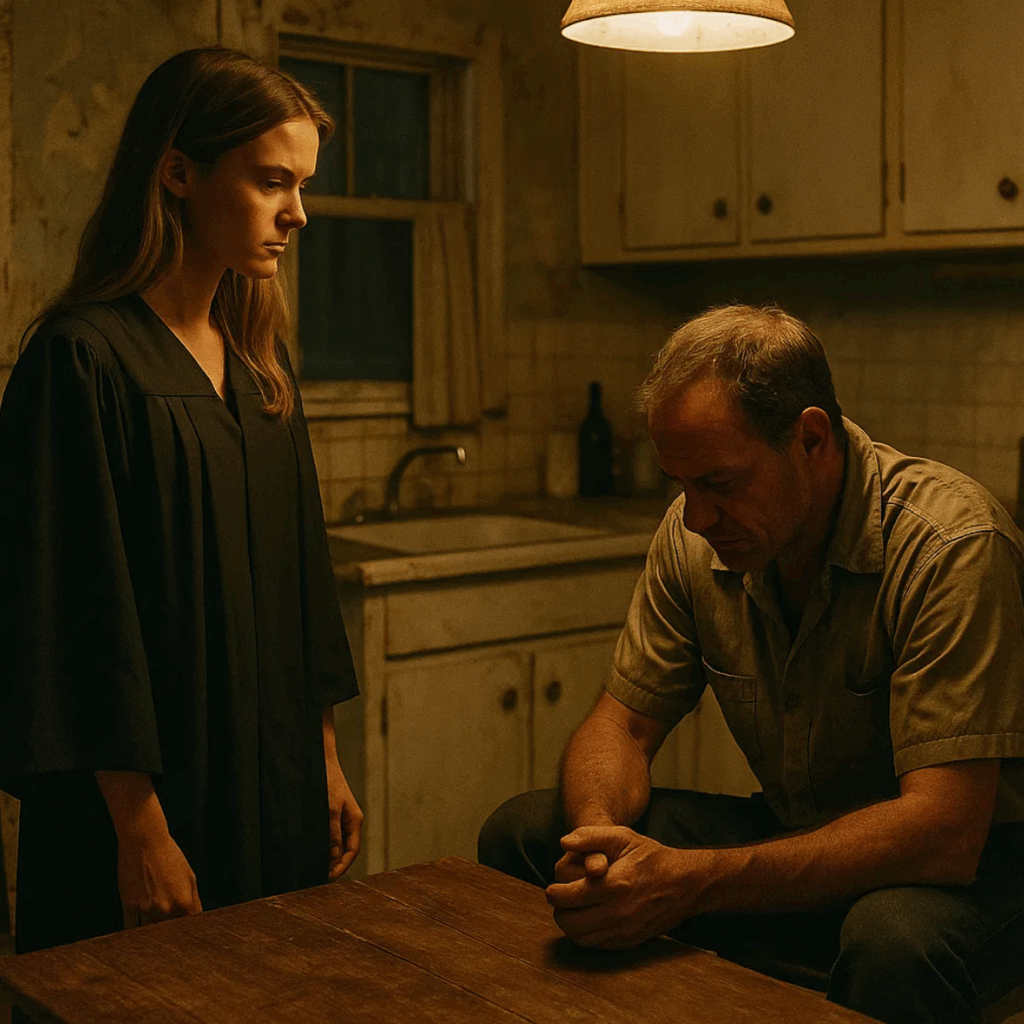
Inside, my father sat at the small kitchen table, elbows on knees, staring at his boots. His cracked mechanic’s hands rested together, as if he were praying to a God he didn’t believe in. “You came,” I said, setting my cap on the chair.
He didn’t look up. “Your ma would’ve wanted me to.” We hadn’t spoken her name in months. Grief had taught us silence. When he finally met my eyes, I saw something raw behind the hardness. Fear. Loneliness. The kind that had haunted him when the bills piled up and engines failed.
“How much did the dress cost?” he asked. “It was borrowed,” I whispered. “Ava’s sister.” He grunted. “Figures.” My voice cracked. “Why did you do it? In front of everyone?”
His jaw worked. “You don’t understand, Soph. They clap for you now, but when life chews you up, none of them will be there. I—” He stopped, swallowed hard. “I needed you to remember who you are. Not some title. Not some crystal thing.”
“I know who I am,” I said. “I’m your daughter. I’m Mom’s daughter. And I worked for this.” He flinched at her name, then hardened. “Hard work’s not the same as success. Success makes you soft. Makes you forget your own.”
“I don’t look down on you,” I said. He shot to his feet, chair scraping. “I heard you’re leaving. For the city. For that internship.” He said the word like it was poison. “You didn’t tell me.” “I tried. Every time I brought it up, you changed the subject to the truck or the bills.”
His fists opened, closed. “I can’t lose you, too.” The words fell between us, fragile as glass.
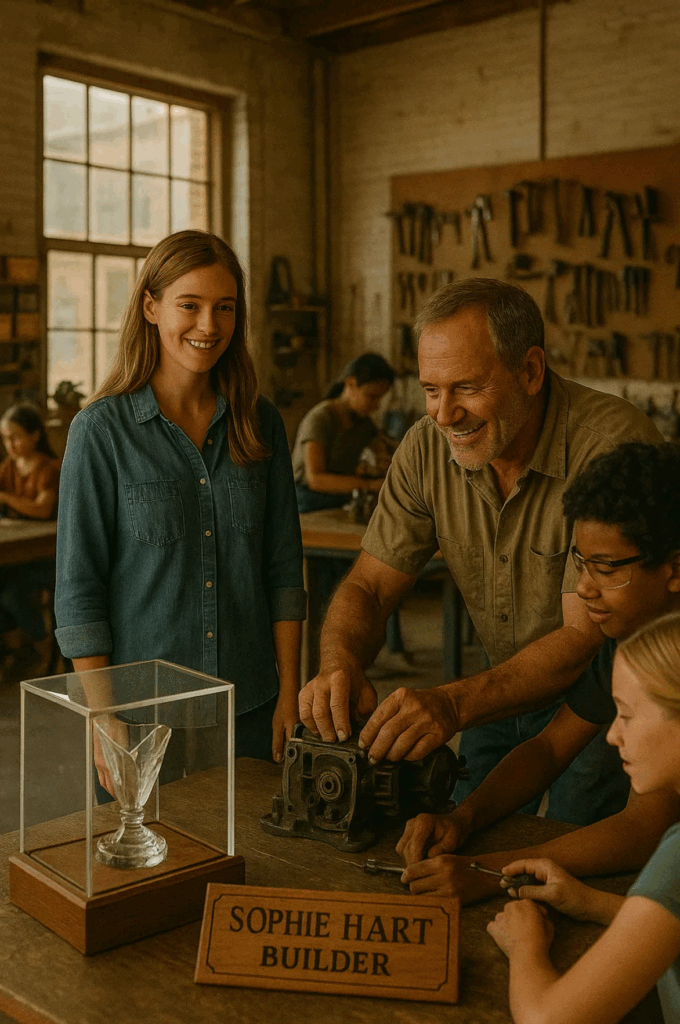
“I’m not leaving you,” I said softly. “I’m going to learn. To grow. To come back stronger. Mom wanted that. She told me once—‘Bring back what you learn and teach the town how to dream bigger.’ Do you remember?”
Something flickered across his face, light breaking through storm clouds. He sank back into the chair, shoulders heavy but softer. “Your ma believed in you. Always did.” “So did you,” I whispered. “Just… in your way.”
Silence stretched. Finally, he nodded toward the counter. “There’s cake. From the bakery. They didn’t charge me ‘cause I swept their stoop.” I laughed, startled, and the sound cracked something between us.
We ate cake in the kitchen’s warm light, while fireflies woke in the yard. Later, I glued the broken trophy back together piece by piece. The cracks gleamed like rivers of light. And for the first time, I believed they made it more beautiful.