At first, she didn’t notice him. The floor-cleaning machine hummed quietly in the back aisle, a monotonous, almost hypnotic drone. Owen Grayson, clad in a faded Everyday Save jacket and pushing the cumbersome machine like a tired part-timer,
moved cautiously, almost silently, past the frozen foods. Every step could have shattered the moment. Then he heard it: a stifled, barely audible sob that cut through the cold between frozen pizzas and vegetables.
It was the sound of someone desperately trying not to cry—and failing. Owen turned his head. At the far end of the checkout area, a young woman crouched, her face buried in her hands. Her apron still hung around her waist;
the headset lay loosely around her neck, as if she had taken it off halfway, never making it to the break room.“I’m trying, okay? I’m trying, but I can’t miss another shift, or they’ll cut my hours again. I haven’t even paid the electricity bill yet,
and now they’re threatening eviction. What am I supposed to do?” Her voice trembled, fragile from fear and exhaustion.
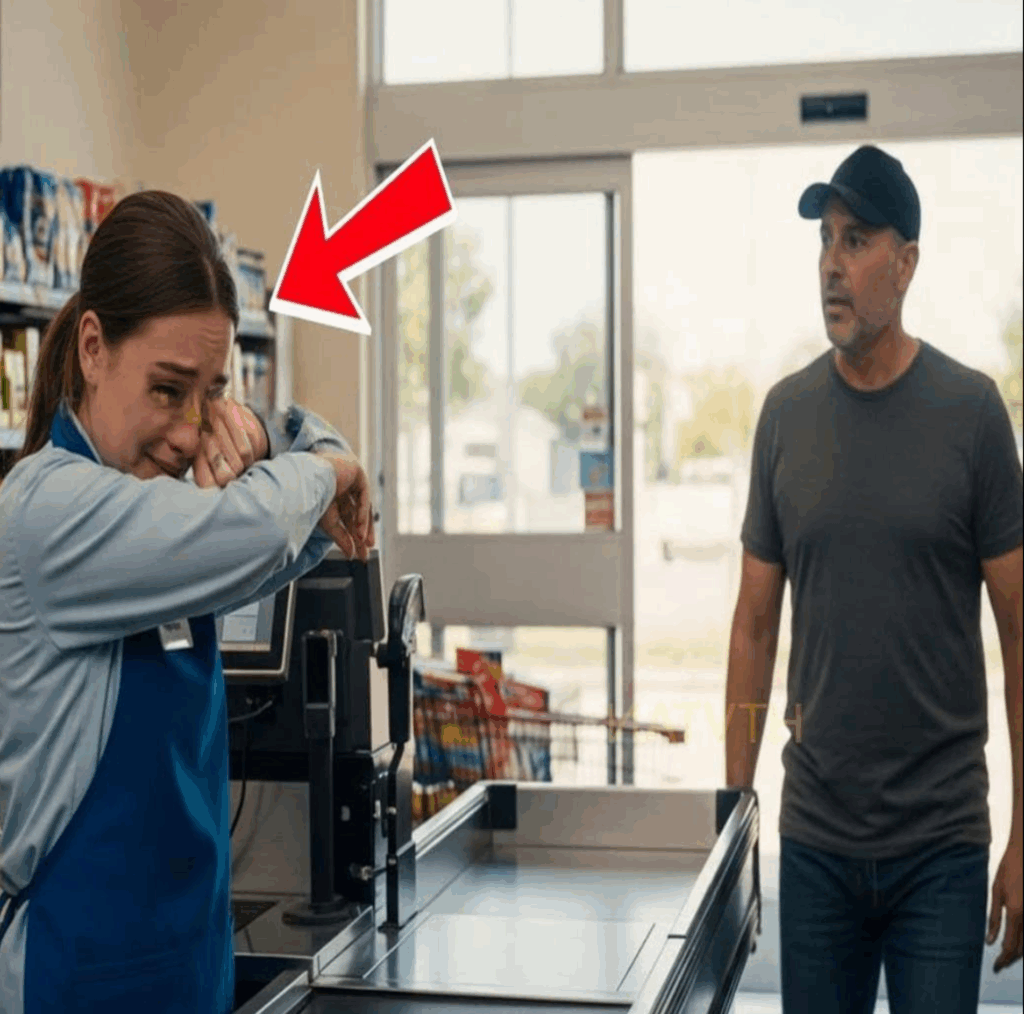
A short pause. “No, I didn’t tell them. Why would I? HR says flexibility is everything. But if I’m not available 24/7, I’m out. You know how it is here. Either you’re invisible… or gone.”
Then, like a punch straight to the heart:“I lost my mom. I lost my house. I’m losing myself. I don’t even know why I keep going.”A quiet sniffle followed, a sound so small and vulnerable it seemed to echo off the linoleum floor.
“I just want someone to see me. Just once—even if it’s the guy who wrote all those damn policies.” A bitter, sad laugh. “But people like him don’t come here. Really, they never do.”Owen’s hand clenched around the handle of the machine.
She didn’t know who he was—but she was speaking about him all the same.The girl behind the register was named Alyssa. She had no idea her life was about to change in that moment, because the man pretending to clean the floors was the one who had built the very system slowly breaking her.
Owen had founded Everyday Save in an old, rusted warehouse in Dayton, Ohio—starting with a single store and a dozen metal carts. Back then, he knew every employee by name, swept the floors himself, manned the cash register on Sundays,
checked deliveries at five o’clock on Monday mornings. But growth came at a cost. By the time the company grew to 300 stores, HR had hired consultants. Policies and efficiency metrics replaced personal leadership.
One of them, “Flexible Scheduling for a Stronger Workforce,” had been sold to him as a win-win: “It rewards availability with job security. Unplanned absences are reduced.” Everything sounded fair, mathematical, flawless.
What no one said aloud: anyone needing time off—for sick children, second jobs, or family emergencies—was quickly labeled “low availability.” Fewer hours, less income, no security. Owen had signed off.
The next morning he returned as “Tim”: cheap khakis, gray hoodie, name tag. The store manager never questioned his presence. Owen swept, mopped, restocked paper towels—and watched Alyssa, constantly.
She arrived ten minutes early, forced smile in place, uniform clean but worn. With each customer, she was friendly, practiced, professional. Yet Owen kept noticing her glance at the door, as if waiting for someone.
During her break, she sat in the cramped break room, eating instant noodles with a plastic fork. Her phone buzzed. She read the message, stared at it, then placed it face down. Owen saw only one sentence flash across the screen: “Reminder: Rent 3 days overdue. Final notice.”
Sleep eluded Owen that night. In his hotel room, he opened his laptop, pouring over reports. Alyssa Thompson, Cashier Level One, Store 242, Lincoln, Illinois. Perfect reviews, flawless attendance—but her hours had steadily shrunk:
28 to 24, then 16, and finally just 8 per week. It all started when she had to take two days off to care for her dying mother. The system flagged her, and no one ever checked. By noon the next day, he spoke with coworkers.
An older part-timer whispered, “They never fire you here. They just strangle your hours until you quit.” That afternoon, Owen approached Alyssa. She returned a half-smile. “I used to think about doing something else. But right now, it’s just about survival.”
Her words left him silent. Then she said something that burned itself into his mind: “I don’t need a dream job. I just need a job where I don’t feel like disappearing.”
Owen drafted his resignation—not from the company, but from the system. The next day, he returned—not as Tim, but as Owen Grayson, CEO. No name tag, no hoodie, just a dark gray suit.
He addressed everyone: “I started Everyday Save 21 years ago with a folding table. I swept the floors myself. We built a system that treats people like numbers. But today, that changes.”
He held up Alyssa’s personnel file. Perfect attendance, flawless customer reviews, no disciplinary issues—and yet the system had punished her for being human.“I’ve been listening,” he said. Her eyes widened. “I know what it’s like to be invisible. No one was listening.”
He continued: “This isn’t just about Alyssa. It’s about all of you. From this moment forward, every change will be reviewed by human eyes. If someone is struggling, we will help. No penalties for being human.”
He handed Alyssa a small sign: “This is a human workplace. If you’re tired, you may sit. If you’re struggling, you may speak. You will not be punished for being human.” Three months later, Alyssa led the “Voices First” team. Mondays, they met, and every store displayed the sign:
“You will not be punished for being human.”Turnover dropped. Dignity returned. Owen began leading as a human again—not just as a CEO. For everyone who had been invisible at work, swallowing their pain because speaking out would cost too much: this story is for you.