Millionaire and the Beggar: A Reunion Forged in Cruelty and Redemption
The Saturday morning market in downtown Chicago was alive with its usual orchestra of sounds and colors. The sharp calls of vendors rose above the crowd, advertising peaches so ripe their fragrance lingered in the air, fresh bread still steaming from the ovens,
and flowers bursting with color. Children tugged at their mothers’ sleeves for candy, dogs barked as they strained on their leashes, and laughter blended with the rhythmic hum of the city. Amid this chaos, Daniel Whitmore strode through like a man untouched by the world around him.
The click of his Italian leather shoes echoed sharply against the pavement, his navy suit tailored to perfection, an island of rigid formality in the sea of casual shoppers. To Chicago, Daniel was more than just another wealthy man—he was a self-made millionaire,
the commanding figure behind Whitmore Enterprises, a rising empire in real estate and investments. His confidence bordered on arrogance, and he carried himself with the unspoken belief that discipline was the root of success, and poverty the inevitable price of failure.
By the corner of a vegetable stall, a frail figure sat on the ground. A cardboard sign rested against her knees, the words shaky but desperate: “Hungry. Please help.” Her coat was threadbare, her hair streaked with gray, and her hands trembled as she held out a paper cup.
Coins rattled weakly inside it—small tokens of pity from passersby who hardly slowed their pace. Some avoided her eyes entirely; others dropped change without a word. To Daniel, the sight of her was not just unpleasant but offensive, a blemish on the orderliness of his world.
As he drew near, the woman instinctively reached toward him, perhaps mistaking him for a kind soul about to offer her relief. The movement startled Daniel. Pride flared inside him—he recoiled, disgusted at the thought of her hand touching him.
Without thinking, he lashed out with his foot, kicking her hand aside. “Get off the street. You don’t belong here,” he muttered coldly.
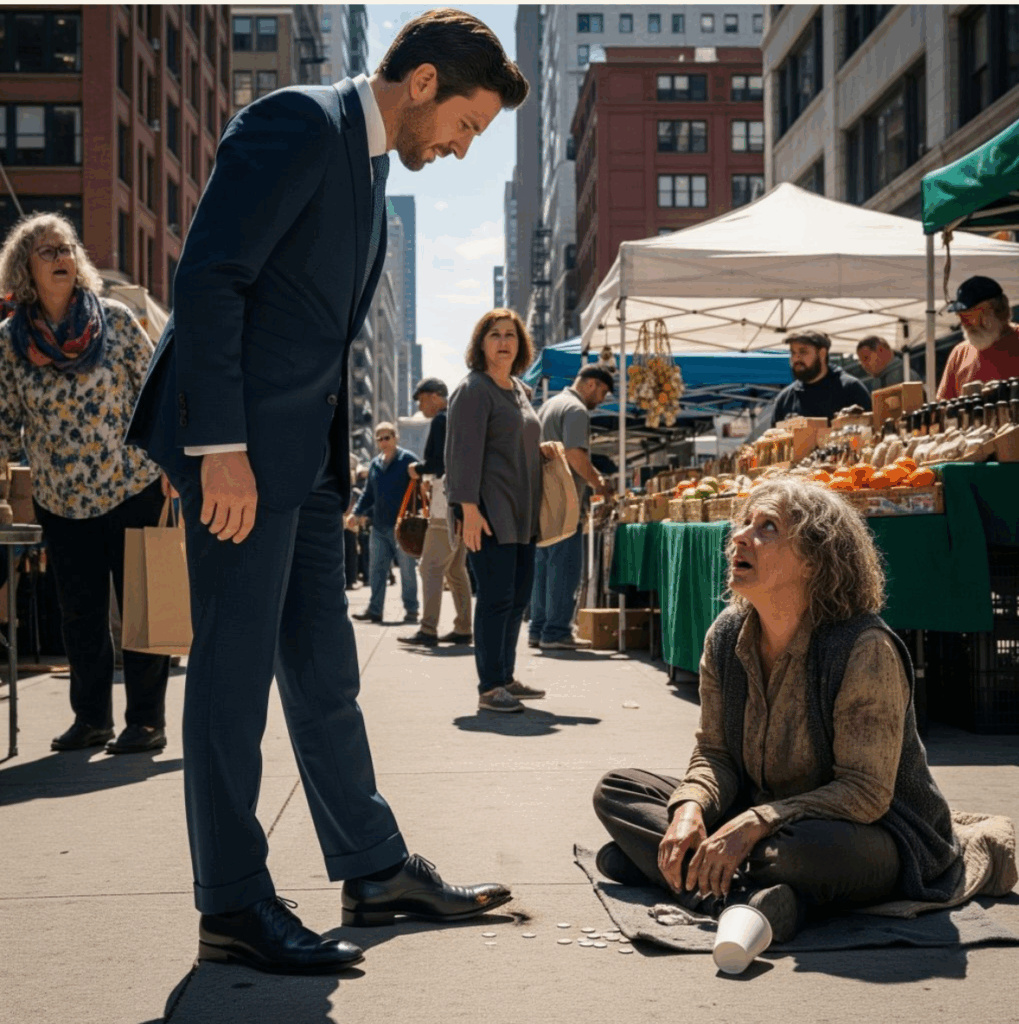
The force of the shove sent her backward against the wall. Her cup tipped, spilling its precious coins across the sidewalk with a metallic clatter that drew the attention of those nearby. A hush fell as whispers rippled through the crowd.
Disapproval was etched in their faces, but Daniel kept his chin high, unwilling to show doubt.
The woman’s eyes widened, her voice breaking the tension not with anger, but with a whisper so fragile it seemed to tremble in the air. “Daniel?”
He froze. Something in the way she said his name—a softness, a familiarity—struck him like a blow. But just as quickly, he dismissed it, shaking his head and walking on. Yet even as he left, her voice clung to him like an echo in his chest.
That night, high above the city in his glass-walled penthouse, Daniel sat with a glass of bourbon, the skyline glittering at his feet. He tried to drown the memory of her voice, but it returned again and again. The eyes—those soft, brown eyes—haunted him.
He had seen them once before, long ago, in a life he had locked away with bitterness.
The truth was something Daniel had carried like a hidden scar. His mother, Margaret, had disappeared when he was seven. His father, Richard Whitmore, had raised him with iron discipline, telling him she had abandoned them.
That she was unstable, unworthy. Daniel had buried his grief in ambition, his loneliness in drive. And yet, he had never stopped searching—quietly, in the shadows. Private investigators. Dead ends. Records that led nowhere. She had become both a ghost and an obsession.
The next afternoon, unable to resist the pull in his chest, Daniel returned to the market. And there she was, in the same corner, the same weary posture, her fragile frame bracing against the chill. For a moment, he simply stood and watched,
his heart pounding with a mixture of fear and disbelief. The tremor of her hand, the curve of her lips as she pressed them together—it was all achingly familiar.
Finally, he stepped closer. His voice, usually firm and commanding, faltered. “Do I… know you?”
She looked up, startled, her eyes widening. For a fleeting second, they softened with warmth, then clouded with shame. “You don’t remember me, do you?” she whispered.Daniel’s chest tightened. “Why did you call me by my name yesterday?”
Her hand shook as she reached into the pocket of her coat, pulling out a worn photograph. The edges were frayed, the colors faded, but the image was clear: a little boy with messy brown hair and bright blue eyes, his smile innocent and free.
Beside him stood a woman, younger then, her smile radiant with love. Daniel’s knees weakened. His breath caught. Those eyes—the boy’s eyes—were his own. “Where did you get this?” he demanded.
“I am her,” she said softly. “I am your mother.” The world tilted. Years of longing and rage clashed within him. He had imagined this moment countless times: finding her in some faraway town, or hearing she had died. But never this—never as a broken beggar at his feet.
Fury erupted in him. “If you’re my mother, why did you leave me? Do you know what you did to me?”
Tears pooled in Margaret’s eyes. “I didn’t leave you, Daniel. Your father… he took everything. He painted me as unfit. He had the money, the lawyers. I tried to fight, but I had nothing left. I thought—” Her voice cracked.
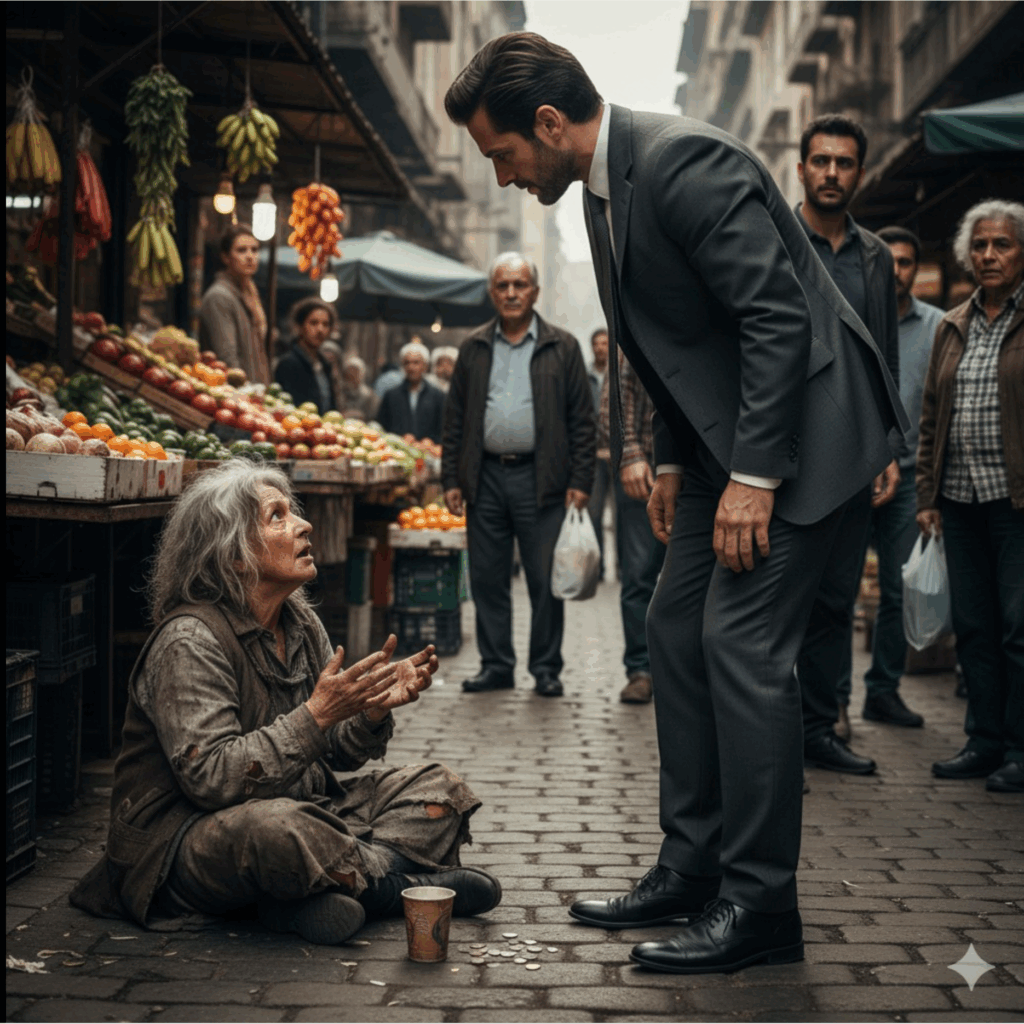
“I thought maybe you’d be safer, better off, with him. I never stopped loving you.” The ground beneath Daniel seemed to crumble. The man he had revered as strong, as unshakable, now appeared as a liar, a thief who had stolen his childhood truth.
Confusion and anger twisted inside him, but so too did something else—something he hadn’t felt in years: longing.
The days after that encounter blurred. Daniel moved through his offices like a ghost, the meetings, the deals, the wealth—all meaningless. At night, he held the photograph she had pressed into his hand, staring at the boy he once was, and the mother who had never truly left him.
At last, he reached out. He invited her to meet him again, this time at a small café by the river. When she arrived, wearing her same tattered coat, the stares of the patrons burned Daniel with shame. But he waved her over gently. For the first time, his voice lacked arrogance. “Sit.”
They spoke for hours. Margaret revealed the truth of her long disappearance—her failed battles in court, her years of drifting, her collapse into poverty after illness stole her strength.
She confessed she had watched from a distance as Daniel grew up, afraid to come close, afraid of what Richard’s threats could do to her—and to him.
Listening, Daniel felt his hardened shell begin to crack. “All these years,” he whispered, “I hated you.”Her eyes glistened. “And I hated myself for not being stronger.”The silence between them was heavy, but something fragile began to take root.
A bond, long severed, trembled back to life.Before the night ended, Daniel made a vow. “You will never sleep on the streets again. Not while I live.”
Though she resisted, pride and shame warring inside her, he insisted. He found her an apartment—small, but warm. He hired doctors, made sure she had food, safety, dignity. Slowly, she began to heal, though the scars of her past could not vanish.
For Daniel, the journey was harder. He had to unlearn the cold shield of success, to face the vulnerability of love and forgiveness. To be more than a millionaire—to be a son.
One evening, weeks later, they stood together on the balcony of her new home. The city lights shimmered below, reflected in Margaret’s tired but hopeful eyes. She turned to him and whispered, “I never stopped searching for you in my heart.”
Daniel swallowed hard, emotion rising like a tide. He had found his mother in the most unexpected way—through cruelty that gave way to recognition, through shame that birthed compassion. The memory of the market haunted him, yet it had opened the door to something far greater: redemption.
And for the first time in his life, Daniel Whitmore felt a wealth that no empire could ever buy.