The newly built tower of Thompson Holdings gleamed with dazzling brilliance that night, a monument to wealth and arrogance, as Manhattan’s elite gathered for what had already been declared *the grandest inauguration of the year
. Beneath the glittering chandeliers, which scattered light across marble pillars like shards of captured starlight, nearly two hundred of the city’s most powerful men and women mingled with champagne in hand, accustomed to a world that revolved around their influence and fortunes.
Their host was none other than William Thompson III, a magnate whose name was synonymous with obscene wealth, but also with the kind of arrogance that turned admiration into fear. Guests whispered about his empire, his ruthless methods,
and his insatiable appetite for control. To them, the night was simply another glittering spectacle of power.
But among them moved a woman who did not belong. Dressed in a dark uniform that rendered her nearly invisible against the marble and shadow, she blended into the background as though she were part of the decor. Her name was Kesha Williams, thirty-five years old, working only three weeks as a part-time cleaner for the company’s events. Nobody noticed her. Nobody cared. And yet, fate had chosen her to stand at the center of it all.
It happened in a single, humiliating instant: Kesha slipped. The crystal tray in her hands shattered against the floor with a thunderclap of breaking glass. The sound silenced the hall. Two hundred pairs of eyes turned, piercing through her as she knelt among the shards,
trembling hands scrambling to gather the pieces. And then, slicing through the silence like a blade, came William Thompson’s mocking voice: “If you dance this waltz, I’ll marry you to my son!”
The crowd erupted in cruel laughter. The words, meant only as humiliation, echoed against the marble walls. Jonathan, William’s twenty-eight-year-old son, stepped forward in protest, his voice strained:
“Dad, this is ridiculous…” But William, drunk on power and wine, ignored him. He turned the accident into a spectacle, ordering the orchestra to prepare a waltz. With sadistic delight, he declared that if Kesha could outdance his wife Victoria, Jonathan would be forced to marry her.
Victoria Thompson, proud, vain, and known as a fashionable dance instructor among the high society women, initially refused to degrade herself with such a contest. Yet William’s pressure, and the crowd’s eager anticipation of scandal, forced her hand.
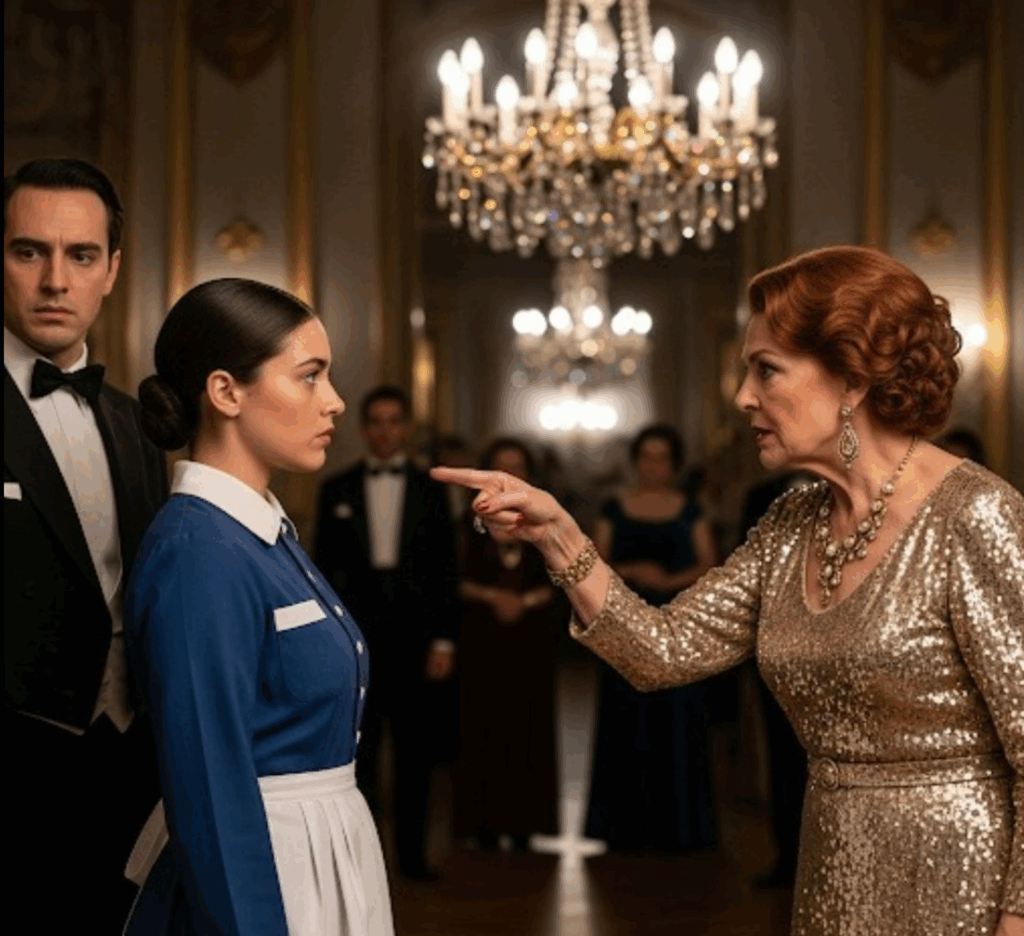
Kesha rose slowly, her face calm, her voice firm as she met William’s gaze: “I accept.”
The hall stirred with murmurs. Some were amused, others leaned forward with interest. No one knew the truth about this “cleaning woman.” For she was not merely Kesha Williams. She had once been Kesha Maro, the celebrated prima ballerina of the American National Ballet.
Fifteen years earlier, an accident had shattered her body and career. Doctors told her she would never dance again. The press declared her “dead to the stage.” But deep inside, she had never stopped being a dancer.
As William strutted among his guests, collecting bets on her humiliation, someone quietly approached Kesha. It was Marcus, the head of security, and once a stagehand at the National Theatre. He recognized her instantly.
“I saw you dance, Kesha Maro,” he whispered. “And I know—you can silence the world again.”Victoria was first to perform. Her waltz was polished, elegant, every step the product of expensive lessons. But it was empty. Artifice instead of art. The audience clapped politely.
Then came Kesha’s turn. She requested the same piece be played again. Closing her eyes, she let the music carry her back to the golden nights when crowds had risen to their feet in thunderous ovations.
And then, she began to dance. What the guests expected—stumbles, embarrassment—never came. Instead, she moved with flawless grace, every step precise, every gesture alive with emotion. Pirouettes, soaring leaps, a seamless fusion of ballet and waltz,
drawn not from lessons but from a lifetime of artistry. The hall, moments earlier buzzing with ridicule, fell into reverent silence. Victoria’s smile faltered, William’s smug expression dissolved. Kesha’s dance filled the room with a majesty that no wealth could purchase,
no cruelty could tarnish. When the music ended, she held her final pose like a queen reclaiming her throne.For a heartbeat, silence reigned. Then came a storm of applause. They had not seen a cleaner—they had witnessed a legend.
Marcus stepped forward and announced with proud clarity: “Ladies and gentlemen, allow me to reintroduce to you: Kesha Maro, former Prima Ballerina of the American National Ballet.”
The name hit like a thunderclap. Gasps rippled across the hall as memories returned—front pages, ovations, tragedy. Kesha simply nodded and spoke with quiet irony:“The rumors of my death were greatly exaggerated.”
William went pale. He had tried to humiliate one of America’s most celebrated artists before the entire elite—and it had all been captured on camera. Marcus had recorded it. Jonathan had too. William’s empire, his pride, his very name began to collapse before him.
Kesha reminded him of his own words, binding and public: if she outdanced Victoria, Jonathan would marry her. Marcus played the recording for all to hear.
William raged, called it “blackmail.” But Kesha’s voice cut through, steady as stone:“This is not blackmail. This is accountability.”Jonathan stepped forward, turning to Kesha.
“Miss Maro, if you allow me, I would gladly fulfill my father’s words.
Not from compulsion, but because it would be an honor to stand beside a woman of your talent and dignity.”
The hall buzzed with astonishment. William threatened to disown his son, but Jonathan stood firm:“There are things greater than money. Integrity, for one.”
Kesha, with dignity, refused the idea of a forced marriage. She declared that true unions are built on love and respect, not humiliation. Yet she accepted Jonathan’s invitation to dinner—as equals. Applause thundered again, this time for her strength as much as her art. William slunk away, shamed and furious.
The aftermath was swift. Marcus’s recording spread across the world within a day. Headlines blazed:“Billionaire Humiliates Legendary Dancer—and Loses Everything.”
William’s reputation was destroyed. Business partners withdrew, the board demanded his resignation, Victoria filed for divorce. Wealth, power, family—all slipped from his grasp.
For Kesha, however, new doors opened. Prestigious ballet companies sought her return for special performances. The Lincoln Center proposed a project. Hollywood reached out for her story. Yet the letter that moved her most came
from children at the small community school where she once taught before working as a cleaner. They had pooled together twenty-three dollars to beg her to come back. Tears welled in her eyes as she accepted. But she resolved to create something even greater.
Six months later, the Kesha Maro Arts Center opened in Manhattan, funded by donations from across the globe. It became a haven where children of every color and class could discover art and dance. Jonathan, now at the helm of the family business,
was its first major donor—reshaping the company around responsibility, not arrogance.At the opening, Marcus spoke to the crowd: “This was not just a triumph over prejudice. It was proof that true nobility answers cruelty with beauty.”
Kesha watched with quiet joy as children took their first ballet steps across the polished floor. “Sometimes we must lose everything,” she said softly, “to discover who we truly are. And sometimes others must lose everything, to realize who they never should have been.”
Jonathan arrived with flowers, and together they left the celebration—not as the conclusion of a cruel wager, but as the beginning of something new.
And so Kesha showed the world that true revenge is not in destroying an enemy, but in creating something beautiful, inspiring, and everlasting. By answering cruelty with brilliance, she transformed not only her own life, but the world around her.