When the lawyer knocked on Mark Sullivan’s door that gray, rain-swept afternoon, his first thought was that there had been some kind of mistake. The rain pattered against the windows in dull, steady beats, while the wind howled through the trees that bent around the house.
Mark had just set down a half-empty cup of coffee, its surface already cooled and bitter, when he frowned and stood, wondering who on earth would visit at such an hour. He had never dealt with lawyers before. Why would one suddenly appear at his doorstep?
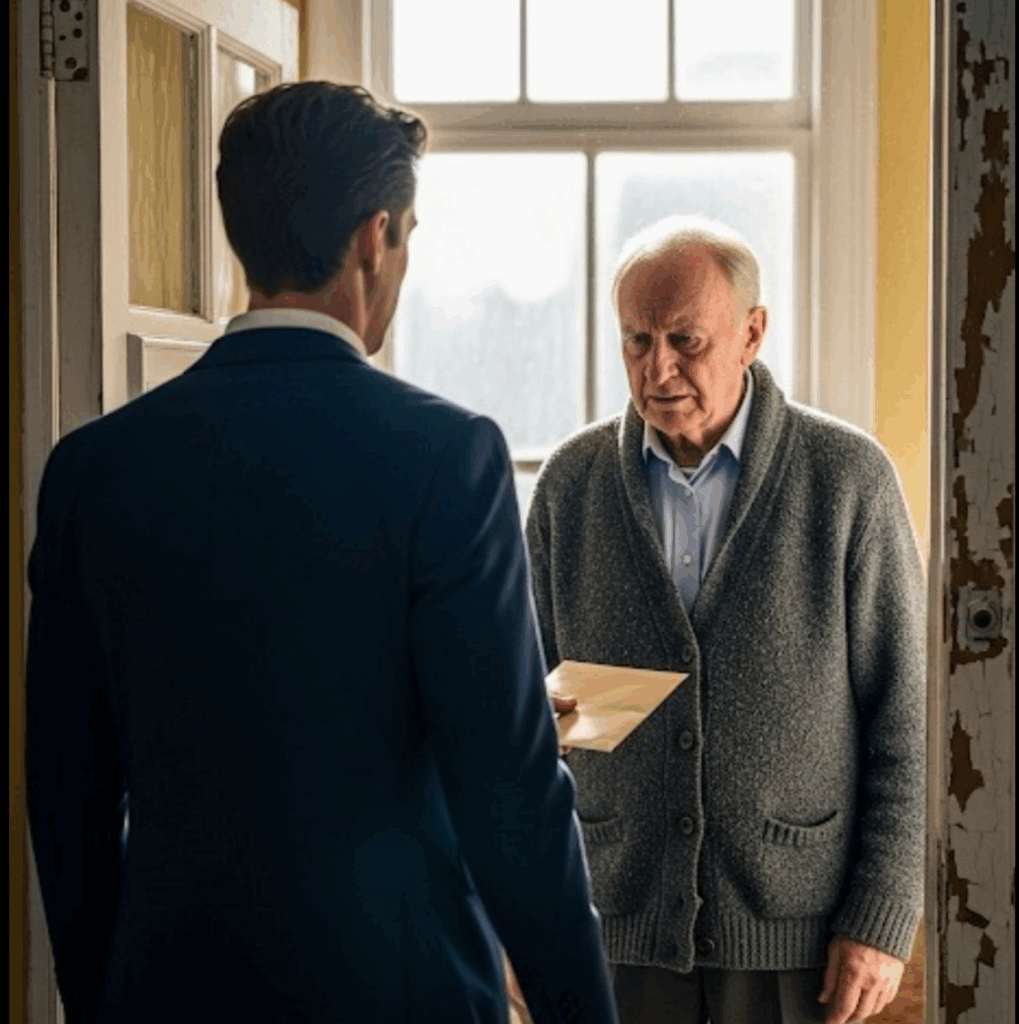
Yet when the man in the charcoal suit introduced himself, clutching his leather briefcase like something sacred, Mark felt his heart stumble in his chest.
“Mr. Sullivan,” the lawyer said in a calm, deliberate tone.
“I’ve come regarding the estate of your late father-in-law.” Mark froze. Estate? What estate?
For twenty years, his father-in-law, Walter Benson, had lived under his roof. Walter had moved in not long after Mark and Emily’s wedding. Back then, he was sixty-nine — still quick in step, sharp in mind, living on a modest pension.
It didn’t take long for Mark to notice that Walter never contributed to the household expenses. Not once did he offer money for groceries, not once did he cover utilities, not even for small, incidental costs. In the beginning, Mark brushed it off.
He had a good job in logistics, a steady income, and Emily always soothed him with her gentle smile.“Dad worked hard all his life,” she would remind him. “He doesn’t have much left. Let’s not make his old age a burden.”
Mark yielded — at least outwardly. But as the years stretched on, bills rose, food prices climbed, and Walter’s appetite showed no sign of shrinking. He loved hearty breakfasts, fresh fruit, good cuts of meat. Mark calculated once, silently,
that feeding Walter alone cost nearly two hundred dollars each month. Yet no one spoke of it.Life settled into a rhythm of its own: Walter seated at the kitchen table with his newspaper, Mark rushing out the door with his briefcase,
and Emily balancing the unspoken weight between them. Walter didn’t cook, but he kept his space tidy and filled the house with stories of his youth.
“Back in ’58,” he would begin, eyes gleaming, “I hitchhiked from Chicago all the way to Denver. Had nothing but two dollars and a pocketknife…”
Mark would listen, half-smiling, even while mentally ticking through the next grocery list.
As the years wound on, Walter’s health began its quiet decline. Arthritis crept into his joints, his breathing grew labored. By eighty-five, he needed regular doctor visits, and Mark often left work early to drive him. He told himself it was duty.
Emily bore the brunt of daily care without complaint, never once raising the matter of money. To her, it was not even a question.
One cold winter morning, Walter simply didn’t wake up. He slipped away quietly, peacefully — a faint smile on his lips, as though still clutching a memory from long ago.
The funeral was small, understated. A handful of relatives, a few old friends. Walter had never liked fuss. His life was much like an old, sturdy kitchen chair — worn but dependable, always there, until one day it simply wasn’t.
Mark assumed that was the end of it. Life would return to its familiar shape: one plate fewer at the table, one chair forever empty. But three weeks later, when the lawyer appeared, everything changed.
“Mr. Sullivan,” the man said gravely, “I am the executor of Walter Benson’s will.”Mark blinked. A will? Walter had never spoken of such a thing.“That happens often,” the lawyer replied with a faint, knowing smile. “But you should hear what he left you.”
Mark’s heart thudded. What could Walter possibly have left? An old watch? A few trinkets? Walter had worn the same threadbare sweater for years — what secret could he possibly have hidden away?The lawyer opened his case,
withdrew a neat stack of documents, and began to read. The dry legal words gave way to something startlingly human:“…to my son-in-law, Mark Sullivan, whose patience and generosity over the last twenty years did not go unnoticed…”
A strange warmth spread through Mark’s chest. The lawyer closed the folder. “Tomorrow, Mr. Sullivan, I’ll need you to accompany me to the bank. Your father-in-law’s estate is… substantial.”
That night, Mark hardly slept. He tossed in bed, questions whirling. Substantial? How could that be? Walter, who never contributed a dime? He rose at dawn, restless, his morning coffee left untouched when the lawyer, Robert Gaines, arrived promptly.
Same flawless suit, same polished shoes, same air of withheld secrets.The ride to the bank was short, yet every second dragged beneath the weight of silence. Robert spoke lightly of the weather, but Mark’s mind circled one phrase over and over: “Not small.”
Inside a private bank office, a manager awaited them. On the desk sat a solid, steel box.
“This safe deposit box has been here for more than thirty years,” Robert explained. “Mr. Benson prepaid its fee every single year. Never missed one. ”Mark’s brow furrowed. Thirty years? The key turned, the lock clicked. The lid lifted slowly.
Inside lay carefully bound envelopes, stacked neatly, with a handwritten letter resting on top.Mark’s hands trembled as he opened it. Walter’s strong, slightly slanted script stared back at him: Mark, If you are reading this, I am no longer in this world.
I know you must have wondered — perhaps even resented — why I never paid for groceries or bills. The truth is, I could have. But I didn’t. I saved. Not for myself — for you. I learned that real help doesn’t always come in small, passing bills; sometimes it must be hidden away for years, until the moment it can truly change something.
For twenty years, you gave me a home, patience, and kindness. Now it is my turn to give back. Tears blurred Mark’s vision. The first envelope burst open with thick stacks of hundred-dollar bills. Beneath them, savings bonds, certificates, investment papers.
“The preliminary estimate,” the bank manager said, “with accrued interest, comes to over two hundred and sixty thousand dollars.”Mark’s breath caught. Two hundred and sixty thousand. Twenty years of silent saving.
“Every month,” Robert added gently, “he set aside what he believed you were spending on him. He didn’t return it immediately — he invested it carefully. He wanted it to come back to you in full, with interest, when it could mean the most.”
That evening, Mark shared everything with Emily. At first, she shook her head in disbelief, then, as she held Walter’s letter in her hands, tears welled in her eyes.
“Oh, Dad…” she whispered, covering her mouth with her hand.
They spoke for hours about Walter’s quirks — the way he folded napkins into perfect squares, double-checked locks before bed, the old jazz records he played on repeat. And finally, about what to do with the money.
The decision came easily: part would go into Sophie’s college fund, part to pay off the mortgage, and maybe — just maybe — enough for a long-delayed family trip.
For the first time in years, Mark felt a deep, quiet peace. For two decades, he had carried what he thought was a one-sided burden. Now he understood: Walter, too, had carried something — not debt, but intention.
And that Sunday afternoon, as Mark sat at the kitchen table with a fresh cup of coffee, he looked at the empty chair across from him. It no longer felt quite so empty. For he knew now that the man who had shared his table for twenty years had,
all along, been feeding something else — a future, built in silence, with patience, and with love.