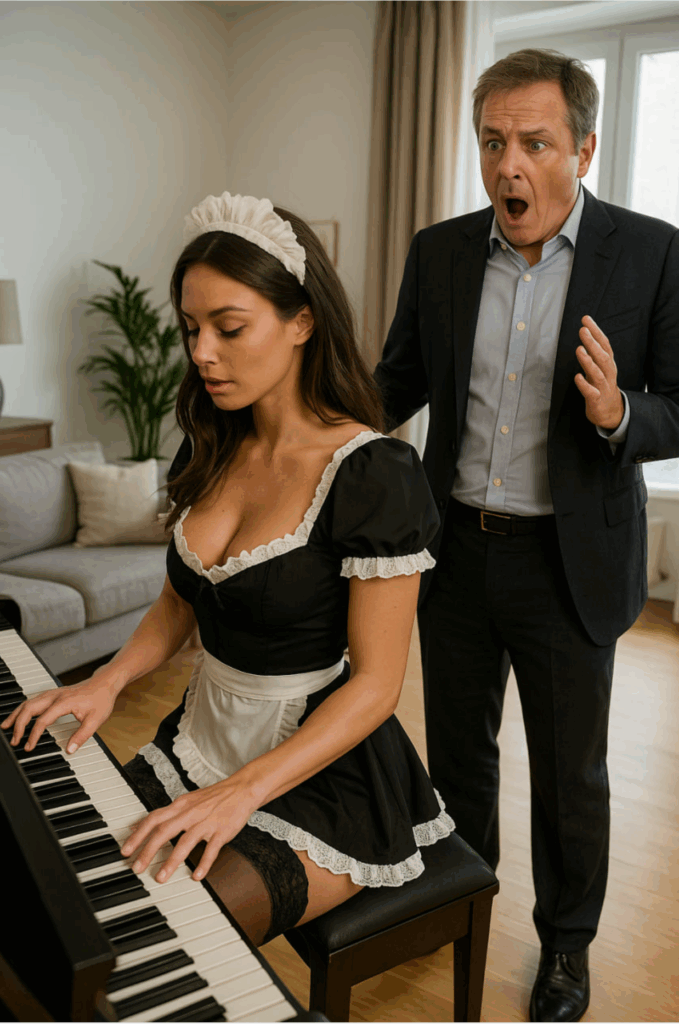
The grand hall was still wrapped in silence, as though time itself had paused, suspended above the piano. Slowly, Léna let her hands fall into her lap, the movement so delicate and fragile it seemed to sanctify the hush around her.
The faces of the distinguished guests changed in that instant: moments ago they had worn mocking smiles, now they glanced at one another with unease, as if suddenly forced to confront the weight of their own conscience.
Viktor sat rigid in his chair, feeling the tremor that shook the glass in his hand. The liquid rippled with every faint vibration, mirroring the storm rising within him. For years, he had never been left speechless, never at a loss for words
—yet now something heavy stirred in his chest. The melody had torn open the sealed doors of memory. It brought back the image of his mother, delicate and luminous, who had once played the piano at twilight.
Before her death, the last thing he had heard from her was Chopin—those very same notes that now poured from Léna’s fingers.
“Who taught you to play like this?” he asked at last, his voice low and unsteady. Though it was little more than a whisper, the silence in the hall carried it clearly to every ear.
Léna lifted her gaze slowly. The fear that had once haunted her eyes was gone; what remained was a deep, serene calm. “No one,” she said softly, though her words rang out with the clarity of a bell. “Music was my only home. But that home was taken from me.”
“Taken?” Viktor narrowed his eyes. “What do you mean?” The guests leaned forward, tense. What had begun as mere amusement was no longer entertainment—it had become a confession, almost a sacred revelation.
“My mother was a pianist in a small theater,” Léna continued, each word falling like a stone into the heavy stillness. “A wealthy man, who claimed to love music but was cruel at heart, shut the place down. He sold the instruments, and cast us into the street.
My mother soon died, from grief and from want. I was left alone. I have not touched a piano since… not until now, when I saw this Steinway.”
Viktor’s face drained of color. A cold realization surged through him as he recalled his father’s boastful laughter—how he had “put an end to the foolish whims of an insignificant troupe.” In that instant, he understood:
it was his family that had destroyed this girl’s life, his lineage that had shattered her world.He slowly set down his glass. In his chest, something stirred that he had not felt in years—shame.
“Léna…” His voice was almost a whisper. “I didn’t know.”
But the girl did not ask for his apology. There was no accusation in her eyes, no hatred—only the pure, steady weight of truth.
“Now you do,” she replied simply. And those three words struck with more force than any cry of anger could have.
The guests murmured nervously among themselves, but Viktor no longer cared. His gaze lingered on her, and on the polished body of the piano that shimmered in the candlelight. He knew a choice had to be made, one that would change everything.
At last, he spoke, slowly, deliberately: “This house is as much yours as it is mine. If you wish… stay. Play. Let music live again within these walls.”
Léna gave the faintest nod. In that moment, the barriers of class and wealth dissolved. There was no longer master and servant, no longer rich and poor. Only two human beings, bound together by the same melody, the same wound, the same healing power of music.
And when her fingers touched the keys once more, no one dared to laugh. The music held them all captive, wrapped around every heart in the hall. It was more than sound, more than song—what they heard was life itself, speaking through her hands.