
“And what exactly gives you the right to register your daughter and grandson at MY apartment?!” the wife demanded angrily when she discovered that her husband had already promised her consent without even asking her.
“Zhanna, please, don’t get upset right away! Mom will be here any minute. She just wants to ask us for a small favor.”
Zhanna was standing in front of the hallway mirror, fastening her earrings. At the sound of her husband’s voice, her hand froze. She looked at Kirill through the mirror.
“What do you mean, don’t get upset? I don’t even know what this is about.”
“That’s exactly why I’m telling you in advance. Just hear her out, okay?”
“Kirill, whenever you start a conversation like that, it always turns out that someone has already made a decision on my behalf.”
“Nobody has decided anything,” he replied too quickly.
His answer came so fast that Zhanna immediately sensed something was wrong.
It was Saturday morning. They had planned to enjoy a quiet breakfast, then go shopping for a new living room lamp and finally organize the top shelf of their wardrobe. There had been no mention of a family visit.
Ten minutes later, the doorbell rang.
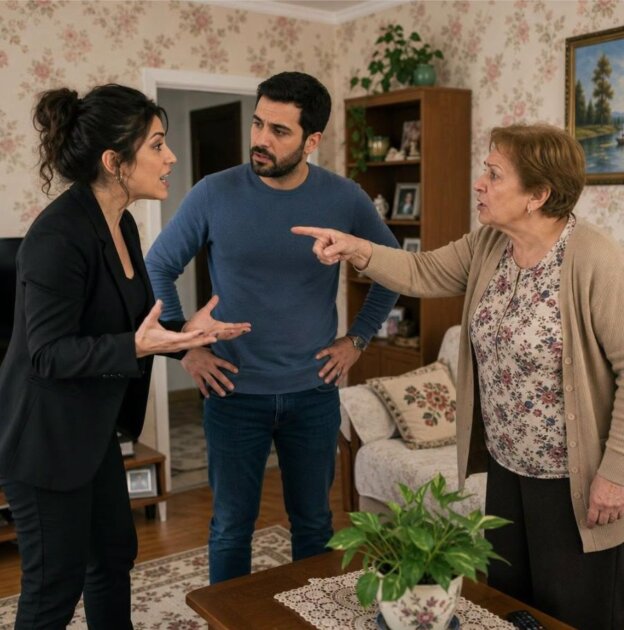
Kirill’s mother, Anna Sergeyevna, walked in with such confidence that anyone would have thought her visit had been arranged in advance. She took off her coat, sat down on the hallway bench, and placed a thick folder of documents beside her.
Zhanna immediately noticed the papers but decided not to ask anything just yet.
“Well, children, we have a little matter to discuss,” her mother-in-law began. “Nothing serious, just a temporary arrangement. There’s really no need to overthink it.”
“If it’s so simple, why did you need to come here personally?” Zhanna asked.
Kirill shot his wife an irritated look.
“Zhanna, don’t start!”
“I only asked a question.”
Anna Sergeyevna opened the folder.
“Sveta needs a permanent registered address in the city. Both she and Artyom. At least for a year, preferably three. You have a spacious apartment in a good neighborhood, and there’s an excellent school nearby. It would make things so much easier for the boy.”
Zhanna stared at her for several seconds.
“Wait a minute. Where exactly do you want to register them?”
“Well, at your place, of course.”
“At our place?”
“Yes. Kirill said it wouldn’t be a problem.”
Zhanna slowly turned toward her husband.
“What did you say?”
Kirill awkwardly scratched the back of his neck.
“I said we’d discuss it.”
“Don’t twist the story!” his mother interrupted. “You said, ‘Mom, Zhanna will sign the papers. It’s no big deal.’ I even asked you specifically whether you were sure, because Sveta needs to submit the documents soon.”
“Mom, you didn’t have to put it like that…”
“Then how should I put it? I’m telling her exactly what happened.”
Zhanna fell silent. Suddenly, everything became clear.
This apartment wasn’t an inheritance or a gift from her parents. She had bought it herself at the age of thirty-one, after years of hard work and saving.
First, she had purchased a tiny studio on the outskirts of the city, then sold it later at a small profit. After that, she spent another three years saving money, took out a mortgage for the remaining amount, and went without almost everything other people considered normal: vacations, expensive clothes, weekend getaways.
By the time she met Kirill, she already owned the apartment. And before they got married, she had paid off the mortgage in full.
Kirill had moved in with her. Zhanna had never made him feel like a guest in his own home. She had never thrown the fact that she owned the apartment in his face during an argument. She had never demanded gratitude for allowing him to live there, nor had she ever used her ownership as a way to establish superiority.
She had simply treated it as their shared home.
But now it had become painfully obvious that someone had interpreted her generosity as permission for her husband’s family to use her property whenever it suited them.
“And what exactly gives you the right to register your daughter and grandson at MY apartment? Just because it’s convenient for you?! No! And don’t tell me it’s just some insignificant stamp on a piece of paper! If you want to help her, register her at your own address! But nobody gets to make decisions about my home behind my back!”
Anna Sergeyevna recoiled as if she had been slapped.
“Is this how you treat me? I came here with good intentions!”
“Good intentions begin with asking someone first. Not showing up with completed paperwork after your son has already promised my signature.”
“Nobody is trying to take your apartment away!”
“I never said that.”
“Then what’s your problem?”
“My answer is no.”
“Just because you enjoy making things difficult?”
“Because this is my apartment, and I’m the one who decides what happens here.”
Kirill finally spoke.
“Zhanna, seriously? Are you deliberately making such a huge issue out of this? Sveta isn’t trying to take your apartment. She just needs an address so she can enroll Artyom in a decent school and sort out his city registration.”
“Then register them at your mother’s apartment!”
Anna Sergeyevna immediately grimaced.
“I live on the other side of the city. Besides, my apartment is small.”
“But you still have an address.”
“Yes, but why should the child have to travel across the entire city every day when there’s a good school just seven minutes from your place?”
“Because she’s your daughter, he’s your grandson, and they’re your family. I’d simply like to know how I became an automatic participant in all this.”
“You’re Kirill’s wife. That makes them your family too!”
“Being family doesn’t mean you can freely distribute someone else’s property among yourselves.”
“Here we go again with this ‘my apartment’ nonsense!” Kirill snapped. “We’ve been living together for five years! Am I a stranger in this apartment?”
“Are we talking about where you live, or about registering your sister?”
“We’re talking about how you behave as if we’re asking you to hand over the entire apartment!”
“And I’m asking you not to promise other people my consent!”
What hurt Zhanna most wasn’t actually Anna Sergeyevna’s request. Sveta really was going through a difficult time. She was divorced, had been staying with a friend in the suburbs for a while, and wanted to find a job in the city. Her nine-year-old son, Artyom, also needed to change schools, so time was becoming an issue.
Zhanna might even have been willing to listen to her request. Perhaps she would still have said no, but at least they could have discussed it like normal adults.
But now this was no longer a request. It was a ready-made plan in which her signature was treated as nothing more than an insignificant final formality.
Anna Sergeyevna spent at least another twenty minutes explaining that registering an address involved no obligations, that children deserved help, and that Zhanna was being unnecessarily suspicious. According to her, “normal people don’t cling so desperately to a few square meters.”
Zhanna’s answers became shorter and shorter.
“No.”
“But at least think about it!”
“No.”
“What has Sveta ever done to you?”
“Nothing. That’s precisely why I’m not talking about her. I’m talking about your request.”
“This isn’t even a request anymore. It’s some kind of test of your humanity! You’re behaving as if you have no heart!”
“Then I guess I’ve failed the test. As far as I’m concerned, this conversation is over.”
Anna Sergeyevna finally stood up, her face so red that Zhanna thought she might explode with anger.
“You’re greedy, Zhanna! And completely insensitive! Two people live in a huge apartment, yet you aren’t even willing to help a child!”
“Artyom isn’t my child.”
“There! That tells me exactly what kind of person you are!”
“He’s your grandson, though. So I’ll say it one more time: register him at your own apartment!”
“Kirill, I’ve said everything I needed to say. Now it’s up to you to deal with your wife!”
Zhanna calmly looked her mother-in-law in the eyes.
“Just don’t forget that she won’t be dealing with the apartment. She’ll be dealing with me.”
After Anna Sergeyevna slammed the door behind her, Kirill remained silent for a long time. Then he started picking up random little things from the hallway bench, even though there was practically nothing there.
“You really shouldn’t have treated her like that,” he finally said.
Zhanna let out a disbelieving laugh.
“Are you serious?”
“You could have refused politely.”
“I refused politely during the first three minutes. Then I had to listen for another twenty-five minutes about why I supposedly had no right to say no.”
“You kept bringing up the apartment.”
“Because the apartment was exactly what we were talking about!”
“But we’re still husband and wife.”
“And?”
“In a marriage, people shouldn’t constantly distinguish between what’s ‘mine’ and what’s ‘yours.'”
Zhanna looked at him for a long moment.
“Wonderful. Then tomorrow I’ll call your mother and tell her we’ve decided to sell her vacation house. Sveta needs the money more than she does.”
“What does my mother’s vacation house have to do with anything?”
“Why was your first reaction to say it was hers?”
Kirill understood what she meant and turned away irritably.
“Stop twisting everything!”
“I’m not twisting anything. It’s just easy to make decisions about someone else’s property when that property happens to belong to me.”
That evening, they barely spoke to each other.
The following day, during dinner, Kirill brought up the subject again.
“I spoke to Mom. She admitted that maybe she went a little too far yesterday.”
“I see.”
“But Sveta really is having a difficult time.”
Zhanna put down her fork.
“Kirill, my answer is no.”
“You haven’t even heard me out!”
“Because I’ll tell you exactly what I told you yesterday.”
“What about just six months?”
“No.”
“Artyom hasn’t done anything wrong!”
“I know that.”
“Then why should he have to suffer?”
“And why should my apartment be responsible for solving their problems?”
“Because we can help!”
“You can help. You have a salary, a car, free time, and plenty of acquaintances. Help her yourself!”
Kirill leaned back in his chair, offended.
“So we’re not a team anymore?”
“We aren’t a team when it comes to decisions you’ve already made without me.”
From that point on, the subject returned almost every day. Sometimes Kirill approached it gently. Other times, he became increasingly irritated.
He tried one argument after another.
There was a good school nearby.
The commute was inconvenient for Sveta.
The boy needed a stable registered address.
His mother was so worried she couldn’t sleep.
His sister was offended and believed Zhanna hated her.
But Zhanna always gave the same answer:
“I do not agree.”
A week later, Kirill tried a different approach.
“Do you know what Sveta thinks now? She thinks I have absolutely no say in this marriage.”
“And does it bother you more what your sister thinks, or the fact that you really can’t make decisions about my apartment without asking me?”
“Here you go again!”
“Yes. Here I go again.”
“I’ve lived here for five years, and I contribute to our life together!”
“To the utilities and groceries?”
“Not just those!”
“We assembled the bedroom wardrobe together. You bought the television. I’ve never denied any of that. But it doesn’t make the apartment yours.”
“I’m not asking for ownership!”
“Then why does it bother you so much that I get to decide who is registered at my address?”
Kirill didn’t answer.
Zhanna was slowly beginning to understand that, for her husband, this had long since stopped being merely about Sveta.
Kirill was hurt by the rejection itself. As long as the apartment was simply the place where they shared their lives, everything had been fine. But the moment his own family needed to use it, he suddenly found it insulting that his wife had the right to make the decision.
One evening, he even accused her of being too attached to four walls.
“People should be attached to their families, not to bricks,” he said.
“And does being family mean I have to agree with your mother about everything?”
“Family sometimes requires compromise.”
“Interesting. Why am I always the one expected to compromise?”
“Because this wouldn’t cost you anything.”
“Then you compromise! Register your sister at your own apartment!”
“I don’t own an apartment!”
“Exactly.”
Kirill stood up, went into the other room, and didn’t speak to her again until nearly midnight.
Anna Sergeyevna didn’t give up either. Although she had stopped calling Zhanna directly, she phoned her son regularly. Sometimes Kirill went out onto the balcony to talk. Other times, he stayed inside, and Zhanna couldn’t help overhearing fragments of their conversations.
“Mom, I’m talking to her.”
“No, I haven’t managed to convince her yet.”
“I told you, stop putting pressure on me!”
“Then what exactly am I supposed to do?”
After calls like these, Kirill almost always returned looking irritated.
One time, Zhanna asked him:
“Does your mother still want you to put me in my place?”
Kirill looked at her sharply.
“Have you been eavesdropping?”
“No. You speak so loudly on the phone that even the neighbors can hear you.”
“Mom is just worried about Sveta.”
“And you?”
“What about me?”
“Do you also agree with her that I need to be put in my place?”
“Don’t start!”
“I’m not starting anything. I asked you a question.”
“No, of course I don’t agree with her.”
But he said it so uncertainly that Zhanna didn’t really believe him.
On the ninth day, Svetlana herself called. Until then, she hadn’t contacted Zhanna at all, and Zhanna had hoped her sister-in-law would at least feel as uncomfortable about the situation as it actually was.
“Hi, Zhanna! Can you talk?”
“Yes.”
“I don’t want to argue, honestly. I just want to understand why you’re so firmly against this.”
Zhanna closed her laptop and leaned back in her chair.
“Svetlana, I have nothing against you personally. My problem is that Kirill promised you my consent before even discussing the matter with me. Then your mother showed up with a whole folder of documents and a ready-made plan.”
There was silence on the other end of the line.
“He told me you’d already discussed everything.”
“No. He told you that. He never discussed a single thing with me.”
“I didn’t know that.”
“Now you do.”
“But even if we put that aside… would you still say no?”
“Yes.”
“Why?”
“Because I don’t want two more people registered at my apartment.”
“But we aren’t even planning to live there!”
“Perhaps not today. But circumstances can change tomorrow. I simply don’t want to get involved in all of this.”
Svetlana’s voice immediately changed.
“So you think I’m some kind of fraud?”
“I never said anything like that.”
“But that’s practically what you’re implying!”
“No. I’m saying that I’m not obligated to take responsibility for other people’s living arrangements through my own property just because my address happens to be convenient for them.”
“But I’m your husband’s sister!”
“Yes. But that doesn’t make my apartment any less mine.”
“Mom was right. You cling to that apartment as if it’s the only thing you have in your life.”
“Because I worked hard to earn it.”
“And what about Kirill? Does he count for nothing?”
“Why do you keep turning this into something else? Kirill is my husband. But that doesn’t mean he can promise other people my consent.”
Svetlana sighed irritably.
“Fine. I understand. I’m just sorry things turned out this way.”
“I’m sorry too. Especially because if you’d asked me properly in the first place, we might never have had an argument at all.”
“But your answer would still have been no?”
“Yes.”
After the conversation, Zhanna sat in the kitchen for another ten minutes, staring at her switched-off phone.
She felt terrible knowing that, by now, the entire family saw her as the woman who had refused to help.
Nobody asked why Anna Sergeyevna didn’t want to register her own daughter at her address. Nobody discussed why Svetlana couldn’t look for another solution. And nobody questioned why Kirill had promised someone else’s signature.
Only one thing seemed to matter: Zhanna owned an apartment, so the family believed she was obligated to make it available to them.
That evening, Kirill already knew about the phone call.
“Sveta cried because of you.”
“She didn’t cry in front of me.”
“But she did afterward.”
“And what exactly are you trying to achieve by telling me that?”
“You could try being a little kinder sometimes.”
“Kirill, for an entire week you’ve been trying to convince me that I’m the one at fault because your sister didn’t get something I never promised her in the first place.”
“She’s still part of our family!”
“And I’m not a free address-registration service.”
“You’re turning everything into some official formality again!”
“No. You chose my apartment as the most convenient solution, and now you’re trying to convince me that I have an obligation to share it with you.”
“I just want things to be normal between everyone in the family.”
“Then start by never promising your relatives that I’ll automatically agree to something.”
Kirill went to change his clothes. Half an hour later, he returned looking somewhat calmer.
“I really thought you wouldn’t mind.”
“Why did you think that?”
“Because you’ve always helped before.”
“Do you honestly think lending my car to your mother for one day is the same as registering two people at my apartment?”
“No.”
“Then why didn’t you ask me?”
Kirill shrugged.
“I don’t know. I thought it was just a small thing.”
For the first time in several days, Zhanna saw something in his expression that suggested he might actually be reflecting on his own behavior rather than simply trying to persuade his wife.
But it didn’t last long.
Two days later, Anna Sergeyevna called her son again. Kirill was putting his phone on the charger when he accidentally switched on the speakerphone.
“Are you even talking to her anymore?” his mother demanded. “Or did she say no and you immediately backed down?”
Kirill quickly switched off the speakerphone, but it was already too late.
“Mom, I’ll call you back.”
“No, not later! Answer me now! Are you the man of that household, or are you just a tenant?”
Kirill ended the call.
Zhanna was standing beside the table, looking straight at her husband.
“Now I understand where all those comments about you being nobody in this apartment are coming from.”
“Don’t start!”
“Does your mother fill your head with this every day?”
“She’s just worried about Sveta.”
“No, Kirill. She’s telling you that if you can’t control my apartment, then you’re not a real man.”
“Zhanna…”
“And you’re bringing that idea home and trying to prove your authority through me.”
“I’m not trying to prove anything!”
“Yesterday you asked why you couldn’t make any decisions in this family. For five years, that question never seemed to bother you.”
Kirill sat down on the kitchen bar stool.
“It’s just a terrible feeling knowing that you can throw ‘This is my apartment’ in my face whenever you want.”
“I only say it when you try to decide who gets to live here or who gets registered at my address.”
“Even so, it feels awful.”
“Then perhaps the apartment isn’t really the problem. Maybe it’s what your mother has been telling you, and now you’re trying to prove to her that you have authority in this household.”
Kirill suddenly stood up.
“Stop analyzing me all the time!”
“I’m not analyzing you. I’m simply tired of someone else’s request turning into a test of your masculinity and proof of my supposed family obligations.”
After that, they didn’t discuss the registration issue for two whole days.
Zhanna began to believe that her husband had finally understood how far things had gone. But Kirill hadn’t actually abandoned the plan. He had simply started looking for another solution.
Almost three weeks passed. At home, everything seemed to have returned to normal. Kirill didn’t mention Sveta for several days, and Zhanna began to think the whole matter had finally been put behind them.
Then, one Saturday, they went grocery shopping.
On the way home, Kirill received a message. He read it and quickly slipped his phone into his pocket.
“Was that Sveta?” Zhanna asked.
“Yes.”
“What does she want?”
“Nothing.”
“Then why do you look like someone who’s about to explain something unpleasant?”
“Zhanna, we’ll talk about it when we get home.”
“No. Tell me now!”
Kirill remained silent for a moment before finally speaking.
“I offered her another possibility.”
Zhanna already had a bad feeling.
“What possibility?”
“That she could stay with us for a while. With Artyom.”
Zhanna slowly turned her head toward him.
“What?”
“Just temporarily. The second room is empty anyway.”
Their apartment did indeed have a smaller second bedroom, which Zhanna used as a home office and guest room. It contained her desk, bookshelves, and a pull-out sofa. Kirill, however, always spoke about it as if it were a completely unused room.
“So you offered your sister the opportunity to move into my apartment?”
“Into our apartment!”
“Don’t start playing word games again!”
“I thought that if you lived with her for a little while, you’d see that Sveta wasn’t bothering anyone. Then perhaps we could calmly discuss the registration issue again.”
Zhanna stared at her husband in silence for several seconds. Eventually, Kirill lowered his eyes.
“So your plan was to move them in first, let me get used to having them around, and then start pressuring me again to register them?”
“I never said I’d pressure you.”
“Then what exactly did you tell Sveta?”
“That I’d talk to you.”
“After everything that happened last time, you still haven’t learned anything?”
“I didn’t promise her you’d agree!”
“No. You simply offered her my home as temporary accommodation.”
“Here you go again with this ‘my home’ business!”
“Yes, Kirill. Mine. And right now, it’s particularly important that you understand that.”
“You’re just being stubborn!”
“No. I’m going to explain something very clearly. If your sister shows up at this apartment with her child and suitcases, I won’t be the first person I ask to leave. It’ll be you. Because that would mean you’ve once again decided to present me with a fait accompli.”
Kirill gave a disbelieving smile.
“You’d really throw me out because of my own sister?”
“Not because of your sister. Because of you.”
“Don’t be ridiculous!”
“I’m not joking.”
He tried to argue for a few more minutes, but Zhanna didn’t raise her voice.
“Call Sveta right now and tell her that moving in here is not an option.”
“I’ll take care of it.”
“Fine. But if she shows up at this door anyway, you’ll be packing your bags along with her.”
That evening, Kirill really did call his sister. The conversation was clearly uncomfortable.
Zhanna wasn’t eavesdropping, but she still caught a few sentences.
“No, Sveta, that’s not going to work.”
Then:
“Because it isn’t.”
And finally:
“Mom can call me if she wants something.”
Anna Sergeyevna called within five minutes.
This time, Kirill went out onto the balcony and closed the door behind him.
When he returned, he sat down beside his wife with a gloomy expression.
“Well?” Zhanna asked.
“Nothing.”
“Did you manage to put me in my place?”
“Very funny.”
“I’m not laughing.”
“Mom thinks I’m turning the family against you.”
“And what do you think?”
Kirill sat down opposite her.
“I think we could have sorted this out right at the beginning. We could simply have helped them, and none of this would have happened.”
Zhanna nodded.
“Then you still haven’t understood.”
“What am I supposed to understand? That the apartment belongs to you? I’ve already learned that.”
“No. You need to understand that you cannot promise another adult’s consent. Even if that adult happens to be your wife.”
Kirill said nothing.
After the argument about moving in, those conversations finally stopped. Kirill no longer suggested that Sveta could stay with them, even for a few weeks. He stopped trying to take Zhanna somewhere to sign documents. The words “address registration” almost completely disappeared from their home.
But the problem wasn’t entirely resolved.
Anna Sergeyevna continued calling her son regularly for a long time. Eventually, she found another solution for Sveta through a more distant relative, but that didn’t make her any less offended.
In her eyes, Zhanna would forever remain the woman who had refused to help her husband’s family, despite living in a three-bedroom apartment with more than enough space for two additional people.
Svetlana also behaved coldly toward her. At family gatherings, she greeted her, answered questions when necessary, and then immediately turned to someone else.
Zhanna made no effort to repair their relationship. She didn’t feel guilty, and she had no intention of explaining the same refusal over and over again.
During the first few months, Kirill occasionally made indirect comments about the whole affair.
“By the way, Sveta now has to travel an hour and twenty minutes just to get to work.”
“I see.”
“And Artyom didn’t get into the school he wanted.”
“These things happen.”
“Does none of this matter to you at all?”
“Of course it matters. I feel sorry for them. But that doesn’t change my decision.”
Eventually, Kirill stopped making those remarks.
But Zhanna had changed.
Previously, she had treated Kirill’s family matters as their shared responsibilities almost automatically. If her mother-in-law needed help with shopping, Zhanna helped. If Sveta needed a ride to the car repair shop, Zhanna drove her. If someone needed to borrow her car for a day, she lent it. If they needed to buy a family gift, she naturally assumed she would contribute.
After what had happened with the apartment, however, she began asking herself a question every time: What exactly are they expecting from me, and why does anyone think it’s automatically my responsibility?
Kirill didn’t like this at all.
“Now you examine every little thing separately,” he remarked one day.
“Yes.”
“Because of one incident?”
“Because in that one incident, you made decisions on my behalf twice.”
Kirill wanted to say something, but eventually remained silent.
What bothered him most wasn’t even the fact that Zhanna hadn’t registered Sveta and Artyom. It was that after everything that had happened, the word “family” no longer worked like a magic spell on his wife.
If Anna Sergeyevna needed help, Kirill first had to decide for himself whether he could provide it.
If Sveta needed something, he no longer said, “We’ll help her.” Instead, he said, “I’ll see what I can do.”
Zhanna didn’t forbid him from supporting his relatives. She didn’t monitor his money or demand that he cut off contact with them.
She simply refused to let them automatically involve her and her property in other people’s plans.
A few weeks after the argument about moving in, Kirill finally stood up for his wife against his mother for the first time.
They were having dinner when Anna Sergeyevna called. Within seconds, she had already started talking about Zhanna.
“Kirill, how much longer are you going to let your wife behave like this? Why do you allow her to dictate everything to you?”
“Mom, enough! We’ve already settled this.”
“Nothing has been settled! You’ve simply backed down!”
“No, Mom. It’s just that the apartment isn’t jointly owned by us.”
Kirill said the words firmly, although it was clearly difficult for him.
“You’re the husband! You’ve lived in that apartment for five years!”
“And?”
“You should at least have the right to have a say in what happens there!”
“I do have a say. But I don’t have the right to sign anything on Zhanna’s behalf.”
Zhanna lowered her head toward her plate and continued eating. She didn’t want to interrupt, nor did she want to turn this rare moment into another argument.
But Anna Sergeyevna wasn’t ready to calm down.
“So you’ve completely abandoned your own sister?”
“Sveta has already found another address. What more do you want?”
“She had to go through other people to solve this! She had to ask for help and humiliate herself!”
“Mom, Svetlana is an adult woman.”
“Of course! And your wife is apparently the most independent and stubborn woman in the world!”
“I’ll call you back later.”
“Don’t bother! We have nothing left to talk about!”
Kirill ended the call.
He sat silently for several seconds.
“Thank you,” Zhanna said.
“For what?”
“For finally not promising her another way to convince me.”
“I never promised anything like that before.”
Zhanna looked up at him.
“Kirill…”
“All right, fine. I did.”
The admission sounded surprisingly ordinary, without any dramatic apology or elaborate explanation. Perhaps that was exactly why Zhanna believed him more than she had believed all his promises over the previous weeks.
However, their relationship never returned to the way it had been before.
Before the argument, it had seemed completely natural for them to discuss everything together: whom to help, what to buy their parents, where to spend the holidays, and whom to meet on weekends.
Now Zhanna found herself waiting for Kirill to clarify whether he had already promised something without consulting her.
He noticed this and became increasingly annoyed.
“Do I now have to prove before every conversation that I haven’t made a decision without you?”
“For now, yes.”
“And how long is this going to last?”
“I don’t know.”
“Well, that’s convenient for you!”
“It’s not convenient for me either. But you’re the one who caused this.”
Kirill would get offended. Sometimes he went into the other room. Other times, he argued that his wife was incapable of moving on from a single mistake.
Zhanna didn’t argue about how much time should pass. There was only one thing that mattered to her: the same mistake must never happen again.
On one occasion, Svetlana visited her mother, and Anna Sergeyevna organized a family lunch.
Kirill was getting ready to go alone. Zhanna had already refused the invitation as soon as it was mentioned.
“Mom promised she wouldn’t bring up the apartment.”
“All right.”
“Then why aren’t you coming?”
“Because I don’t want to spend three hours sitting at a table, wondering when the subject will come up again.”
“You’re completely distancing yourself from my family.”
“Possibly.”
“Doesn’t that bother you at all?”
“What bothered me was your mother showing up at my door with completed documents. What bothered me even more was you spending three weeks pressuring me afterward. And then I found out you’d even offered your sister the opportunity to move in. After all that, I have every right not to want to attend a family lunch.”
Kirill eventually left alone.
He returned that evening looking gloomy. Zhanna didn’t ask any questions, but he started talking on his own.
“Mom thinks you’re deliberately destroying our family relationships.”
“I see.”
“Sveta said she’ll never ask us for anything again.”
“That at least makes things simpler.”
“Why do you always have to make comments like that?”
“What would you like me to say? Should I beg her to keep asking us for things?”
Kirill irritably threw his keys onto the hallway cabinet.
“Sometimes it’s simply impossible to talk to you!”
“Other times, we don’t need to discuss things we’ve already settled.”
After that, Kirill really did start bringing home his mother’s complaints less frequently. Probably not because he completely agreed with his wife, but because he finally realized that by acting as a messenger between his mother and Zhanna, he was primarily hurting himself.
Several months later, Anna Sergeyevna brought up the apartment again. This time, however, she wasn’t talking about address registration.
She told her son that, in the long run, perhaps the most sensible solution would be for Zhanna to transfer a small share of the apartment into her husband’s name. That way, Kirill would feel more secure in the marriage.
Kirill didn’t discuss this with his wife.
Zhanna found out accidentally when her husband was talking to his mother in the kitchen, believing that his wife was in the bathroom.
“Mom, no. Don’t even start! After everything that happened, I don’t want to discuss this.”
Zhanna stopped in the hallway but didn’t listen any further.
In some ways, Kirill had finally begun to understand the situation. Not in the way Zhanna would have wanted, not immediately, and not without resentment. But at least he had understood the practical reality: if he tried to make decisions about his wife’s apartment one more time, he might actually find himself standing outside the front door.
Anna Sergeyevna, however, never accepted this.
She continued to believe that her son was merely a tolerated resident in his own marriage and that he had no real security. Yet before the scandal, she had never said anything like that during the five entire years he had lived there. Now, however, it was convenient for her to use the apartment as proof that her daughter-in-law supposedly had too much power over her husband.
And Kirill found himself caught between two simple facts.
His mother wanted him to finally put his wife in her place.
His wife had made it perfectly clear where he would find himself if he ever tried to move someone into the apartment again without first asking for her consent.
So Kirill stopped bringing up the apartment issue openly.
And perhaps that was what annoyed Anna Sergeyevna most of all: not so much Zhanna’s firm refusal, but the fact that her son had finally stopped making promises about something that had never belonged to him in the first place…

