She Was One of the Most Beloved Stars in the World, But Then She Fell in Love With a Married Man, Left Everything for Him, and Became Public Enemy Number One in America. Yet the Love Story She Sacrificed Her Career For Ended in a Particularly Painful Betrayal… 😢
In 1949, Ingrid Bergman was at the very top of the world. She was one of Hollywood’s most successful and beloved actresses, admired not only for her beauty and talent but also for her clean, elegant, and modest public image.
She had already captured the hearts of millions of viewers with her unforgettable performance in Casablanca, alongside Humphrey Bogart, and had won her first Academy Award for her role in Gaslight. Film critics praised her, major studios wanted to work with her, and the American public saw her as almost the perfect woman.
But just when it seemed that the whole world was at her feet, Ingrid made a decision that would change her life forever.
After watching the Italian film Rome, Open City, she was deeply impressed by the work of its director, Roberto Rossellini. She wrote him a letter expressing her desire to work with him. Not long afterward, the two began working together on the film Stromboli, which was shot in Italy.
What began as a professional collaboration quickly turned into a passionate love affair.
Rossellini was charismatic, creative, and full of passion. Ingrid felt she had finally found someone who understood her in a way she had never experienced before. But there was one major problem: both of them were married to other people.
Ingrid was married to Swedish dentist Petter Lindström, and they had a daughter named Pia. She knew that choosing Rossellini could destroy her family life and the career she had worked so hard to build. Nevertheless, she decided to follow her heart.
She left her husband and her life in America, turned away from Hollywood, and moved to Italy to be with the director she loved.
When it became known that she was pregnant with Rossellini’s child, the story turned into an international scandal. Their son, Roberto, nicknamed Robin, was born in February 1950. That same year, after their divorces had been finalized, the couple married.
For Ingrid, it was the beginning of a new love story. For America, it was almost like a betrayal of the nation itself.
The public that had adored her felt deceived. A woman who had been portrayed by many as a symbol of purity and morality had dared to have an affair with a married man, leave her husband, and start a new family. Newspapers attacked her mercilessly, hate mail poured in, and her films faced boycotts and hostile reactions.
The scandal became so enormous that even the United States Senate got involved.
Senator Edwin C. Johnson criticized her behavior in a speech on the Senate floor, presenting her as a negative influence on the public. Suddenly, the actress who had once been one of America’s most beloved women became someone many people refused even to watch on screen.
Ingrid paid an enormous price. She lost her standing in Hollywood, became estranged from American audiences, and was forced to rebuild her life and career in Europe.
But she did not give up.
For years, she continued working in European films, even when it was unclear whether American audiences would ever forgive her. She focused on her family and her work, determined to prove that her talent was greater than any scandal.
Then, in 1956, something happened that many people thought would never happen: Ingrid returned to Hollywood.
She starred in Anastasia, playing a mysterious woman who claimed to be the lost Russian princess. Her performance received extraordinary praise, and she won her second Academy Award for Best Actress.
It was an impressive answer to everyone who had believed her career was over.
In 1975, she won her third Academy Award, this time for her role in Murder on the Orient Express. She had become one of the few actresses in history to win three Oscars.
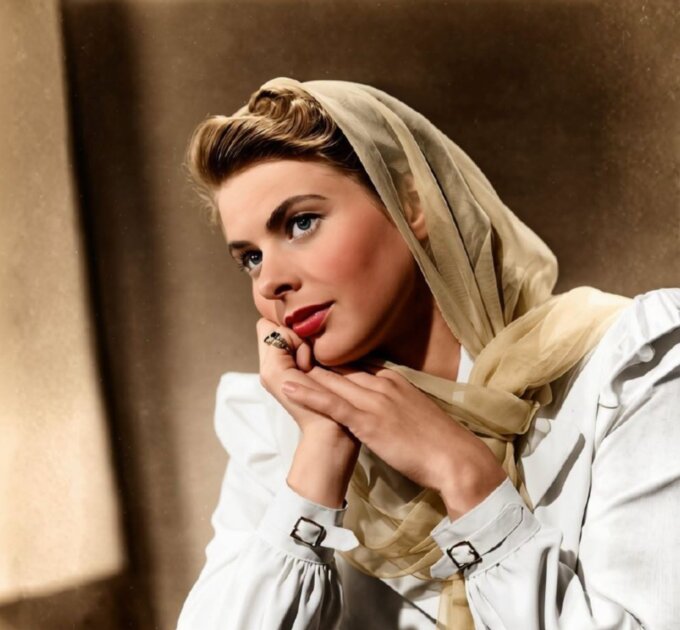
Even America’s attitude toward her changed over the years. Long after the public scandal, an apology for the treatment she had received was expressed in the Senate. The woman who had once been held up as a negative example was once again recognized for her talent and contribution to cinema.
But while her career was recovering, the love story for which she had sacrificed so much was beginning to fall apart.
The woman who had left everything for the man she loved discovered that even a great love does not guarantee a happy ending.
Her marriage to Roberto Rossellini was far from easy. Both were strong personalities with great artistic ambitions, and each had their own vision of life and career.
Ingrid wanted to continue acting and appearing in films, but Rossellini did not always support her desire to return to the international spotlight. He preferred to control their artistic projects, and tensions between them continued to grow.
Over time, it became clear that the crisis went far beyond professional disagreements.
Rossellini began a relationship with Indian screenwriter Sonali Dasgupta and eventually left Ingrid for her. In 1957, their marriage came to an end after years of trying to keep their family together.
The irony was especially painful: Ingrid had once left her first husband, given up her status, and sacrificed the public’s affection to be with Rossellini. Now she found herself on the other side of a betrayal story.
She knew all too well what it meant to be the woman left behind.
But amid all this drama, there were also three children who had to cope with a complicated family reality.
Ingrid Bergman had four children from three pregnancies.
Her eldest daughter, Pia Lindström, was born during her first marriage. She later built an independent career and became a successful television journalist.
She had three children with Roberto Rossellini: Roberto, nicknamed Robin, and twin daughters Isabella and Isotta, who were born in 1952.
Isabella Rossellini went on to become an internationally famous actress and model, successfully establishing her own name in the worlds of art and cinema. Her twin sister, Isotta, chose a completely different path, focusing on academia and literature.
Robin also maintained a relatively private life, although in the 1980s his name was linked to Princess Caroline of Monaco, the daughter of Prince Rainier III and Grace Kelly. The two were seen together at various events, and the press published rumors about a possible marriage, but it never happened.
After their parents separated, Ingrid and Roberto’s three children lived in Rome for a period, in an apartment where they were cared for by nannies and housekeepers. Their parents lived separately and came to visit them.
Isabella later described it as an unusual childhood, almost like living in a small commune of children. She remembered her father as a very devoted man who was deeply involved in his children’s lives and took close care of them.
She even jokingly called him a “seahorse.” The reason was that, in nature, male seahorses carry their young in a special pouch. To her, the comparison suited a father who was especially present, affectionate, and involved.
But alongside the family memories, there were also painful moments, particularly for Ingrid, who had to confront the question of how much her career had cost her in her life as a mother.
And now comes one of the most moving chapters of her life.
In 1978, many years after the scandal and her separation from Rossellini, Ingrid starred in Autumn Sonata, directed by Swedish filmmaker Ingmar Bergman. Despite sharing the same surname, the two were not related.
In the film, Ingrid played a famous pianist who had devoted her life to her musical career but had become distant from her daughter, paying a heavy emotional price for it.
The character touched an especially sensitive part of the actress’s own life.
Ingrid knew the guilt of a mother who had to be away from her children in order to work. She spoke about moments when her children would hug her and beg her not to leave, while she had to free herself from their arms and go off to film.
She knew her children needed her, but she also felt that she could not give up the profession that was an inseparable part of her identity.
In a way, the film allowed her to express feelings she may have struggled to talk about in her private life. She was not just a famous movie star, but also a woman who had faced difficult choices, longing, and a sense of loss.
Her performance in the film received widespread praise and is considered one of the most moving and personal roles of her career.
However, by that time, Ingrid was already battling a serious illness.
She had developed breast cancer and spent years fighting the disease while continuing to work. In August 1982, on her 67th birthday, she died in London after a long struggle. Her body was cremated, and her ashes were returned to Sweden, with part of them scattered at sea off the country’s coast.
Even until her final days, she refused to give up acting.
Her last role was portraying former Israeli Prime Minister Golda Meir in the television miniseries A Woman Called Golda. She was already very ill, suffering from pain and swelling in her arm following the removal of lymph nodes, but she insisted on completing the work.
Her determination paid off: after her death, she received an Emmy Award and a Golden Globe for her performance as Golda Meir. Her daughter, Pia Lindström, accepted the awards on her behalf.
And so ended the life of one of the greatest talents in cinema history.
Ingrid Bergman was a woman who loved passionately, made decisions that changed her life, paid an enormous public and personal price, experienced betrayal and heartbreak, but never stopped being true to herself and her passion for acting.
She was neither a saint nor did she try to present herself as one. She was a real woman, with weaknesses, mistakes, courage, and moments of pain.
She lost the public’s affection, became estranged from Hollywood, had to rebuild her career, and struggled with guilt and difficulties in her family life. But in the end, history did not remember her only for the scandal that shook America.
It remembered her for her three Academy Awards, her unforgettable films, her extraordinary talent, and her courage to live her life according to what she believed in.
Because sometimes, behind the smile of the biggest star, there is a life story far more complicated than any Hollywood screenplay.
❤️ If you also believe that behind every great star is a human being with pain, love, and difficult decisions, share Ingrid Bergman’s story.
And what do you think: Was Ingrid brave when she decided to follow her heart, even at the cost of her career and family, or was the price she paid simply too high?