
# After My Husband’s Death, I Took My Daughter to the Father-Daughter School Dance in His Place—Her Classmates Laughed at Us Until Five Police Officers Walked In and Changed Everything Forever
Every year, my husband bought our daughter flowers for the father-daughter school dance. Six months after his funeral, I decided to take Mia myself because I wanted her to feel happy again, even if only for one evening. But barely had we stepped onto the dance floor when some of her classmates began laughing at us. My daughter burst into tears, and I held her helplessly in my arms. Then five police officers walked into the room. What happened next changed everything in a single moment.
In the six months since we lost Richard—Ritchie, as we lovingly called him—our house had become almost unrecognizably quiet.
His coffee mug was still sitting on the kitchen shelf, exactly where he had left it. Sometimes, when I walked past the kitchen door in the early morning, I could almost smell his cologne lingering in the air. I would stop without thinking, waiting for a moment to hear his voice.
But he never came.
Mia and I were now two hearts living in a home that had been built for three.
My daughter used to be a lively, noisy, cheerful child. Now she moved from room to room as though she needed to apologize for taking up space in the world.
One Monday, a school flyer appeared on the kitchen table. It was decorated with pink letters and glittering borders.
“Father-Daughter Dance — Friday Evening.”
I placed it on the table and waited for Mia to come home.
When she walked through the door, she dropped her backpack and immediately noticed the flyer. She froze for a moment.
“I’m not going,” she announced.
“Sweetheart…”
“Mom, please! Don’t start.”
She turned and hurried upstairs. Her bedroom door clicked shut softly. She hadn’t slammed it, yet somehow the sound hurt more than if she had.
I stood in the kitchen for a long time, holding the pink flyer and thinking about Ritchie.
Every year, without exception, he bought Mia a little bouquet of pink carnations. Then he would knock on her bedroom door, straighten his shoulders, and bow like a gentleman arriving to take a lady on a date.
“Miss Mia,” he would say solemnly. “Your carriage awaits.”
Mia always burst into laughter, hiding her smile behind her hands.
I used to watch them from the doorway, thinking how lucky our daughter was to have such a wonderful father.
Now all we had were the memories.
I went upstairs and gently knocked on Mia’s bedroom door.
“Mia? Can I come in?”
“Yes.”
She was curled up on her bed, clutching her father’s old police academy sweatshirt against her chest. I sat beside her and carefully brushed the hair away from her face, using the same gentle motion her father had always used.
“I know I’m not your dad,” I whispered. “I know nothing will ever be the same without him. But I would love to take you to the dance, if you’ll let me.”
Mia remained silent for a long time.
“They’ll laugh at me, Mom.”
“Who will?”
“Brooke and her friends. They laugh at anyone they think isn’t good enough. Brooke’s dad is some really famous lawyer downtown. She told the whole class he was going to fly home especially for the dance. She said the same thing last year, too, but he never showed up. She cried in the bathroom, and then the following week she made Sarah miserable because she thought Sarah’s shoes were old-fashioned.”
My heart tightened.
How heartbreaking, I thought, that a child who had been hurt so deeply by someone else’s absence would try to hide her own pain by making other children suffer.
“If they laugh at us, we’ll dance anyway,” I told her gently, taking her hand. “For your dad.”
Mia looked up at me. Her eyes were so much like her father’s that, for a moment, I forgot how to breathe.
“You would really go with me?”
“I would go anywhere for you, sweetheart.”
She studied my face for a long time, as though she were trying to decide whether she could believe that someone would truly stay beside her when things became difficult.
Then she slowly nodded.
“Okay, Mom,” she whispered. “Let’s go. For Dad. I want to be there.”
I pulled her into my arms and held her tightly, trying to hide how fiercely my heart was pounding.
Because the truth was, I had no idea how to replace the person she had loved more than anyone in the world.
**On the evening of the dance, I stood behind Mia for a long time, curling her hair.**
She sat perfectly still in front of the mirror, wearing a pale blue, knee-length dress. The soft fabric shifted gently whenever she moved, and her curls fell delicately over her shoulders.
I carefully secured a sparkling hair clip in her hair, trying to keep my hands from trembling.
“You look like a painting,” I whispered.
“Mom, stop! I’m going to cry, and I’ll ruin my mascara.”
I laughed.
For the first time in months, genuine laughter had returned to our home.
Before leaving, I picked up a small bouquet of pink carnations from the table. They were exactly like the flowers Richard had bought for his daughter every single year.
The petals felt soft beneath Mia’s fingers.
“Dad always brought me these,” she said quietly.
“I know, sweetheart.”
I didn’t add anything else. Sometimes words only make the pain sharper.
The school gymnasium glowed with festive lights. Strings of tiny bulbs hung along the walls, paper stars decorated the ceiling, and a DJ was setting up at one end of the room. Parents gathered around a table covered with refreshments, fathers adjusted their ties, and little girls twirled happily in their colorful dresses.
Near the entrance, I immediately noticed Brooke.
She stood beside her mother, glancing toward the door every few seconds. Her mother kept checking her phone, then shaking her head in disappointment.
Brooke’s smile looked painfully stiff, as though one wrong movement might make it shatter.
For a while, everything went well. We took photographs in front of the decorated backdrop. Mia secretly stole a cookie from the refreshments table and gave me a conspiratorial smile.
For a moment, she was the little girl I had missed so desperately.
Then the DJ picked up his microphone.
“All right, ladies and gentlemen, fathers and daughters! It’s time for the most special moment of the evening. Everyone, please join us on the dance floor!”
The girls hurried toward their fathers.
I felt Mia’s hand tighten around mine.
I didn’t ask her anything. I simply squeezed her fingers and led her to the center of the room.
A slow melody filled the air. I placed my hands on her shoulders, just as Richard had done every year.
Mia looked up at me and tried to smile.
That was when I heard the laughter.
“Oh, my God! Do you even know what a man looks like?”
I turned around.
Brooke stood near the edge of the dance floor with two of her friends. She covered her mouth with one hand, but she made no real effort to hide her laughter.
“Why did you even come if you don’t have anyone to dance with?” she continued. “This is so pathetic. You don’t even belong here!”
Her friends giggled and nodded along.
Mia’s expression changed in an instant. Her smile disappeared, her lips began to tremble, and the bouquet in her hand shook.
Across the room, the chair beside Brooke’s mother’s handbag stood empty. Her mother had left the room.
Mia couldn’t hold it in any longer.
Tears streamed down her face. Her shoulders shook, and right there in front of everyone, my little girl broke down.
I pulled her into my arms.
Around us, adults stood awkwardly, looking away. One father cleared his throat. Another mother suddenly became fascinated by the floor.
But nobody said a word to Brooke.
Nobody defended my daughter.
My face burned with anger and helplessness.
Before I could say anything, I heard the sharp clicking of high heels approaching us. One of the teachers hurried over.
“Jennifer, Mia, perhaps it would be better if you stepped away from the dance floor for a moment,” she said with a strained smile.
I thought I had misheard her.
“Excuse me?”
“Just so we don’t escalate the situation any further. I hope you understand.”
Behind her, Brooke and her friends were still giggling.
And the teacher was asking us to move aside.
Mia tugged at my sleeve.
“Mom, please. Can we just go home?”
Something inside me broke.
I knelt in front of her, cupped her tear-streaked face in my hands, and tried to meet her eyes.
“I’m sorry, sweetheart. I’m sorry I wasn’t enough for you tonight.”
Mia immediately shook her head.
“No, Mom. You were enough. You were exactly what I needed.”
I wiped her cheeks, picked up the fallen carnations, and stood. I wanted to lead my daughter out of the room, leaving behind the humiliation and the pain she should never have had to endure.
But at that very moment, the heavy gymnasium doors swung open with a long, creaking sound.
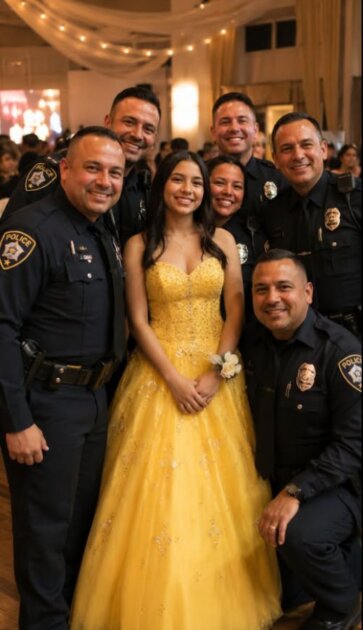
Five uniformed police officers walked into the room.
They moved forward with purpose, their shoes striking the polished floor. One of them carried a bouquet of pink carnations.
All five were heading straight toward us.
The music stopped abruptly. The room became so quiet that I could hear the faint scuff of my own shoes.
The parents froze. The children stared at the approaching officers with wide eyes.
The older officer leading the group stepped forward. His badge read DANIELS.
“Ma’am, would you please step away from the center of the dance floor?” he asked quietly.
My knees nearly gave way. I pulled Mia closer, convinced that something terrible had happened.
“Please…” I whispered. “Whatever it is, just tell me!”
Sergeant Daniels looked at me with a tenderness I had never expected to see on the face of a uniformed officer.
“Everything is all right, ma’am. Please, trust us.”
A younger officer stepped forward. His badge read REYES.
He knelt in front of Mia and held out the small bouquet of pink carnations.
Mia’s lips trembled.
“These are for you, young lady,” Officer Reyes said gently.
Then he reached inside his vest and pulled out a carefully folded sheet of paper.
The edges were worn, and the creases were soft, as though someone had opened and refolded it countless times.
“Your father left us these instructions a long time ago,” he said.
Mia stared at me in astonishment.
I slowly shook my head. I had absolutely no idea what he was talking about.
Sergeant Daniels turned toward the room.
“Richard was one of our own. Years ago, he called us together at the station and asked us to promise him something.”
The room fell so silent that the faint hum of the decorative lights seemed suddenly loud.
“He told us, ‘If anything ever happens to me, make sure my little girl never feels alone at the father-daughter school dance.’”
Sergeant Daniels paused.
“We promised him. And tonight, we’re here to keep that promise.”
I covered my mouth with both hands.
Mia’s tears continued to roll down her cheeks.
“Dad wrote that?” she asked in a trembling voice.
“Yes,” Officer Reyes replied. “In his own handwriting. Three years ago.”
He carefully unfolded the paper and held it out for her to see.
I caught a glimpse of Richard’s handwriting, and that was enough. I recognized the slight slant of his letters and the way he always crossed his sevens with a line.
It felt as though my heart had been torn open all over again.
“Did Dad know this would happen?” Mia whispered.
Officer Reyes shook his head.
“He hoped he would never need us. But he wanted to make sure you would never be alone if the day came when he couldn’t be here himself.”
Out of the corner of my eye, I noticed Brooke.
The mocking smile had vanished from her face. She watched the officers and Mia as though she were standing outside a bakery window, looking at something she had wanted her entire life but had never been able to have.
Then I understood why she had tried so hard to hurt my daughter.
Her father hadn’t come.
Again.
Tears gathered in Brooke’s eyes, and her chin began to tremble. She suddenly turned toward the wall, hoping nobody would see her face.
Sergeant Daniels nodded to the DJ.
“Could you start the music again, please?”
A few moments later, the soft melody returned.
The five officers formed a quiet circle around Mia.
Officer Reyes bowed to her, just as Richard used to do.
“May I have this dance, Miss Mia?”
Mia nodded. She couldn’t manage a single word.
Reyes took her hand and began to dance slowly. He guided her gently, making sure she never had to worry about getting a step wrong.
When the next part of the song began, another officer stepped forward. Then a third.
Each of them danced with Mia as though she were a princess.
I stood watching as my daughter began to laugh through her tears. Her pale blue dress twirled across the polished floor as she danced with people who had loved her father not merely as a colleague, but as a brother.
The teacher stood beside the refreshments table, pressing one hand to her mouth and wiping her tears with a napkin.
Brooke slid down the wall near the podium, drawing her knees against her chest. Her beautiful dress crumpled around her. A few seconds later, her mother sat beside her, finally putting away her phone. She wrapped an arm around her daughter and whispered something into her ear.
When the last officer stepped back, Mia remained standing in the center of the room.
She was breathless from dancing, her cheeks were flushed, and her eyes were shining in a way I hadn’t seen in six months.
Officer Reyes approached me.
“Ma’am,” he said quietly, “we’re not finished yet.”
Sergeant Daniels took the microphone from the DJ.
“Six months ago, our community lost one of its finest. Officer Richard lost his life while trying to help two strangers stranded on the highway. He died risking his own life to save others.”
His voice carried across the room.
“He was a hero in uniform. But he was also a hero at home. Above all, he was a father who loved his daughter more than anything in this world.”
The room fell silent. Somewhere behind me, a parent let out a muffled sob.
Officer Reyes turned toward me and extended his hand.
“Ma’am, may I?”
I shook my head, unable to stop crying.
“I can’t. I just…”
“You’ve already done the hardest part,” he said gently. “You showed up.”
He took my hand and led me to the center of the room, beside Mia.
The officers gathered around us. The music swelled again, louder and fuller, as though every wall in the room wanted to carry the melody.
Sergeant Daniels smiled at me.
“Your husband would be very proud of you. Both of you.”
My shoulders trembled as I began to dance with my daughter. For a moment, I closed my eyes and imagined Richard standing beside us, wearing his familiar smile and holding another bouquet of pink carnations.
When the song ended, Mia leaned against me.
And for the first time in months, I felt something I had almost forgotten how to feel. It wasn’t that the grief had disappeared. It was that perhaps we really could learn to live with it.
As we prepared to leave, I noticed Brooke standing a few steps from the dance floor. Her mother gently encouraged her to come forward.
Dark streaks of mascara ran beneath Brooke’s eyes. Her hands trembled so badly that the bracelet around her wrist rattled against her other jewelry.
She took one step toward Mia, then another.
“Mia… I’m sorry,” she whispered.
She glanced at her mother, who gave her an encouraging nod. Brooke swallowed hard, as though the next words were stones lodged in her throat.
“My dad didn’t come. Again. He never comes.” She wiped her nose with the back of her hand, smearing the makeup she had probably spent the entire afternoon carefully applying. “When I saw you with your mom, you looked so happy. And I… I wanted someone else to feel as terrible as I did.”
Her voice broke.
“But you didn’t do anything wrong. I’m sorry.”
Mia looked at her for several long seconds.
Then she glanced down at the pink carnations in her hands and carefully divided the bouquet in half.
“Here,” she said softly. “Half of them are yours.”
Brooke’s face crumpled, and she began to sob.
Her mother covered her mouth with one hand and looked at me. Her eyes held an apology too profound to be expressed in words.
The teacher approached us as well. Her voice trembled.
“Jennifer, I should have protected Mia. I’m so sorry.”
I didn’t answer immediately. I simply squeezed her hand.
Some apologies don’t need long explanations. And some mistakes should teach us never to look away when someone needs our help.
When we were finally ready to leave, I turned back to Sergeant Daniels.
“How did you know we would be here tonight? I didn’t call anyone.”
He smiled gently.
“Ma’am, we’re police officers. Sometimes we know about things before other people do.”
In the car, Mia placed the remaining flowers in her lap. At a red light on the way home, she rested her head against my shoulder.
For a long time, neither of us spoke.
Then my daughter whispered my name.
“Mom?”
“Yes, sweetheart?”
Mia gently squeezed the pink carnations.
“Dad was there with us tonight.”
My throat tightened. I kissed the top of her head and smiled through my tears.
“Yes, sweetheart,” I whispered. “I think he was.”
For the first time in six months, I could believe it, too.
Because Richard could no longer walk through that door, buy another bouquet of flowers, or bow to his daughter before asking her to dance.
But what he had left behind was still alive.
In his promises. In his friends. In the love of the people who had never forgotten him.
And, most of all, in the little girl who had finally learned to laugh again that evening.
The grief didn’t disappear when we got home. His absence didn’t become any less painful.
But that night, I learned something I would never forget: sometimes love stays with us in ways we never expected. Sometimes it lives on in a promised dance, a bouquet of pink carnations, or the loyalty of five people who refuse to forget a friend.
And sometimes, the greatest miracle arrives just when we believe there is nobody left to stand beside us.

