
My Husband Secretly Canceled My 60th Birthday Party to Buy Our Son a Car. But He Never Expected Me to Make a Decision of My Own…
“Don’t call the restaurant! There won’t be any banquet. I canceled it on the eighth!”
Gena told me this as casually as if he were saying we had run out of bread. He didn’t even look up from his plate, calmly continuing to spread butter on his toast.
Meanwhile, I stood motionless by the stove, my phone in my hand.
I had already dialed the number of the Rowan Tree restaurant. All I wanted to ask was whether they could serve pike-perch aspic instead of pink salmon. I had spent a week thinking about it, comparing prices, discussing the menu, and imagining who would sit at each table.
I was preparing for my sixtieth birthday.
I had been waiting for this day for thirty-six years, even if I hadn’t consciously realized it. I didn’t want a luxurious celebration, just one evening when I wouldn’t have to serve everyone, clear the table, or wash the dishes after the last guest had left.
Just one evening when I would be the one being celebrated.
“What do you mean, you canceled it?” I asked.
“Exactly what I said. I went there, filled out the cancellation form, and they refunded the deposit. Everything was done properly.”
“And the money?”
Gena took a bite of his sandwich. He chewed slowly, swallowed, and only then answered.
“I gave it to Kirill. He bought a car with it.”
At that moment, the cottage-cheese pancakes burned in the frying pan.
I turned off the gas. I didn’t even try to save them.
One hundred and thirty-two thousand rubles.
That was how much the banquet for twenty-four people would have cost, calculated at 5,500 rubles per person. We had been saving since spring. Gena had put aside part of his bonus, while I baked cakes for our neighbors and acquaintances on weekends.
Sometimes I got up before dawn on Saturdays, worked late into the night, and could barely feel my fingers by Sunday. But I never complained. I knew what I was saving for.
The money was in Gena’s savings account because it paid a slightly higher interest rate. I had been the one to tell him back in September to handle the reservation. At the time, it never occurred to me that I would ever regret trusting him.
“Did you ask me?” I asked quietly.
Gena finally looked up.
“And would you have given him the money?”
“No.”
“Well, there you go! That’s exactly why I didn’t ask you. I didn’t spend it on myself, Larisa. I spent it on our son!”
There was even indignation in his voice, as though I were the one who had done something unforgivable.
“I’m not complaining that you helped Kirill. I’m complaining that you made a decision about my own birthday without me.”
After thirty-six years of marriage, I thought I knew everything about this man. I knew the cough he used to disguise his lies and the way he rubbed his neck when he felt guilty.
But now, I saw neither gesture.
He was calm. Far too calm.
“Kirill starts a new job on Monday,” he explained. “He’ll be repairing refrigeration equipment in shops all over the area. They won’t hire him without a car. His old one finally broke down in August. Oksana is six months pregnant. There’s a bus to the village only three times a day. Do you want his wife standing in the cold at a bus stop with her big belly?”
“No. I want my husband to ask me what I want at least once.”
“We’ll celebrate at home. I’ll roast some meat and invite Valera. Why do you need all that fuss?”
“Because it matters to me! You only turn sixty once!”
“Oh, come on! Who goes to a restaurant for their sixtieth birthday these days?”
I looked at him and suddenly felt as though I no longer recognized him.
“Call Kirill. Tell him to return the car or buy one on credit, like everyone else.”
Gena’s face hardened.
“I’m not going to humiliate my own son. The car is already registered in his name.”
With that, he stood up, rinsed his cup, and placed it on the drying rack.
His ear tilted to the left, just as it always did when he considered something perfectly reasonable.
As though the whole matter had been settled.
As though my opinion had never mattered at all.
That day, I went to the Rowan Tree restaurant anyway. I didn’t even know why. Perhaps I was hoping I had misunderstood something. That the whole thing was just some stupid mistake.
The tables in the dining room had already been rearranged for another event. The smell of chlorine mixed with the aroma of fried onions in the air.
Karina, the young events coordinator I had spoken with several times over the past few weeks, recognized me as soon as I entered. When she saw me, she immediately lowered her eyes.
“Larisa Nikolayevna… We thought you knew about it.”
She took a folder from a shelf and placed the cancellation form in front of me.
Gennady Petrovich Somov’s signature was on it. Bold, confident letters, ending in a long, sweeping stroke.
The date: October eighth.
It was the seventeenth.
For nine whole days, he had sat across from me at breakfast, eaten my cottage-cheese pancakes, asked what I was making for dinner, and never once mentioned that he had already canceled the celebration.
“Could the date still be reinstated? November seventh? I would, of course, pay the difference.”
Karina shook her head sadly.
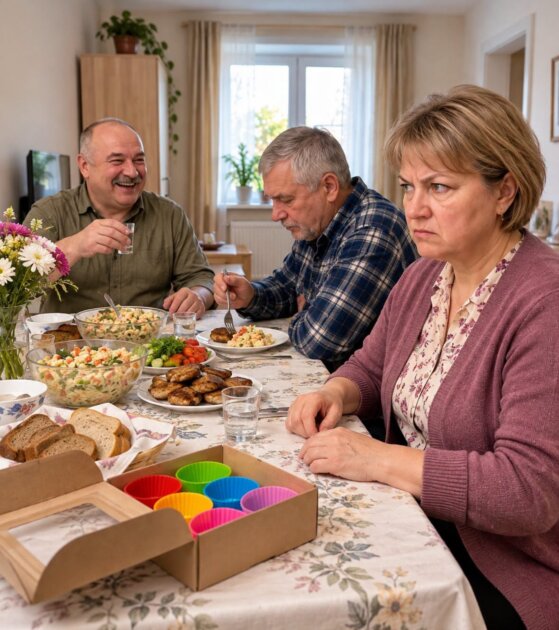
“I’m sorry. Someone booked November seventh the very next day for a wedding. November is a very busy month for events. I could offer you a new date after January tenth.”
January.
Two months after my birthday.
I would have to call everyone again, explain myself, and tell them there would be no celebration after all. And where would I get the money to pay for everything again?
I had spent my own savings in August. I had booked a place at a sanatorium in Pyatigorsk for the two of us so Gena could receive treatment for his back.
I told Karina I would think about it, then walked out onto the street.
On the steps, I called Galya Surikova, with whom I had worked at the same factory for ten years.
“Larochka!” she exclaimed. “Gena called last week! He said you had decided to celebrate with just the family. I thought you had discussed it together. You didn’t know?”
“No,” I replied.
Silence fell on the other end of the line.
“Oh, darling…”
Later, I discovered that Gena had called almost everyone. His relatives, my former coworkers, even the neighbor who lived on the fifth floor of our building.
He had told them all that I didn’t want a restaurant celebration because I felt uncomfortable about my age.
The only person he hadn’t called was my sister, Vera.
At the time, I had no idea how important that small detail would become later.
Gena was nowhere to be found when I got home. He had gone to his brother’s place near the garages.
I stood on a stool and took an old winter boot box down from the top of the wardrobe.
Wrapped in colorful napkins lay twenty-four sugar peonies. I had made one for every guest. I had spent my evenings working on them since September, after finishing my regular job. I carefully shaped each petal and placed a tiny yellow dot in the center of every flower.
I had planned to decorate my birthday cake with them.
I sat down at the table and stared at the box for a long time.
Then I called Kirill.
“Mom?” he asked in surprise. “Is everything all right?”
“I’m coming to visit you tomorrow,” I replied. “I want to see your new car.”
My son fell silent.
“Of course, Mom. Come whenever you like.”
I could tell from his voice that there was something he wasn’t telling me.
And the next day, I found out what it was.
“I Thought You Had Agreed to It Too, Mom!”
The bus to Sosnovka ran three times a day. The Sunday morning service was always packed. I stood by the rear door, gripping the handrail with one hand.
The bus smelled of mandarins, even though Christmas was still a long way off.
Gray fields, damp gardens, and bare trees slid past the window. I tried to figure out what I would say to my son, but every sentence that came to mind sounded like an accusation.
I didn’t want an argument.
I just wanted to hear the truth.
An immaculate silver Logan stood outside Kirill’s house. It had been washed so thoroughly that the neighbor’s fence was reflected in its side.
Polinka ran toward me with her coat unbuttoned.
“Grandma! Look at Dad’s car! It even has an air freshener! And Dad already took me for a ride!”
Oksana stepped onto the porch, holding her belly with one hand. Kirill followed right behind her, wearing an old sweater and holding an oily rag.
“Mom, if you’d told me you were coming, I would have picked you up.”
Then he glanced at the car.
“I mean… I would have come to get you in the car.”
That little hesitation told me more than any explanation could have.
Inside, we sat down in the kitchen. Oksana put some water on to boil but didn’t sit with us. She remained by the window, nervously twisting the edge of her sweater.
A drawing by Polinka hung on the refrigerator beneath a magnet: a gray car with enormous wheels, a smiling sun above it, and the words printed in large letters underneath:
DAD’S CAR.
I decided not to beat around the bush.
“Kirill, what did your father tell you when he gave you the money?”
My son looked at Oksana first, then at me.
“He said you had both decided together. He said you no longer felt like going to a restaurant because you were uncomfortable about turning sixty. He told me you had suggested giving me the money instead.”
I felt my throat tighten.
“Did he also tell you not to call me?”
Kirill lowered his eyes.
“Yes. He said you didn’t like that sort of thing and that I would only upset you.”
For nine days, I had waited for at least one message from my son. Even a simple “Thank you, Mom” would have been enough.
But nothing came.
Now I knew why.
“Me, the woman who spent the entire summer planning where everyone would sit? Me, who made twenty-four sugar flowers for my own cake?”
Kirill’s face turned pale.
“Mom, I swear I didn’t know! If I had known this was what happened, I would never have accepted the money!”
Oksana finally spoke.
“Larisa Nikolayevna, please try to understand our situation too. The car is already ours. Kirill has to start work tomorrow. Two banks rejected our loan applications because his previous employer paid him partly in cash. I’m due in January. We haven’t even bought the crib yet.”
There was no malice in her voice. Only fear.
And somehow, that made the situation even harder.
“I’m not asking you to give the car back,” I said. “I just wanted someone to ask me first.”
Kirill stood up.
“I’ll pay the money back, Mom. I’ll start in the spring. I’ll give you ten thousand rubles a month.”
Oksana quietly interrupted him.
“Kirya, but then what will we use to buy the crib?”
My son sat down again.
I looked at them and suddenly saw the young family they were: people trying to make ends meet. A pregnant woman, a man about to start a new job, and a little girl proudly drawing her father’s car.
I didn’t want to take that happiness away from them.
But that didn’t mean what had happened didn’t hurt.
“You don’t have to pay anything back right now,” I finally said. “Buy the crib.”
Kirill looked at me with relief.
“Thank you, Mom!”
I didn’t hug him. I wasn’t ready to.
My son offered to drive me to the bus stop, but I refused. He followed me to the gate anyway.
“Mom, please don’t be too angry with Dad. He did it for me.”
I stopped and looked at him.
“I know, sweetheart. I know exactly who he did it for.”
Then I set off down the muddy road.
Polinka continued waving to me from behind the fence long after I had turned away.
That evening, Gena was smoking on the balcony. He had thrown an old jacket over his undershirt and was tapping his ashes into an empty pea can.
I went outside and closed the door behind us.
“You told Kirill that I was the one who wanted to cancel my birthday.”
Gena shrugged.
“What was I supposed to say? That his mother wouldn’t let him have the money? He wouldn’t have accepted it then.”
“Maybe that would have been the right thing to do!”
“Besides, half the money was mine. In July, I spent three nights at the pumping station when a pipe burst. I worked hard for that bonus.”
“And the other half was mine,” I replied. “Twenty cakes, Gena. Twenty! I spent every weekend working. I didn’t find that money growing on a tree either.”
Gena was silent for a long time.
Then he looked out at the damp courtyard.
“When I was eighteen, my father told me, ‘You’ll earn it yourself.’ For three winters, I rode my bicycle to the factory. Twelve kilometers there and twelve back. Sometimes my hands froze to the handlebars so badly that I could barely let go.”
He began coughing, then turned away.
“I don’t want Kirill to suffer like that.”
I had heard this story at least twenty times before. He always told it with the same details.
But for the first time, I truly understood why he was so determined to give our son everything he could.
Gena hadn’t simply wanted to buy Kirill a car.
He wanted to make sure his son would never experience the helplessness he had endured as a young man.
But in doing so, he had made me invisible.
“All right,” I finally said. “Kirill can keep the car. I won’t ask for the money back. But there’s something you are going to do.”
Gena looked at me suspiciously.
“What?”
“You will call every person you told that I didn’t want to celebrate. And you will tell them the truth. You will tell them that you made the decision. Not me.”
“What else? Should I start explaining myself to all those women?”
“Not to the women. To the people you lied to.”
Gena laughed indignantly.
“We held our wedding in a workers’ dormitory! Fourteen people, a bowl of vinaigrette salad, and that was it! And we’ve still been together for thirty-six years! Now you’ve turned sixty, and suddenly you want a restaurant!”
I was already heading toward the door when he called after me.
“We’ll celebrate at home on November seventh. I’ve invited Valera. Kirill and his family will come too. Just bake a cake. Yours is always the best.”
I turned around.
“Am I supposed to bake my own birthday cake too?”
“Well, who else would do it? You’re the family’s pastry chef!”
And he even smiled.
At that moment, I understood that Gena didn’t think of himself as a bad man. He simply believed that if something was good for the family, he had the right to take anything from anyone to make it happen.
Even his own wife’s happiness.
“Then you can bake it yourself,” I said.
He laughed as though I were joking, then went into the living room, turned on the television, and settled comfortably into his armchair.
I remained in the kitchen with the twenty-four sugar peonies.
By the Third Toast, I Finally Learned the Truth
On the morning of November seventh, I went to work.
I had taken time off in the summer for the banquet, but I couldn’t bear the thought of sitting at home while Gena clattered around with frying pans and pretended nothing had happened.
The smell of vanilla and hot oil greeted me in the workshop.
I had barely taken my apron off the hook when my coworkers switched off the mixer and began singing.
Faya brought out a honey cake from the refrigerator. Written in cream on top were the words:
“Larisa, Happy 60th Birthday!”
The lettering was slightly crooked, and one of the letters had smudged.
I had never seen a more beautiful cake in my life.
“You’ve been baking all kinds of delicious things for us for thirty years, Nikolayevna,” Faya said. “Now let us bake something for you for once!”
I held the knife in my hand, but I couldn’t bring myself to cut the cake.
In thirty years, I had made wedding cakes, birthday cakes, cars, hearts, soccer balls, and fairy-tale characters.

