
# My Fiancé Put a Prenuptial Agreement in Front of Me, Certain I Would Never Read It. I Read Every Word… and Called Off the Wedding.
He had placed the pen beside the folder before I had even sat down at the table. It was an elegant blue pen with gold detailing. I had never seen it in our apartment before.
“Nothing special, just a few little details,” Artyom said, sliding the folder toward me. “Just a formality. My mother found a lawyer, and everything has been prepared properly.”
Valentina Sergeyevna, my future mother-in-law, was sitting on the sofa by the window, scrolling through her phone. She didn’t even glance at the table. She was avoiding my eyes so deliberately that it was impossible not to notice.
I opened the folder. The smell of freshly printed paper drifted out. Eight pages, tiny print, tightly packed paragraphs.
“Eight pages of formalities?” I asked.
Artyom smiled.
“You know what lawyers are like. They love making everything unnecessarily complicated. Don’t read too carefully. It’s a completely standard agreement. The apartment, the car… just so there won’t be any arguments later.”
He poured himself some tea. He didn’t offer me any, even though the teapot was right in front of him.
“Our wedding is in three weeks, Ksyusha,” he continued in a softer voice. “Let’s not waste time on paperwork like this. Besides, I know how much you hate boring legal documents.”
That was when I started reading very carefully.
Not because I was offended. I had worked at a publishing house for eight years, and for the last four, my job had involved reviewing contracts and legal documents. At least ten similar documents crossed my desk every week. Copyright agreements, licensing contracts, and all kinds of legal paperwork.
I knew exactly where the most important conditions were usually hidden.
Usually, they were placed where people’s eyes were already tired and they were desperate to turn the page and get it over with.
Artyom had probably forgotten what I actually did for a living. Once, he had asked about my job. I told him I edited texts at a publishing house.
“Oh, I see. So you just fix commas,” he had nodded.
And ever since, that was how he saw me: the girl who fixed commas.
The first clause concerned the apartment on Smolnaya Street. Since Artyom had purchased it before our marriage, it would remain his exclusive property in the event of a divorce.
Fine. I had no problem with that.
The second clause dealt with the car. That would remain his property, too.
That didn’t surprise me either.
Then I reached the third clause, and my eyes stopped on the lines.
“Are you still reading?” Artyom asked, stirring his tea. “I told you there’s nothing unusual in there.”
“Yes,” I replied.
The third clause was titled: “Arrangement of Household Responsibilities.”
At first glance, it sounded harmless enough. But the actual wording said something entirely different.
Throughout the marriage, the wife would be solely responsible for managing the household, cleaning, cooking, and organizing the family’s daily routine.
The next sentence read:
“Domestic activities performed by the wife shall not give rise to any property claim and shall not be subject to financial compensation upon the dissolution of the marriage.”
I read it twice.
Not because I didn’t understand it. I simply wanted to make sure I was actually seeing what I thought I was seeing.
“Artyom,” I said, raising my eyes. “Have you read the third clause?”
“Which one?” he asked without looking up from his phone. “The one about the household?”
“Yes. How exactly am I supposed to understand this?”
“Well, it just says who’s responsible for what at home. My mother thinks it’s better to clarify these things in advance so we don’t end up arguing about them later.”
“And what are you responsible for?”
He finally looked at me.
“I earn the money, you run the household. What’s so complicated about that? It’s the traditional family model.”
I returned to the document.
The fourth clause. The fifth clause.
Now I knew I couldn’t afford to skip a single line.
I can still remember the sixth clause word for word.
“In the event of the birth of a child, the wife agrees to assume primary responsibility for the child’s care until the age of three. During this period, the wife waives any financial claims relating to lost income or the loss of professional and career opportunities.”
I slowly closed the folder and rested my palm on top of it.
“Artyom.”
“Hmm?”
“Am I understanding this correctly? If we have a child, I’ll have to stay home for three years, and if I lose my job, professional experience, or career opportunities because of it, that’s entirely my problem?”
He sighed as if he were being forced to explain something painfully obvious.
“Ksyusha, what else did you expect? You’ll go on maternity leave anyway. That’s what every woman does. I didn’t invent the way life works. The lawyer said it’s better to put everything in writing beforehand.”
“And whose lawyer is this?”
He fell silent for a moment.
“A friend of my mother’s. Why?”
Valentina Sergeyevna finally put down her phone. She folded her hands in her lap and looked at me with a gentle, patient smile, as though she were trying to explain a simple task to a child who couldn’t understand it.
“Ksyushenka, don’t overthink this!” she said. “Nobody wants to hurt you. This is simply to make sure everything runs properly in the family. We’ve always done things this way: the man provides for the family, and the woman takes care of the home. I raised Artyomushka on my own, so I know exactly what I’m talking about.”
“Had you already seen this agreement before bringing it here today?”
She smiled faintly.
“Of course. I helped put it together. After all, you wouldn’t know how to make sense of legal documents like these. You’re only good with commas.”
There it was.
The commas again.
I sat quietly, my hand still resting on the closed folder.
Meanwhile, Artyom finished his tea, stood up, carried his cup into the kitchen, and simply left it in the sink. He didn’t even rinse it.
“Well, shall we sign it?” he asked when he returned. “I have a meeting at seven. Let’s not drag this out.”
I thought I would be angry. But I wasn’t.
Instead, I felt as though someone had placed a completely different manuscript in my hands from the story we had supposedly been writing together. And now they were expecting me to stamp my approval on it without even thinking.
I opened the folder again and turned to the last page.
“Artyom, did you actually read this agreement from beginning to end?”
“I already told you it’s standard.”
“That’s not an answer.”
He was silent for a few seconds.
“I skimmed through it. The important parts. My mother and the lawyer checked everything. Why would I need to get stuck on every little detail?”
“So you didn’t read it.”
“Ksyusha, why are you making such a big deal out of this?” He sat down beside me again. “I thought you’d just sign it and we’d be done. You never liked arguing. That’s exactly what I love about you. You’re so calm. Everything is so easy with you.”
Calm.
In other words, convenient.
Now I could see exactly what he had been counting on. That I would flip through the eight pages, notice the sections about the apartment and the car, and assume everything was fine.
Then I would pick up the blue pen with the gold trim and sign.
Because I was the woman who only knew how to fix commas.
The woman who didn’t like arguing.
The woman who made everything so convenient.
For four years, I had reviewed contracts that protected people’s rights and everything they had worked their entire lives to build. And now he had placed a document in front of me that he assumed I wouldn’t even bother reading.
“Valentina Sergeyevna,” I said, turning toward my future mother-in-law. “May I ask you something? The wording in the sixth clause, where I waive any claims related to my career, was that your idea or the lawyer’s?”
“And why would that matter, dear?”
“It matters a great deal. A lawyer usually writes down what the law allows. But asking me to waive my professional opportunities in advance isn’t just a legal formality. It’s a condition designed to ensure that later I won’t even be able to complain if I sacrifice my career for the family. Someone had to specifically request that wording.”
Her expression changed. The pleasant smile disappeared.
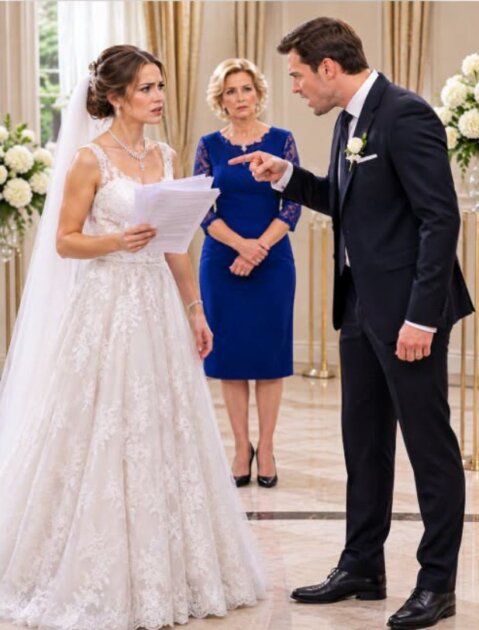
“What exactly are you trying to imply?”
“Nothing. I’m simply reading. Out loud. Just as you wanted everything to be done properly, in front of everyone.”
For the first time, Artyom began nervously looking back and forth between me and his mother.
“Clause eight,” I said, turning the folder toward him. “Read this one yourself. Please.”
He took the document, lowered his head, and began reading slowly.
The eighth clause stated that if the marriage ended at the wife’s initiative, she would be required to vacate the shared residence within one month and would have no right to compensation for any money she had invested in renovating or furnishing the property.
But there was one small detail.
We had already been planning to buy a new apartment. Together. With a mortgage. I had been saving my share of the down payment from my own salary for months.
The same salary that, according to Artyom, I earned just by fixing commas.
“This can’t be…” He looked up. “This must be something left over from a template.”
“What kind of template, Artyom? One from a previous fiancée’s agreement?”
The room became so quiet that I could hear the ticking of the wall clock.
Valentina Sergeyevna stood up.
“That’s enough of this hysteria!” she snapped. “This is a perfectly normal agreement. Every respectable family has arrangements like these. Artyom, tell her!”
But Artyom said nothing.
He just sat there, staring at the eighth page.
His silence hurt more than the agreement itself.
At least the document had been written by a lawyer I didn’t know. But now the man who was supposed to stand beside me at the altar in three weeks and say “I do” couldn’t even defend me.
All he had needed to say was one sentence.
“Mom, this is too much. We can’t sign something like this.”
That was all.
But he didn’t say it.
He remained silent because arguing with his mother would have been uncomfortable.
With me, however, everything had always been so easy.
I closed the folder and pushed the blue pen toward the middle of the table, directly in front of him.
“I’m not signing this.”
“Ksyusha, let’s talk about it tomorrow when we’ve both had a chance to calm down,” Artyom replied quickly. “You must be tired. I understand…”
“I’m not tired. I simply read the whole thing.”
“And what exactly did you read?” Valentina Sergeyevna interrupted. “A few completely ordinary papers! You were just looking for an excuse to find fault with something. If you don’t want to get married, just say so! Why put on this whole performance?”
“I did want to,” I replied.
Then I paused.
“Right up until page six.”
I stood up and took my coat from the back of the chair.
The hallway was dark. I couldn’t find the light switch immediately. Behind me, Artyom kept talking. He said I should sleep on it, that his mother hadn’t meant anything by it, that we were adults and could discuss everything.
Adults.
A grown man had placed a contract in front of me that essentially turned me into an unpaid housekeeper without rights or financial recognition. And he had been so certain I wouldn’t read it that he hadn’t even bothered to go through it himself.
Before leaving, I turned around one last time.
“Artyom, did you really think I wouldn’t read it?”
He looked at me awkwardly.
“I just thought that you… you know… you usually don’t get hung up on things like this…”
“I don’t? Finish that sentence!”
But he couldn’t.
From the living room, I heard Valentina Sergeyevna shouting that I would regret this, that I wouldn’t find a man like her Artyom on every street corner, and that at my age I couldn’t afford to be so picky.
I was thirty-one.
I closed the door behind me, and as I walked down the stairs, I noticed something strange.
For the first time in six months, I could finally take a deep breath.
The next morning, I called off the wedding.
I phoned the restaurant. I lost the deposit, but I didn’t care for a single second.
I sent every guest the same short message:
“The wedding has been canceled. Please don’t ask me about the details.”
I left the ring in its box on Artyom’s windowsill. I went to collect it when he wasn’t home. I handed the apartment key to his neighbor.
Artyom called.
First, he begged. Then he blamed me. Then he started begging again.
He also sent me a long voice message claiming that he had torn up the agreement, that I had misunderstood everything, that his mother was “a completely separate person,” and that the two of us should be the ones deciding how to live our lives.
I listened to half of it.
Until that point, there was at least some remorse in his voice.
But in the second half, he started talking about how much money he had spent on the wedding and what his relatives would think.
What would his relatives think…
Apparently, that was what hurt him most.
Not that he had lost me.
But that three weeks before the wedding, he would have to explain to his uncles and aunts why his fiancée had walked away.
When I told my mother what had happened, she remained silent on the phone for a long time.
“But couldn’t you have simply crossed out those clauses?” she finally asked cautiously. “Changed the whole thing to reasonable terms and still gotten married? It’s just a piece of paper. People build their lives together on things much more important than that.”
I thought about it for a long time.
Honestly.
The objectionable clauses could indeed have been removed. A lawyer could have rewritten the entire agreement in an hour.
But you can cross out sentences in a contract.
What you cannot erase is the fact that Artyom had brought that document to me fully expecting me to sign it without a second thought.
And you cannot erase the fact that when his mother looked me in the eyes and told me I was only good with commas, he didn’t say a single word.
The contract had simply put into writing what they both really thought of me.
Even if I had crossed out the objectionable clauses, I would still have been marrying the people who had written them in the first place.
“Mom,” I finally said, “they didn’t write the agreement incorrectly. They wrote down exactly how they saw me. They just discovered that I’m not the kind of woman they thought I was.”
My mother fell silent again.
“All right,” she eventually said. “You know best. Just don’t regret it later.”
I didn’t regret it.
At least, not most of the time.
Sometimes, late at night, I still remember the good moments. Artyom knew exactly how I liked my coffee. He remembered that I didn’t eat cilantro. For my thirtieth birthday, he took me to the seaside, and he never complained when I slept through most of the journey.
Then I remember that blue pen with the gold detailing.
The pen he had placed on the table before I even sat down.
He must have chosen it specially or brought it from the lawyer’s office. We had never owned a pen like that at home.
He had planned everything in advance.
The pen, the folder, the perfect moment.
He had simply forgotten to consider one thing: that I knew how to read.
Ever since then, whenever someone at work brings me a contract and says, “It’s just a standard document. There’s no need to read every single line,” I examine it especially carefully.
And I almost always find a sixth clause.
It’s hiding somewhere, printed in tiny letters between the long paragraphs.
Most people simply never get that far.
I always read to the end now.
A month later, Valentina Sergeyevna sent me a message, too.
Just one message. She didn’t even bother saying hello.
“You ruined my son’s life over a simple formality. I hope you at least feel ashamed of yourself.”
I read it again.
Not because I didn’t understand it.
I understood it immediately.
I wasn’t ashamed.
But one question still lingered in my mind. I even typed it out to her, but eventually deleted it before sending.
The question was very simple:
If this really was just an innocent formality, why did they do everything they could to make sure I wouldn’t read it?

