
## The Summer House
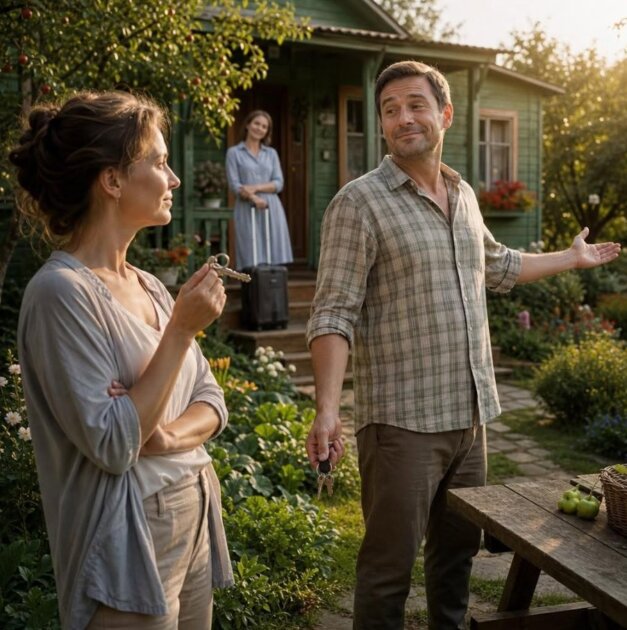
— I’m giving the summer house to my sister. She needs it more than we do, and we never use it anyway, — my husband announced, as casually as if he were telling me we had run out of milk.
I didn’t answer. I simply watched as his hand reached for the bowl again. He picked up a walnut, squeezed it between his fingers, and cracked it open. He swept the shell into his palm, glanced around for the trash can, but didn’t bother getting up. Instead, he dropped the pieces back into the bowl among the whole walnuts.
The summer house. A six-hundred-square-meter plot of land, forty kilometers outside the city. My grandfather had planted the apple trees himself. Blackcurrant bushes lined the fence. The little wooden house had begun to sag slightly, and in one corner stood a cast-iron stove that we used to light in September when we went out to collect potatoes.
On our right lived Aunt Zina, a hard-of-hearing, perpetually cheerful woman who tried to give me seedlings every time she saw me. On the left, a Moscow couple had bought the neighboring plot three years earlier and built such a tall corrugated-metal fence around it that ever since, I had felt as though we were trapped inside a box.
Anton had probably visited the place five times in all those years.
The first time was when we took an old refrigerator out there. He sat on the veranda, drank a beer, and announced that he was bored out of his mind.
The second time was at my grandfather’s funeral. He stood by the gate holding a shovel, scrolling through his phone.
The third time was when I asked him to help repair the roof. He walked around the house, declared that the old slate tiles would last another few years, and then returned to the city, claiming he had urgent work to do.
I couldn’t even remember the other two occasions. Perhaps they had never happened.
— My sister needs it more, — Anton repeated. — They’re paying off a mortgage, they have two children, and Valera has been unemployed for months. All we do is pay taxes on the place.
I remained silent.
The familiar tension appeared on Anton’s face. He always started by speaking calmly, then became irritated, and eventually I was the one to blame for failing to understand his perfectly reasonable decisions.
— Are you even listening to me?
— Yes.
— Well?
— Nothing.
He stood up and began pacing around the kitchen. He opened the refrigerator, looked inside, and closed it again. Then he poured himself a glass of water, drank it, and put the glass in the sink. Not in the dishwasher standing right beside it, but precisely where he knew I hated leaving dirty dishes.
— I’m not asking for your permission, — he finally said. — I’m just telling you what’s going to happen. The summer house is mine. My father registered it in my name.
— Your father registered it in your name, — I repeated. — But my grandfather planted those apple trees.
— So what? My name is on the documents.
I walked over to the table and gathered the walnut shells and whole walnuts back into the bowl. Then I picked it up and placed it on the windowsill beside the plastic cactus.
That cactus had been sitting there ever since we brought our younger son home from the maternity hospital. I had bought it at a gas station for absolutely no reason. Back then, every little thing made me happy. The plastic plant had first traveled around in the car’s cup holder before eventually finding a permanent home in the kitchen window.
Anton had once asked why I kept such a useless dust collector.
I never threw it away. Not because it was valuable. I simply couldn’t bring myself to do it.
— All right, — I said.
Anton froze.
He had expected an argument. He had expected me to start shouting, call his mother, and throw in his face how much work I had put into that property over the past twenty years.
Because I had done everything myself. I had invested my back, my nerves, my weekends, and my vacations in that place. I carried water, painted the fence, dug the garden, pulled weeds, harvested fruit, made preserves, and filled the freezer. Meanwhile, Anton sat in his city office, convinced that the summer house was nothing more than a boring place where one occasionally escaped from the city.
— All right? — he asked incredulously.
— Yes. Give it to your sister.
— See? I knew you’d understand. My clever, sensible wife!
He stepped closer and tried to put his arms around me, but I moved aside. Not dramatically, not angrily. I simply didn’t want him touching me.
He went into the living room. I heard the click of the remote, followed by the television news. The dollar exchange rate, sanctions, more sanctions.
I stayed by the window.
There was no one on the street anymore. On the windowsill, beside the plastic cactus, sat the bowl of walnuts. One of them had cracked open, revealing its kernel. It was a tiny, wrinkled piece that looked like a miniature brain.
I thought about Aunt Zina, who had been waiting for my seedlings all year.
That night, Anton fell asleep early. He always fell asleep quickly, like someone with a clear conscience, or at least the kind of convenient conscience that never interfered with his sleep.
I lay awake for a long time, staring at the ceiling.
One corner of the white stretch ceiling near the window had begun to sag slightly. The installer had once told us it was a construction defect and promised to come back to fix it. We never followed up. Eventually, we forgot about it. By now, neither of us even noticed it anymore.
I got up, put on my dressing gown, and went into the kitchen.
My phone was lying on the table. I unlocked it and searched for Marina’s number. Six years earlier, she had sold us our apartment on Leninsky Avenue. Our old conversation had disappeared, but her number was still there.
I spent a long time typing the message, deleting it, starting again, and finally writing something simple:
“Good evening, Marina! Do you remember me? Anton and I bought the apartment on Leninsky Avenue through you. I’d like to ask how much a summer house about forty kilometers outside the city might be worth now. Six hundred square meters of land, a wooden house, and apple trees. Could it be sold quickly? Very quickly. If you have any interested buyers, I’d be happy to show them around. It’s a good plot, on higher ground, so water doesn’t collect there. There are White Filling and Antonovka apple trees, as well as large blackcurrant bushes. There’s a stove, too, and we still have some dry firewood beside the shed. I’ll be waiting for your opinion.”
I sent it.
Then I washed my face with cold water and looked at myself in the mirror.
My eyes were dry. My lips were pressed together. Between my eyebrows was the wrinkle my beautician always called the anger line.
But I wasn’t angry.
I felt something quite different. A strange sense of calm, as though someone had finally opened a window in a stuffy room after twenty years.
I got up early the next morning. I boiled Anton his usual two hard-boiled eggs and set out his kefir.
When he entered the kitchen wearing only his underwear and a T-shirt, he stopped in the doorway.
I was sitting at the table with my laptop and a few documents in front of me.
— What are you doing up so early?
— I couldn’t sleep.
He sat down, peeled one of the eggs, sprinkled it with salt, and studied me carefully.
— Has something happened?
— No. Everything’s fine.
— You’re acting strangely.
— How?
— I don’t know. You’re unusually quiet.
— I’m always quiet in the mornings.
— No. This is different.
I closed my laptop, stood up, and carried his plate to the sink.
I could feel his eyes following me.
I knew exactly what he was thinking. He couldn’t understand what was happening, and that irritated him. Anton had always liked things to go according to his script.
He would announce that he was giving the summer house to his sister. I would sulk for a day or two. Then he would buy me some little gift: earrings, a dress, or a weekend getaway. I would forgive him, and he would proudly conclude that everything was back to normal.
Except I wasn’t sulking this time.
And that confused him.
— How about going out to the summer house this weekend? — he asked. — Before we transfer it. We could have a barbecue and invite Seryozha and Natasha. Have a nice time.
I turned around.
He was looking at me almost pleadingly. For a moment, I remembered what he had been like during our first year together. Back then, he invited me bowling, took me to the cinema, and constantly tried to win my attention.
I had loved being courted by him then.
Now all I wanted was for him to leave me alone.
— I can’t. I have other plans.
— What plans?
— I’m visiting my mother. I promised to help her with the curtains.
— What curtains?
— She needs the bottoms of the new ones shortened.
He waved his hand dismissively. To him, curtains and household chores were the most boring things in the world.
I went into the bedroom, took out a bag, and packed a few clothes.
It was Friday.
I had plenty to do before Tuesday.
I really did visit my mother, but I didn’t bring any curtains with me. I had tea with her, listened to a story about the neighbor’s cat supposedly tearing up the vegetable garden, and then we talked about the price of cottage cheese and how my father still hadn’t called.
My father had been dead for twelve years.
My mother knew that, but occasionally she forgot. I had stopped correcting her.
Then she asked about Anton.
— He’s working, — I replied.
My mother sighed.
— Your husband is a difficult man, sweetheart.
I didn’t answer.
From my mother’s yard, I drove straight to the summer house. By the time I arrived, evening was falling.
The key turned reluctantly in the rusty lock. I opened the shutters and let in the fresh air.
It was cold inside. The smell of dust, old wood, and something sweet and long forgotten hung in the air.
The checkered blanket was still lying on the iron bed. An enamel basin stood on a small stool. On the stove sat a cast-iron pot with the remains of some long-dried food inside.
I ran my finger across the table. A gray streak of dust remained.
Then I went outside.
The apple trees were in bloom. White and pale pink blossoms covered their branches, as though someone had draped delicate lace over them.
I stopped beneath my grandfather’s Antonovka tree and gently touched its bark.
The trunk was still warm from the afternoon sunshine.
Just then, my phone rang.
Marina had replied.
“Svetlana, sorry for the late response. Could I come and see the property on Saturday? I have a buyer looking for a plot in exactly that area for his mother. If it isn’t too neglected, it could be sold within two or three months.”
I replied immediately:
“Saturday at eleven. The address is the same.”
Marina called me back almost at once.
— Svetlana, are you sure you can sell it? Your husband is listed as the owner on the title documents.
— We’ll work it out, — I replied.
The lie came easily. My voice didn’t even tremble.
I stood beneath my grandfather’s apple tree, looked up at the sky, and thought that Anton had actually already agreed to the sale.
He just didn’t know it yet.
I didn’t sleep that night. I lit the stove, sat on the veranda, and listened to the fire crackling.
There was no city, no apartment, no Anton with his two eggs and television news. His sister didn’t exist either, with her mortgage and unemployed husband.
There was only me, the stove, the apple trees, and the firewood stacked beside the shed.
On Saturday, Marina arrived at exactly eleven in a white SUV. She was wearing high heels, an elegant trouser suit, and oversized sunglasses.
She stepped out, looked around, and took out her phone.
— Well, show me what you’ve got!
I showed her everything. The house, the stove, the well, the apple trees, the blackcurrant bushes, and the firewood.
Marina took photographs, made notes, and asked about electricity, water, and the neighbors.
— I don’t want to promise you anything prematurely, but you could get a good price for this property, — she said eventually. — This area is in high demand right now, especially among buyers from Moscow. If you tidy it up a little, it’ll be a very attractive offer.
— I’ll tidy it up.
— Then I’ll send you the contract on Monday. We’ll need the owner’s identification documents, the title deed, and the cadastral documents. Your husband will also have to appear in person at the sale or provide a properly executed power of attorney.
— I’ll discuss it with him.
Marina had already climbed into her car, but she lowered the window once more.
— Svetlana, if you don’t mind my asking, why are you selling? It’s a beautiful place.
— My husband wants to give it to his sister. She needs it more.
Marina nodded. I could tell she didn’t quite understand, but she didn’t ask any more questions.
After she left, I stood by the gate for a long time.
Then I went inside, took out an old checkered notebook, and made a list. Apple varieties, the age of the blackcurrant bushes, the depth of the well, the condition of the stove, and the amount of firewood.
I spent all of Sunday cleaning.
I threw away rusty nails, broken buckets, empty jars, and old moldy rags. By evening, I had filled three large garbage bags.
The noise brought Aunt Zina outside.
— Are you moving away, dear?
— I’m selling the property.
The old woman stared at me for a long moment.
— What a shame.
— You’re telling me!
She stroked the cat rubbing against her legs.
— And the apple trees? They won’t cut those down, will they?
— I hope not.
— Well, at least they’ll survive, then, — she said before slowly returning to her house.
On Monday morning, I headed back to the city.
Not because I needed a power of attorney for the buyer.
I had something else in mind.
I called my old friend Alina, who worked as a notary in an office on the outskirts of town.
— Come by at noon, — she said. — We’ll find some time to talk.
Her office smelled of paper and furniture polish. When she saw me, she put down the documents she was holding.
— What’s happened? Why all the urgency?
I sat across from her and took out the summer house documents.
— I’d like to have a power of attorney prepared.
— In whose name?
— Anton’s.
Alina looked up.
— Then Anton has to be here, too.
— I know.
— Svetlana, it can’t be done without him.
— Alina, please.
She stared at me for a long time. She had known me since before Anton. We had shared an apartment, exchanged clothes, and once even fallen in love with the same man, who eventually married a third woman.
— I can’t ask you to do anything illegal, — she said quietly.
— I understand.
She took the documents, examined the title deed, and pushed them back toward me.
— Only the owner can sign the power of attorney. You know that.
I said nothing.
Alina leaned back in her chair.
— Svetlana, what are you doing? This is very serious.
— I know.
— And what if Anton finds out?
— He will find out.
Alina closed the folder.
— Then I can’t help you with this. Don’t ask me to do something that could cost me my professional license.
She was right.
I took my papers, thanked her, and headed for the door.
Then I turned around in the hallway.
— Alina?
— Yes?
— Thank you for listening.
— Take care of yourself, Svetlana.
That evening, I waited for Anton at home.
The moment he walked through the door, I could tell from his expression that he knew something.
— Where have you been?
— At my mother’s.
— I called her. She said you weren’t there.
— Then she must have confused me with someone else.
Anton closed the door and stepped closer.
— Svetlana, don’t treat me like an idiot. I know you went to the notary.
I froze.
— How?
— Dasha, Seryozha’s wife, saw you leaving the office. She called and asked why my wife was visiting a notary on Monday morning. At first, I didn’t believe her. Now I’m beginning to think otherwise.
I sat down on the sofa.
Anton took the seat opposite me.
— What are you planning?
— Nothing.
— Svetlana!
— The summer house, — I finally said. — You said you were giving it to your sister. But why give it away when we could sell it instead? We could divide the money.
Anton fell silent.
I watched him begin calculating in his head.
Selling it really did sound better than giving it away. Money had always had an effect on him. He didn’t love it as some grand life ambition. He loved it the way children love sweets: the more they had, the more they wanted.
— How much could it be worth? — he asked.
— Marina thinks two or three million. If we wait, perhaps even more.
— Three million?
— Yes.
Anton rubbed his face.
— And if we want to sell quickly?
— Then we’ll get less.
He was silent for a long time before looking at me.
— Fine. Let’s sell it. I’ll still give my sister some money to help her.
— All right.
— Will you need something with my signature?
— Yes. The power of attorney.
I took the documents out of my bag and placed them in front of him.
Anton quickly scanned the pages.
— Where’s a pen?
I handed him one.
He signed the document and pushed it back toward me.
— There. See? That’s how you do things. There’s no need to turn everything into a problem.
I smiled.
— You’re right.
He stood up, checked his watch, and announced that he was going over to Seryozha’s. Then he grabbed his car keys and slammed the door behind him.
I was alone.
That evening, I sat in the kitchen for a long time, watching the poplar trees swaying outside the window.
A week later, Marina brought the buyers.
A sturdy man in his fifties arrived with his wife. The woman was quiet and wore a headscarf. They walked around the property, touched the trunks of the apple trees, and looked down into the well.
The woman sat on the bench in front of the house, ran her hand along the wooden windowsill, and then looked at the stove.
— We’ll take it, — the man said.
The sale took place at a real estate office in the city.
I sat there with the contract in front of me and Marina beside me.
The buyer transferred the money.
Three million two hundred thousand rubles.
The price of twenty years of work, weekends, vacations, preserving fruit, digging the garden, and exhaustion.
I did the calculations in my head. One hundred and sixty thousand a year. Barely more than thirteen thousand a month. Four hundred and thirty rubles a day.
Less than the cost of one lunch at the canteen where I worked.
When I got home, I transferred half the amount to a separate account. I left the other half in our joint account.
Anton received the notification almost immediately.
A few seconds later, he was standing in the kitchen.
— You already sold it?!
— Yes.
— And why didn’t you tell me?!
I looked at him.
— You signed the power of attorney, didn’t you? Or have you already forgotten?
Anton stood there with his mouth open. Then he let out a nervous laugh.
— Svetka, you really know how to get things done! Three million! Three million two hundred thousand! We could even buy a new car with that! A new Kia! If we added a little more…
— No.
— What do you mean, no?
— We’re not touching the money.
— What do you mean, we’re not touching it?
— We’ll put it in a fixed-term deposit or buy a small apartment to rent out.
— A small apartment? What for?
— So that one day our children won’t have to ask where the money from the summer house went.
Anton’s face darkened.
I could see the struggle between greed and wounded pride playing out inside him. He had already imagined the new car. He could picture himself parking in front of Seryozha’s house, honking the horn, and stepping out proudly.
And once again, I had ruined his excitement.
— We’ll see, — he finally said. — You always come up with these strange ideas.
He went into the bedroom.
I heard him talking to someone on the phone. Probably Seryozha. His voice grew quieter, then louder.
I didn’t care.
I called my mother.
— Mom, how are the curtains coming along?
— They’re up. Why?
— I’ll come over on Saturday and shorten them.
— All right, sweetheart.
I hung up.
The plastic cactus was still sitting on the windowsill. I picked it up and turned it over. The old sticker was still attached to the bottom: “Made in China.”
I peeled it off, crumpled it, and threw it away.
Then I put the cactus back in its place.
Let it stay. It wasn’t its fault it was made of plastic.
That night, after Anton had fallen into a deep sleep, I got dressed, took the car keys, and quietly left the apartment.
I didn’t go far.
I stopped outside the notary’s office on the edge of the city. The gate was locked. I hadn’t expected anything else.
I hadn’t come to go inside.
I simply stood there, looking at the windows and the birch trees in the courtyard.
Then I got back into the car and drove out of the city.
I followed the familiar road. Past the forest, across the bridge, and then turned onto the road I had practically been able to find with my eyes closed for twenty years.
I stopped in front of the gate.
The buyers’ car wasn’t in the yard. They hadn’t moved in yet.
I got out and opened the gate. It creaked softly.
The apple trees stood in the darkness. Their white blossoms seemed to glow, as though tiny fireflies had settled among the branches.
I walked along the path and sat down on the veranda.
I took the old key out of my pocket. The one I had used to open that door for twenty years.
It was still warm from my hand.
I stared at the stars for a long time.
I couldn’t decide whether they belonged to strangers now or whether they had always been mine.
Then, slowly, the sun began to rise.
I stood up, brushed the dust from my clothes, and walked toward the gate.
I left the key on the veranda.
It was a small, rusty piece of metal. Nothing special.
I didn’t look back.
I got into the car, turned the ignition, and drove toward the city.
Behind me were the apple trees, the old house, the stove, and the firewood stacked beside the shed.
Ahead of me were the apartment on Leninsky Avenue, Anton asleep in our bed, and the money left in our joint bank account.
And somewhere deep inside me, a thought began to take shape, one that frightened even me:
Perhaps I shouldn’t have sold the summer house.
Perhaps I should have left that place twenty years ago.

