
My Mother-in-Law Inspected My Fridge — Twenty Minutes Later, a Secret Changed the Entire Family
“Réka, when exactly were you planning to throw this ham away? When it starts crawling out of the fridge by itself?”
Margit, my mother-in-law, held the ham high in the air as if she were presenting evidence of a crime. Everyone fell silent at the family lunch. Bence, my husband, put down his fork, while I tried to remain calm.
“Margit, it still has four days left before its expiration date,” I replied.
“I don’t look at dates. I judge by the smell!”
“But you haven’t even opened it.”
“I worked in a grocery store for thirty-eight years. Don’t try to explain to me how food should be stored!”
Then she opened the bottom drawer of the refrigerator and began listing everything inside.
“Three bell peppers, half a cucumber, two yogurts… Seriously, is this what a proper family’s fridge looks like?”
I had no idea that twenty minutes later, something would emerge from her handbag that would change everything.
I was thirty-four years old and worked as a school secretary at an elementary school in Győr. Bence and I had been married for eight years, and we had a six-year-old daughter named Lili. We lived in a three-bedroom apartment, and we still had eleven years left on our mortgage.
We weren’t rich. We watched for sales, shopped at the local market, and sometimes made dinner from leftovers. I had never been ashamed of that.
Margit, however, always behaved as though our modest lifestyle were some kind of personal failure. She regularly inspected my kitchen, criticized my cooking, and once even sent Bence a photograph of three mugs sitting in the sink.
Whenever this happened, my husband always said the same thing:
“That’s just how Mom is. Don’t take it personally!”
For years, I tried to follow his advice.
That day, we were celebrating Lili’s birthday. I had spent the entire morning cooking, we had ordered a cake, and I had set unicorn-themed napkins on the table because Lili had chosen them herself.
Naturally, Margit wasn’t pleased with that either.
“Paper napkins for a birthday celebration? Fabric napkins are much more elegant!”
Lili looked disappointed.
“But Grandma, I like these…”
“When you’re older, you’ll understand how to entertain guests properly.”
Bence tried to defend our daughter, but the atmosphere had already changed.
During lunch, Margit suddenly stood up and headed toward the kitchen. She said she was going to get some water, but instead, she opened the refrigerator again. She lifted containers, read labels, and then began criticizing my leftover soup.
“Don’t you know how to store food properly?”
“Margit, it hasn’t even cooled down yet!”
At that point, Bence stood up.
“Mom, close the refrigerator. Now!”
Margit closed it, but not before making another remark about how young people nowadays knew nothing about anything.
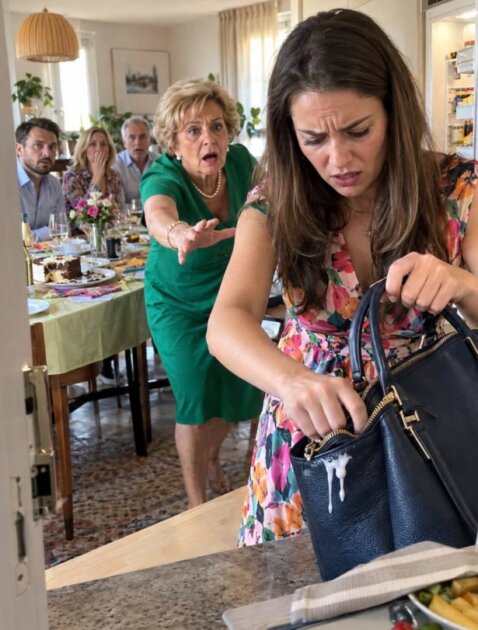
We returned to the table. Lili was counting the candles on her cake when Margit picked up her dark blue handbag.
“If you’re all so particular about food, I brought a few things from home for myself.”
However, a white liquid had begun dripping from her bag onto the floor.
“Margit, your bag is leaking!” I said.
When I lifted it, I caught sight of the corner of a thick brown envelope behind the half-open zipper.
“Don’t touch that!” she shouted.
But the strangest thing wasn’t her reaction. It was my father-in-law’s.
Károly stood up so suddenly that his chair scraped against the floor.
“Margit! Please tell me you didn’t bring it here!”
My mother-in-law turned pale.
The envelope bore the following inscription: “For Réka and Bence. To be handed over in person only.”
“Is this for us?” I asked.
Károly nodded.
“Yes. And I should have given it to you a long time ago.”
Inside the envelope were a bank receipt, a letter, and an old photograph. The receipt showed a sum of 2,400,000 forints, but the recipient’s name was Zsófi, Bence’s sister.
Károly explained that he had sold his old fishing boat and garage. He had wanted to divide the money equally between his children. Zsófi had already received her share, but Bence’s money had been kept in a separate account.
“Your mother tried to change the arrangement yesterday,” he added.
Bence stared at his mother in disbelief.
“Why?”
Margit pressed her lips together.
“Because I refuse to give millions to a household that can’t even manage to do proper grocery shopping!”
Suddenly, everything made sense to me. Her inspection of our refrigerator hadn’t simply been another episode of criticism. Margit had wanted to prove that we didn’t deserve the money.
“Is that why you humiliated me in front of everyone?” I asked.
“I only want what’s best for my son!”
At that point, Károly took out the old photograph. It showed Bence as a little boy, standing beside him on the shore of a lake.
“Do you know why I want to help you?” he asked. “Because I’ve lived in poverty myself. My mother worked as a cleaner, sewed in the evenings, and sometimes all we had on the table was potato soup. My aunt used to come over regularly, look through our pantry, and humiliate my mother in front of everyone.”
His voice broke.
“My mother didn’t cry because we had so little food. She cried because other people believed that having so little made us worth less.”
Then he turned toward Margit.
“Today, you did exactly the same thing to Réka.”
Zsófi spoke up as well.
“Mom, when I received the money, you kept checking what I spent it on. You give us help, and then you expect us to obey you in everything.”
Margit didn’t respond.
Bence stared at the letter for a long time before finally speaking.
“Dad, thank you, but I don’t want money to turn every family lunch into an argument.”
Károly replied calmly.
“It’s a gift, son. There are no conditions attached. You don’t have to prove anything to anyone to deserve it.”
Margit stood up, grabbed her handbag, and headed for the door.
“So I guess nobody needs me anymore!”
But this time, Károly didn’t follow her.
“We’re not trying to send you away. We just want you to treat us with respect.”
Margit stood by the door for a long time. Then, quietly, she admitted that in her childhood home, a well-stocked pantry had always been considered a sign of a respectable household. She had never stopped to consider that her expectations could hurt other people.
Everything wasn’t resolved that day, but something had changed.
Two weeks later, Margit called and asked whether she could come over to see Lili. When she arrived, she brought a small bag containing homemade savory pastries and apricot jam.
Later, she pulled me aside.
“Réka, I’m sorry for the way I behaved at the birthday celebration. I shouldn’t have opened your refrigerator, especially not in front of everyone.”
She didn’t make excuses. She simply apologized.
The following month, Károly transferred the money, and we used part of it to make an early repayment on our mortgage. Margit never asked us what we had spent it on.
At the end of the summer, Lili spent a weekend at her grandparents’ house. When we went to pick her up, Margit was making pancakes.
“Grandma taught me how to flip them without tearing them!” Lili announced happily.
Margit smiled at me.
“Lili says your pancakes taste better because you make them thinner. Perhaps one day you could teach me how to make them that way?”
That was when I truly felt a lump in my throat.
I don’t remember that Saturday because of the money. I remember it because, for the first time, I felt that my mother-in-law was beginning to accept that I didn’t have to live my life exactly the way she would have lived hers.
Our refrigerator still isn’t always full. Sometimes, all we have inside are eggs, milk, and a bowl of leftovers.
But no one opens it without permission anymore.
And Károly’s old photograph still stands on a shelf in our kitchen, inside a simple wooden frame.
On the back, he wrote:
“A family’s wealth is not measured by how much food is in its refrigerator, but by how many people have a place at its table.”

