
# “I’m His Biological Son! I Deserve Half the Apartment!” Kirill Shouted. But His Mother’s Answer Would Haunt Him for the Rest of His Life.
Lyudmila Pavlovna sat in the kitchen, sorting through a pile of old photographs. Maksim poured her a cup of tea and sat beside her. She picked up a faded picture of a little boy, barely a year old, wearing an institutional baby romper. His eyes were strangely serious for such a young child.
“You know, when we first met you, you had this habit of grabbing my finger and refusing to let go until you fell asleep. Viktor looked at me and said, ‘This little boy is ours.’”
Maksim smiled. He had heard that story dozens of times, yet he always let his mother tell it from beginning to end. He knew she needed those memories the way some people needed prayer.
“I made myself a promise that day,” she continued. “I promised that you would never feel the difference between a biological child and an adopted one.”
“I never did. Not because of you.”
Lyudmila put the photograph aside and fell silent. Then she took out another picture. In it, four-year-old Kirill was sitting on Viktor Nikolaevich’s shoulders, while seven-year-old Maksim stood nearby, slightly apart from them. His hand was outstretched, as though he had wanted to take his father’s hand but had changed his mind at the last moment.
“I spoke to Viktor so many times about this. I begged him, argued with him, even cried. He always nodded and promised to change. Then he would buy Kirill a toy car and get you nothing. When I asked why, he would say, ‘He’s still little. He needs it more.’”
“And eventually, he stopped making excuses,” Maksim said.
“Yes. He did.”
Alena, Maksim’s wife, entered the kitchen and placed a plate of sliced apples on the table. She didn’t interrupt, but she was listening. Maksim caught her eye, and she gave him a barely noticeable nod.
*Keep going. I’m here.*
“I was seven when he first told me I was adopted and Kirill was his real son. That evening, I came to your room and asked what ‘adopted’ meant.”
“I remember,” Lyudmila whispered. “It felt as if the ground had disappeared beneath my feet. I lay awake all night, unable to breathe properly. But the next morning, I got up, sat beside you, and explained everything calmly. I told you that love doesn’t begin in a maternity ward, and it isn’t determined by a blood test.”
Maksim smiled sadly.
“I just said, ‘All right,’ and went off to draw. But those three things you always told me—that I mattered, that I was needed, and that I was your son—were enough to carry me through the next twenty years.”
Alena placed a hand on Lyudmila’s shoulder. The older woman covered her daughter-in-law’s hand with her own.
Three people sat together in a small kitchen, and for that moment, nothing else in the world mattered.
***
“Maksim, give Kirill your bicycle!”
“But it’s mine! I got it for my birthday!”
“Kirill doesn’t have one, and he’s upset about it. You’re the older one. You have to be willing to share.”
Maksim told Alena about it that evening, after Lyudmila had gone to bed. He didn’t raise his voice or complain dramatically. He simply laid out the facts, as though reading from a painful inventory of his childhood.
“My stepfather always found a reason to favor Kirill. When I wanted to take swimming lessons, he said there was only enough money for one of us. Then he signed Kirill up. When I brought home good grades, he would say, ‘Well done,’ and immediately turn to Kirill to ask if he wanted ice cream.”
“And Kirill learned how to take advantage of it,” Alena said quietly.
“Very quickly. If I asked for something, he would immediately demand the same thing. And my stepfather chose him every single time.”
Alena listened without interrupting. Her silence was solid and steady, like a wall protecting Maksim from the memories he was finally allowing himself to share.
“Once, Kirill broke a vase. I was twelve, and he was nine. My stepfather walked into the room, saw the broken pieces, and immediately turned to me.”
“He blamed you?”
“He didn’t even ask what happened. He just said, ‘You again!’ Kirill was standing behind the wardrobe, smiling. He knew he wouldn’t get into trouble.”
“And you didn’t defend yourself?”
“I tried. Once, twice, ten times. They always told me I was lying or that I complained too much. Eventually, I understood something: in that house, words only mattered when they came from the right person.”
Alena moved closer and took his hand.
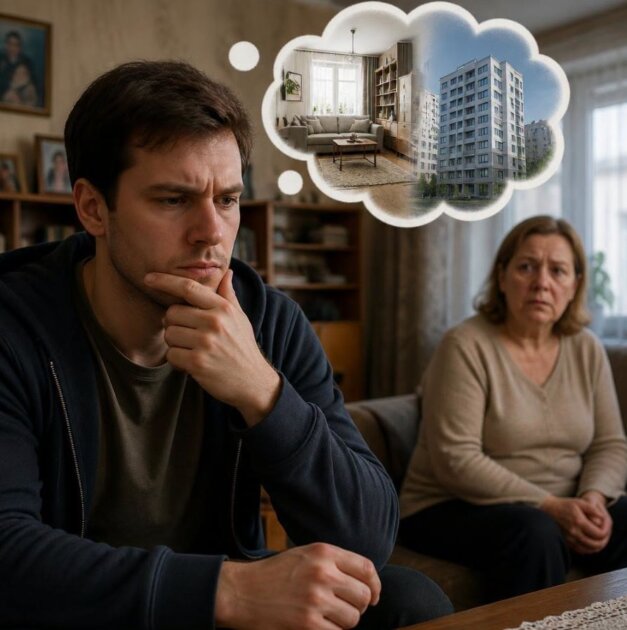
“How did you manage not to become bitter?”
Maksim was silent for a moment.
“My mother. Every evening after something like that happened, she would come into my room, sit on the edge of my bed, and tell me, ‘You matter. You are needed. You are my son.’ She never made excuses for my stepfather. She never tried to explain why he behaved that way. She simply repeated those three sentences. Every single night.”
“She saved you,” Alena whispered.
“She never let me lose myself. Maybe that was even more important.”
***
Viktor Nikolaevich fell ill in the autumn. By winter, it had become clear that the treatment available through the public healthcare system would not be enough. Lyudmila called three private clinics, and all three quoted similarly devastating prices.
One evening, she placed the papers in front of Maksim. Her hands were trembling.
“I don’t know what to do. My fingers go numb every time I look at this bill.”
“How much do we need?”
She told him the amount. Maksim closed his eyes. Alena was standing in the doorway and had already heard everything.
“We can sell the country house,” she said quietly.
“No!” Maksim protested. “That belongs to you! You inherited it from your grandmother.”
“Maksim, please. Don’t argue with me.”
She turned to Lyudmila.
“We’ll put it up for sale. I’ll call the real estate agent tomorrow.”
The older woman stared at her in disbelief.
“Alena, sweetheart, do you understand what you’re offering? That place isn’t just a house and a piece of land. It holds your memories of your grandmother.”
“My grandmother’s memory lives in my heart, not in those walls. Viktor Nikolaevich needs treatment, and we’re going to make sure he gets it.”
Lyudmila looked at her daughter-in-law for a long time before turning to her son.
“Then I’ll call Kirill. He has to help, too. Viktor is his father.”
She called him. Kirill answered after the sixth ring. Loud music played in the background, and someone was laughing nearby.
“Kirill, your father is in the hospital. He needs money for treatment. A considerable amount.”
“What am I supposed to do about it? Healthcare is supposed to be free here. Let them treat him.”
“You don’t understand. The treatment he’s receiving isn’t helping. He needs to go to a specialized clinic.”
“Mom, I have expenses of my own. I had to replace the brake pads on my car last week. It cost so much that I actually had to borrow money.”
Lyudmila tightened her grip on the phone.
“Kirill, he’s your father!”
“So what? I have to live, too! I’m not going to ruin myself because he’s sick. Sorry, I can’t help. I’m busy right now.”
The call ended.
Lyudmila slowly lowered the phone. Maksim and Alena stood beside her. The call had been on speaker, so they had heard every word.
“That’s it, then,” she said bitterly. “The brake pads matter more.”
“Don’t think about him right now, Mom,” Maksim replied. “We’ll find a way. Alena is right.”
The country house sold in nine days. The money was transferred to the clinic.
Maksim visited his stepfather every day. He brought homemade broth in a thermos, adjusted his pillows, and sat beside his bed for hours.
Kirill never came.
Viktor Nikolaevich died in February.
The day before his death, he asked Maksim to lean closer. Then, in a weak, raspy voice, he whispered a single sentence.
“Forgive me. I was a fool.”
Maksim nodded.
Forty minutes later, Viktor was gone.
Kirill appeared at the funeral wearing a brand-new jacket. He stood around for twenty minutes, twirling his car keys around his finger before muttering, “May he rest in peace.”
Then he left.
Lyudmila watched him walk away but said nothing.
***
Six months later, Lyudmila completed the inheritance paperwork. Viktor’s will left everything to his wife. One evening, she called Maksim into the kitchen, sat him down at the table, and announced her decision.
“I’m transferring the apartment to you. As a gift. It’s settled.”
Maksim immediately objected.
“Mom, there’s no need for that. We already live here with you. That’s enough.”
“Maksim, don’t argue with me! Alena sold the country house she inherited from her grandmother to save my husband. A man who wasn’t even related to her by blood. And, to be honest, a man who didn’t always treat you the way you deserved.”
“I know.”
“And yet you both helped him. You never demanded anything from me. You never fought, threatened anyone, or tried to bargain for your share. You simply stayed by our side. This apartment isn’t enough to repay what you’ve done, Maksim, but it’s all I have left to give.”
Maksim squeezed her hand.
“I have you, Mom. That’s worth more than any apartment.”
“The documents will be signed next week. And that’s final.”
A week later, everything was legally completed. Maksim, Alena, their children, and Lyudmila continued living together. They ate dinner together every evening while the children played in the next room.
Kirill had disappeared after the funeral. For six months, no one heard from him.
Then, one morning, the doorbell rang.
Kirill stood on the doorstep with a backpack over his shoulder. He had lost weight, but his eyes were unchanged. They still had that calculating look, as if he were assessing what he could get from the people around him.
“Hi. I’m back.”
“Come in,” his mother said. “You must be hungry.”
They fed him and gave him a place to sleep on the living room sofa. For the next few days, he behaved as though nothing had happened. He ate heartily, asked for seconds of the borscht, and spent long mornings adjusting his hair in the hallway mirror.
On the fourth evening, during dinner, he finally asked the question he had really come home to ask.
“So, what happened with the apartment? Dad died, and you’ve settled the inheritance, right?”
Lyudmila put down her fork. Maksim stopped chewing. Alena looked directly at Kirill.
“The apartment has been taken care of,” his mother replied.
Kirill smiled with satisfaction.
“Great. Then we split it. Half for me, half for you. Actually, if we’re being fair, I should get a little more. After all, I’m his biological son.”
Lyudmila looked at him calmly.
“The apartment has been transferred to Maksim.”
Kirill’s smile vanished.
“What?”
“You heard me.”
He leaned back in his chair. The easygoing expression disappeared from his face as quickly as water sliding off a smooth stone. What remained was cold, naked greed.
“Wait a minute. You gave the apartment to HIM? To that nobody? And I get nothing?”
“When your father was sick, I called you and asked for help. You told me you had to spend your money on car parts.”
“I had problems of my own!”
“So did Alena. She had a country house inherited from her grandmother. It was her only tangible connection to someone she loved. She sold it to save your father. A man who wasn’t even related to her.”
“She chose to sell it herself!”
“Exactly. She chose to do it herself. But I asked you for help, and you refused. Do you understand the difference?”
Kirill jumped to his feet, scraping his chair loudly across the floor.
“He was MY father! That apartment belongs to ME! I’m his biological son, and this guy is nobody! He’s just some kid you picked up from an orphanage!”
Maksim slowly stood up. He was half a head taller than Kirill, with broader shoulders.
“Are you finished?”
“No, I’m not! I’ll file a complaint! I’ll tell everyone how my own mother robbed her biological son to give everything to a stranger!”
“Go ahead,” Maksim replied calmly. “Just remember to mention that you never visited Dad in the hospital. Not once. You never called to ask whether he was still alive. You didn’t contribute a single ruble toward his treatment. At his funeral, you stayed for twenty minutes and left without even asking how Mom was doing.”
“What does any of that have to do with it? This is property! By blood, it belongs to me!”
Alena stood up, too.
“By blood, you’re no more entitled to anything than a stray cat that comes into a house only when it’s hungry. Once it’s fed, it disappears. And yet you expect the door to remain open for you forever.”
“Shut up! This has nothing to do with you!”
Alena stepped closer.
“I’m the woman who sold her own inheritance to save your father. YOUR father, not mine. So I have every right to speak.”
Kirill turned toward his mother. He leaned over her and lowered his voice, making his threat even more frightening than a shout.
“You’ll regret this. I promise you.”
Alena immediately stepped between them.
“Don’t you dare threaten your mother!”
Kirill moved closer, and Alena slapped him across the face. He staggered backward, hit the wall, and slid to the floor.
“Threaten her one more time, and our next conversation will be very different,” Alena said coldly.
Kirill sat on the floor, his cheek burning. He looked up at Alena, then at Maksim, and finally at his mother.
Lyudmila approached him and crouched in front of him, just as she used to do when he was a little boy.
“Kirill, you are my son by blood. I carried you for nine months, gave birth to you, fed you, and raised you. But in the way that truly matters, you have become a stranger to me.”
Kirill tried to interrupt, but she raised her hand.
“Don’t interrupt me! Your father loved you more than anything in the world. Every single day, every single hour, he put you ahead of Maksim. He gave you more, even when it meant hurting his other son. And what did you do? You couldn’t even bring yourself to visit him while he was dying.”
“I didn’t know it was that serious…”
“But you did know! I told you! I begged you for help! You simply refused to hear me because the only thing you ever listen for is money.”
“But I’m your son!”
Tears finally slipped down Lyudmila’s cheeks.
“Yes, you are. And that’s precisely why this hurts so much. But now I’m telling you to leave. This apartment belongs to Maksim. Legally, officially, and morally. You have no claim to it. Not because you weren’t adopted, but because you have behaved as though being related to someone is a privilege rather than a responsibility.”
Kirill struggled to his feet, wiped his cheek with his sleeve, grabbed his backpack, and headed toward the door.
“You’re all insane! The whole family! Fine, choose the stranger. Live with him, then!”
Maksim opened the door for him.
“The stranger isn’t the person who was adopted from an orphanage. A stranger is someone who only comes home when he wants money. Get out.”
Kirill walked out. The door closed behind him.
Lyudmila released a long, trembling breath.
“Are you all right, Mom?” Maksim asked.
“No,” she whispered. “But I will be.”
A month passed. Kirill didn’t call, write, or return. Lyudmila stopped waiting for him. In truth, she had given up on him the day he sat on the floor, thinking not about his mother’s pain but about the square footage of the apartment.
One evening, an unfamiliar number appeared on her phone.
A young woman’s voice came through, nervous and unsteady.
“Hello. Is this Lyudmila Pavlovna?”
“Yes. Who is this?”
“My name is Polina. I’m… Kirill’s former wife.”
Lyudmila sat down abruptly.
“Former wife? Kirill was married?”
“For two years. We divorced eight months ago. He never told you?”
“He has kept many things from me. Go on.”
Polina took a shaky breath.
“We have a daughter. She’s eighteen months old. Kirill left when she was four months old. He said he needed some space. Since then, I’ve seen him twice. Both times, he came to ask me for money.”
Lyudmila closed her eyes. Then she opened them again.
“What is the little girl’s name?”
“Vera.”
“Vera,” Lyudmila repeated softly. “That’s a beautiful name.”
“Lyudmila Pavlovna, I’m not asking you for anything. I don’t want money or a place to live. I just thought you should know that you have a granddaughter. Kirill told me his parents were dead. Both of them. He claimed he had grown up an orphan and had always been on his own. I accidentally found your number in an old phone he left behind when he moved.”
Lyudmila let out a short, dry laugh without a trace of amusement.
“So he was an orphan. Abandoned by his parents. I see.”
“Perhaps I shouldn’t have called…”
“No, Polina. You did the right thing. Please, give me your address.”
“Why?”
“Because I have a granddaughter I’ve never met. And because I know what it’s like to raise a child when the person who promised to stand beside you walks away.”
She wrote down the address and ended the call.
Then she went into the kitchen, where Maksim was washing dishes and Alena was helping the children draw.
“Kirill has a daughter,” Lyudmila announced. “She’s eighteen months old. He abandoned her when she was four months old. And he told his wife that his parents were dead.”
Alena put down her pencil. Maksim turned off the tap.
For three seconds, nobody spoke.
“What’s her name?” Alena asked.
“Vera.”
“When do we leave?”
Lyudmila looked at her daughter-in-law. This was the woman who had sold her grandmother’s country house to save a man who wasn’t related to her. The woman who had protected her from her own biological son. And now, without asking a single unnecessary question, she was ready to travel to meet a little girl she had only just learned existed.
“Tomorrow morning,” Lyudmila replied.
Maksim dried his hands.
“I’ll drive.”
The next day, they went to Polina’s home and brought her and Vera back with them.
When the little girl was placed in Lyudmila’s arms, she wrapped her tiny fingers around the older woman’s index finger and held on as tightly as if she never wanted to let go.
Lyudmila froze.
“Look at that,” she whispered. “She’s holding my finger.”
Polina smiled through her tears.
“Yes. She’s done that since birth.”
Maksim stood in the doorway, watching them. Then he turned to Alena.
“Kirill spent his entire life insisting that blood was everything. That a biological child was worth more than an adopted one. And then he abandoned his own daughter. His own flesh and blood.”
Alena gently touched her husband’s arm.
“Blood means nothing on its own. What matters is what you do for someone. Every single day.”
Lyudmila kissed Vera’s forehead. Polina was crying openly now, no longer trying to hide her tears. Maksim’s children peeked out from their room, curiously watching the little girl with the enormous eyes.
The family Kirill believed he had lost forever was opening its doors to the very child he himself had abandoned.
Meanwhile, Kirill sat in a rented apartment, counting his debts. His financial problems had grown far beyond anything he could realistically repay.
He dialed his mother’s number again and again. Each time, the phone informed him that the number was unavailable.
He tried Maksim. It rang, but nobody answered.
He tried Alena. The call ended after a few short tones.
Finally, he called Polina.
“Polina, I need help. You know I’m in a difficult situation right now.”
Her voice was calm.
“Kirill, I’m at your mother’s house. The same mother you told me was dead. She’s holding our daughter in her arms. The little girl you abandoned.”
A long silence followed.
“What?”
“You heard me. Don’t call me again. And don’t contact them, either.”
Polina hung up.
Kirill stared at the phone screen. There was not a single number left he could call. Not a single door he could knock on. Not a single person who would willingly let him in.
All his life, he had believed that blood gave him the right to everything. Attention, money, an apartment, forgiveness. He had believed that being a biological child made him untouchable. That simply being born was enough to ensure he would always receive what he wanted.
But while he sat counting his debts, Lyudmila Pavlovna was rocking a little girl to sleep in the apartment that now belonged to her adopted son.
Her own granddaughter.
The daughter of the biological son who had betrayed everyone who ever loved him.
Lyudmila thought about how cruelly life sometimes repeated itself. The boy she had brought home from an orphanage had never needed to be begged to stay. She had never needed to convince him that family was more than an address or an inheritance.
Yet the child she had carried beneath her heart had grown into a man who abandoned everyone who needed him.
Not because he had died.
But because he had never learned what it meant to love.
Vera slowly drifted off to sleep in Lyudmila’s arms. Her tiny fingers remained wrapped around the older woman’s index finger.
Lyudmila did not try to free her hand.
She remembered another little child she had held in exactly the same way decades earlier. A boy who had not been born from her body but had nevertheless become the truest son she could ever have wished for.
And now there was this little girl, too.
Her biological granddaughter.
Perhaps life had given her one more chance. Not a chance to change Kirill, and not a chance to reclaim everything she had lost.
But a chance to make sure that another child would never grow up believing she was worth less because someone else had been born more important.
Vera stirred in her sleep and tightened her tiny fingers around Lyudmila’s hand.
The older woman bent down, kissed her forehead, and whispered:
“Don’t be afraid, sweetheart. I won’t let you go.”
Because family is not held together by blood.
It is held together by the people who stay when they have nothing left to gain.

